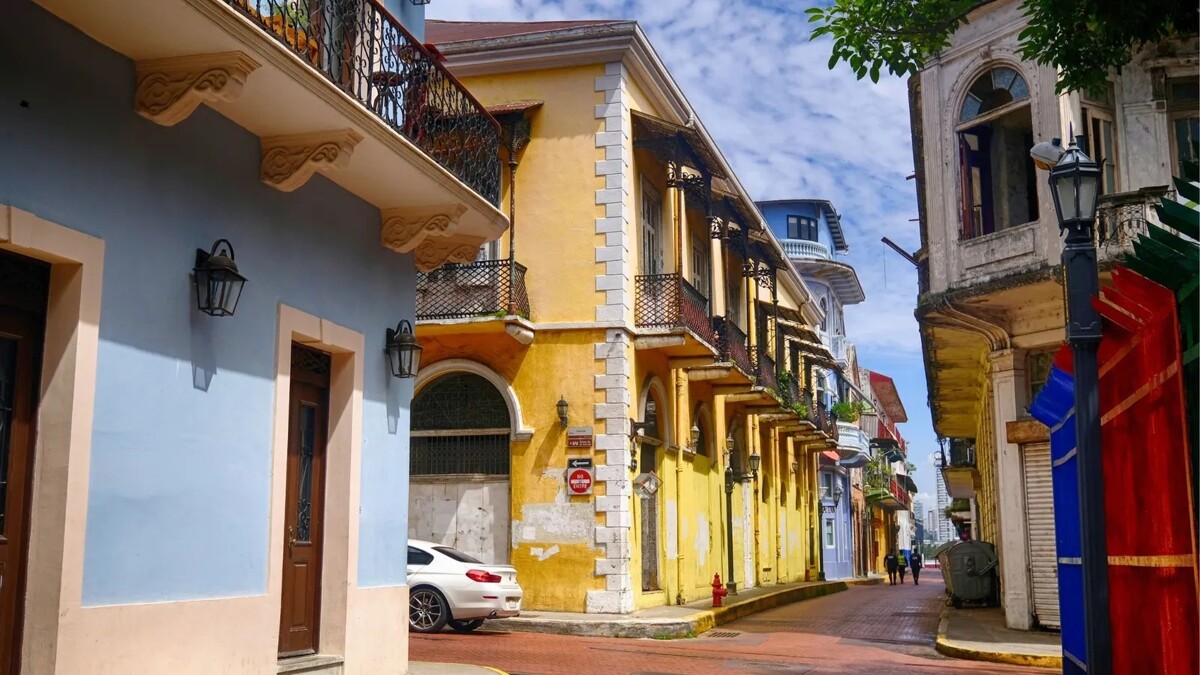
Set beside the Pacific coast at the great waterway’s southern end is Panama, where its “sprawling” skyline of steel-and-glass skyscrapers trumpets the success of “Central America’s fastest-growing economy”. However, I stayed in the charming, pastel-hued old town, at the “excellent” Hotel La Compañía Casco Antiguo as pictured at the very top of this article. From Panama City, I went on a “zigzagging” road trip, stopping first at Portobelo pictured below, a “drowsy” town with “candy-colored” buildings on the Caribbean coast. Most tourists in Panama focus on its “storied” canal and resort towns such as Bocas del Toro. It is also home to a large Afro-Panamanian community, the subject of “striking” photos by Sandra Eleta, a celebrated artist who runs an informal artists’ residency and hotel called La Morada de la Bruja, or The Witch’s Abode. A group of young Panamenians performing the Congo dance in one of the Spanish fortresses (hence the cannons) of Portobelo by the Caribbean Sea, Panama, Central America. An “eclectic compound” with breezy verandas and walls hung with “folkloric” murals and feathered masks, it is the best stay in town. Below a humpback whale and calf. The post “Panama’s Historic Towns and Wild Islands – Reprinted from ‘The Week’” appeared first on Newsroom Panama. Exploring it on a yacht chartered from San Blas Sailing, I enjoyed such “elemental” pleasures as snorkeling with stingrays and drinking rum cocktails on palm-fringed beaches. San Blas Island Pictured Below. My final stop was the undulating, big-skied Azuero Peninsula, on the Pacific coast, where I went riding and surfing, and also sailed alongside a pod of humpback whales. It’s a place of “raw” beauty, with a “hushed, draughty” cathedral and an impressive Spanish fortress (in its early days, the town’s harbor was often raided by pirates). But this Central American country – a narrow isthmus stretching for 500 miles between Costa Rica (to the west) and Colombia (to the east) – offers far more to interest the curious traveler, said David Amsden in Condé Nast Traveler. Next, I visited the Guna Yala islands pictured below, a “mesmerizing” Caribbean archipelago that has been governed by the indigenous Guna people since 1925. The canal, which was completed in 1914, bisects the country at its midpoint, where it is narrowest (at a mere 37 miles across).