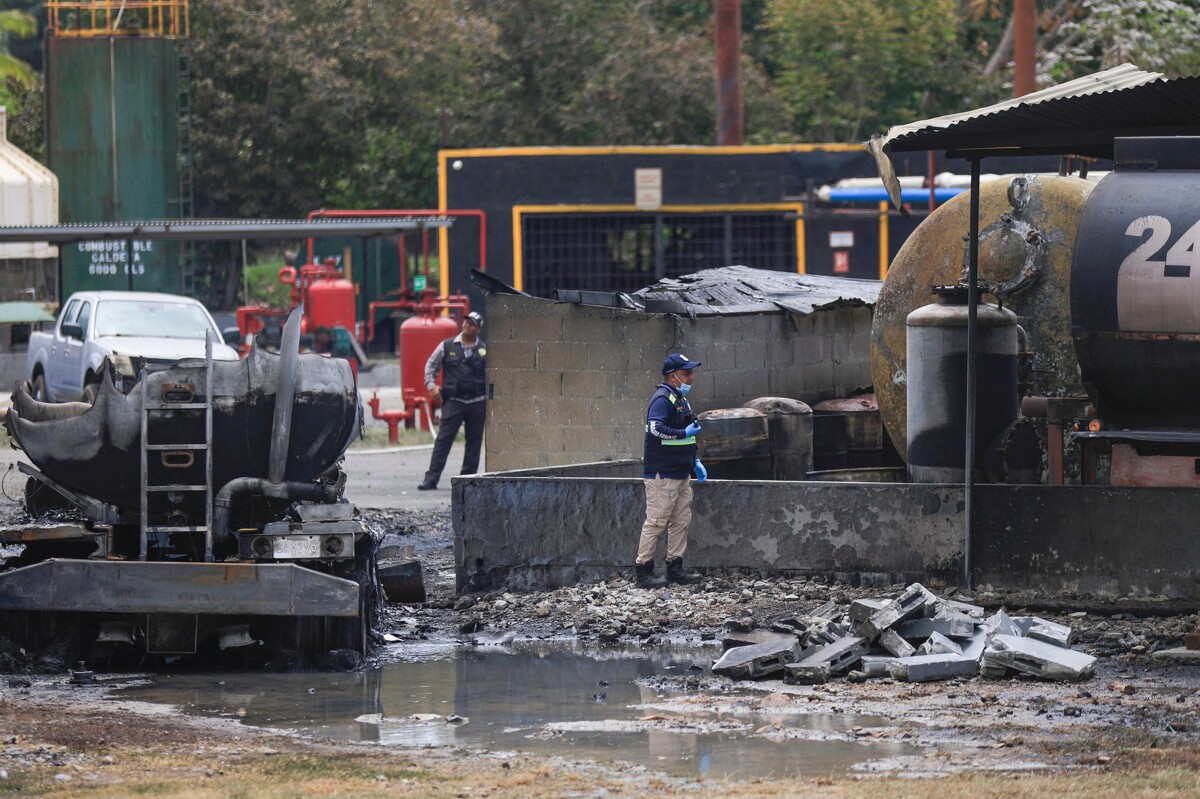
In Panama, the investigation into the explosion and fire that occurred under the Bridge of the Americas four days ago, resulting in one death and two firefighters with burns, continues. The investigation points to a lethal combination of flammable gases and an ignition source in a highly volatile environment due to the presence of multiple fuels. The incident occurred on April 6th at the old fuel tank farm in Balboa, operated by Panama Oil Terminals, S.A. (POTSA). The investigation is in its technical and testimonial phase, led by the National Directorate of Fire Safety, Prevention, and Investigation (Dinasepi). According to Dinasepi director Cirilo Castillo, everything points to a spark that came into contact with flammable material in the atmosphere, i.e., gases derived from fuel transfer. After the fire, authorities are thoroughly assessing the condition of the fuel tanks near the bridge, which were built over 50 years ago and do not meet current standards. Currently, traffic on the Bridge of the Americas is restricted to motorcycles, private vehicles, and small buses, while evaluations are carried out by specialists from the Ministry of Public Works, the Technological University of Panama, the Panama Canal Authority, and the National System for Civil Protection. Edwin Lewis, director of Studies and Design at the Ministry of Public Works, elaborated on the additional assessments being conducted on the bridge, noting that on Thursday, four professionals from the U.S. Army Corps of Engineers, which designed the bridge in the 1950s, were received. The engineer explained that laboratory tests and metal samples exposed to heat are needed to be sent to labs in the US. “Where there are flammable gases, we must at all costs avoid any source of spark: cell phones, electronic lighters, and any equipment that could generate ignition,” he warned. Meanwhile, the Public Ministry conducted an on-site inspection on Wednesday, April 8th, at the POTSA facilities. These tasks were carried out by specialized units that formally initiated the expert process after the fire in the three tankers was extinguished. Specialists have gathered key evidence to determine the origin of the incident, including possible ignition points and the conditions that contributed to the fire. The analysis covers both the site and the vehicles involved and their environment, under technical and scientific criteria. After completing the field phase, the process is now focused on collecting testimonies from people who were at the scene (drivers, company personnel). The action also included administrative offices, where information about the company's operations and the work history of the deceased person was sought. The Metropolitan Prosecutor's Office for Homicide and Femicide, which is in charge of the investigation, also requested the Institute of Legal Medicine and Forensic Sciences (Imelcf) to perform the corresponding analyses to determine the possible causes of the explosion. The Public Ministry is awaiting the Fire Department's report on the cause of the fire and its impact on the Bridge of the Americas structure. President Mulino: the tank area will be evaluated. In turn, the President of the Republic, José Raúl Mulino, indicated in his weekly Thursday conference that the investigation of the incident will be in the hands of the Attorney General's Office, and that the administrative issues associated with the accident are being investigated by the Panama Maritime Authority (AMP). The president also warned that the fire area is not a site for tours, as it is a zone under criminal investigation. However, he clarified that investigations must continue until the origin of the fire is determined with certainty. Due to the confidentiality of the process, authorities have not made any definitive conclusions. Evidence collection and testimony collection. Castillo explained that the first phase consisted of collecting evidence at the site once the emergency was controlled and the scene cooled. “From there, we are not going to miss anything,” he indicated. He also noted that along the Panama Canal and in coastal areas, there are more than 100 hectares of old, abandoned fuel storage facilities in deplorable conditions. “The scene is handed over to the Police, and they guard it until the investigations are concluded,” he stated. Regarding the victim, he clarified that it was not the tanker truck driver, as was initially thought, but an assistant. He advanced that all will be evaluated by the AMP to give them good use for the benefit of the country. Tanks installed since 1945 no longer meet current standards. He recalled that the scene of the facts must be preserved according to protocols, so he requested the National Police to restrict access to any person not linked to the case. According to Castillo, this stage will allow for contrasting versions and discarding hypotheses until a clear conclusion is established about what happened. The official confirmed that there was gasoline of 91 and 95 octanes, diesel, and bunker fuel at the site, which significantly increases the complexity of the analysis and the risk of fire spread. The report will conclude in 30 days. The Fire Department's Investigation Directorate indicated that the final report on the origin and cause of the fire in the La Boca sector could be ready within a maximum of 30 days. Currently, the investigations are in charge of highly specialized personnel, including units from the investigation department and hydrocarbon experts. The fire officer also confirmed that the scene remains under the custody of the National Police while the investigations advance in coordination with the Public Ministry, due to the fatal victim.