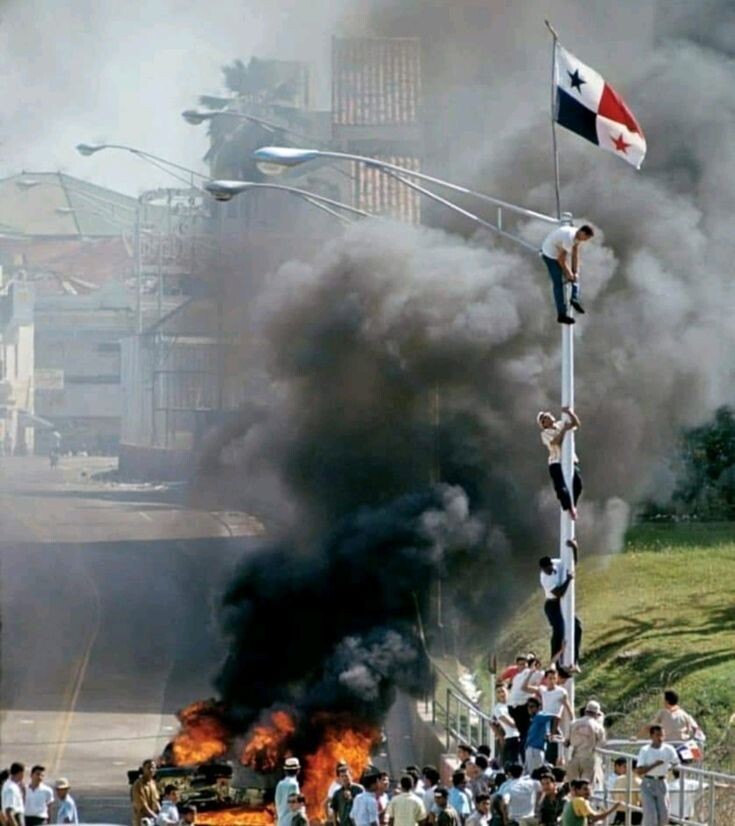
On January 9, 1964, demonstrations peaked with students and civilians protesting in Plaza 5 de Mayo. While the exact number of protesters is unclear, it is known that the U.S. Army deployed military force to meet the demonstrators. After Panama's separation from Colombia in 1903, a Frenchman named Bunau-Varilla signed a treaty with the United States on behalf of the Republic of Panama. In the 1950s, schools and civilian groups organized peaceful demonstrations to fly the Panamanian flag alongside the U.S. flag in public and civic institutions within the Canal Zone. They were escorted out of the Zone to join other students who were not allowed inside. When Panamanian citizens learned that a flag had been destroyed by Zonians, they were angered. Their requests were not granted. Panamanians rioted, destroying American businesses. A few days later on January 7, U.S. students at Balboa High School raised the American flag without the accompanying Panamanian flag. Following these actions, a group of approximately 200 students from Panama's National Institute informed authorities of their intention to march to Balboa High School to hoist the Panamanian flag. Panama had just celebrated 25 years of sovereignty on December 31, 2024. For more historical information, you can check Wikipedia: https://en.wikipedia.org/wiki/Martyrs%27_Day_%28Panama%29. More Panamanians died from smoke inhalation from buildings they set on fire, as well as from gunfire from Panamanian store owners defending their property. This incident caused indignation among the Panamanian people and helped initiate negotiations that resulted in the Chiari-Kennedy treaty, signed in 1963. The Chiari-Kennedy treaty granted more social and economic freedoms to Panamanians within the Canal Zone. In an act of Panamanian sovereignty, every person carried a Panamanian flag. Later, at the suggestion of a commissioner, Robert Fleming, the then governor of the Canal Zone announced that from January 1, 1964, the Panamanian flag would be hoisted alongside the U.S. flag on civilian sites within the Canal Zone. Zonians did not want to fly the Panamanian flag alongside the U.S. flag, so they ignored the decision. This decision was not appreciated by Panamanians or the U.S. Zonians, for different reasons. A struggle began, and the Panamanian flag was torn into pieces. What happened next ensured January 9th would forever be in Panama's history as "Martyrs' Day." This meant that Panamanians could not enter this territorial strip. The protests left many Panamanian civilians dead. During the clash, a Zonian police officer destroyed a Panamanian flag. When the Panamanian people saw the dead students, they angrily asked members of Panama's National Guard at the scene to give them weapons to confront the soldiers themselves. When the Panamanian students were about to raise the flag, Zonian students singing the U.S. national anthem prevented them. The truth can be found in the International Commission of Jurists (Geneva) report, "Events in Panama, January 9-12, 1964." It is unofficially said that President Chiari gave orders allowing the National Guard to shoot U.S. soldiers if they continued firing on civilians. The feeling of support for the Panamanian cause was expressed by Latin American countries days later at the Organization of American States, when the Colombian ambassador said, "In Panama there is now another Berlin Wall." When the United States took possession of this territory (the Panama Canal Zone), they treated it as a U.S. territory, applying its own laws, constitution, and customs, and restricting it to U.S. citizens only. Many Panamanians disagreed with this treaty but accepted it to gain U.S. help in separating from Colombia. Some students carrying the Panamanian flag reached the fence dividing the Canal Zone to hoist the flag. At this point, U.S. police intervened and forced the Panamanian students to leave the school. This was achieved under the Torrijos-Carter Treaties in 1977, when the United States pledged to return the territory of the Panama Canal Zone to the Panamanian people on December 31, 1999. When the Panamanian students arrived at the Zone, U.S. authorities were waiting for them. This treaty politically divided Panama into two, with a piece of U.S. sovereign territory running down the middle. Locally, this area (the Panama Canal Zone) was called "The Zone" by Panamanians and is now referred to as "The Old Zone." The Hay-Bunau-Varilla treaty never sat well with the Panamanian people. On January 3, 1964, a Zonian police officer named Carlton Bell hoisted the American flag without the accompanying Panamanian flag at the monument to the Heroes of War in Gamboa, considered a civilian site. January 9th is the national observance of Martyrs' Day in Panama, paying tribute to civilians and students who lost their lives to help make Panama a sovereign country. They considered it wrong for the U.S. to hold land within Panama in perpetuity. The flag they carried belonged to their own school, the National Institute of Panama, and due to its age and use over the years, it carried historical significance. With this fight on January 9, 1964, and the martyrdom of civilians, Panama reaffirmed its struggle for full sovereignty of its territory. After negotiations, Zonian police allowed a small group of students to enter the Zone and go to Balboa High School to hoist the Panamanian flag. This treaty granted the Panama Canal, along with a 5-mile strip of land on either side of it, to the United States in perpetuity. For Panamanians to pass from one side to the other, they had to cross a path that would later become the "Bridge of the Americas." Panamanian President Roberto F. Chiari made an unprecedented move in the history of Latin American countries. He broke diplomatic relations with the United States. However, the National Guard, under international law, could not shoot or fight U.S. soldiers. The exact number of protesters is unclear; unofficial reports suggest from 5,000 to 30,000. The newly opened Pan American Airlines building was burned. The National Guard was the only agency authorized to carry firearms. Expect the Pacific beaches to be busy again, with people taking Friday off to create a long holiday weekend. U.S. soldiers opened fire with machine guns, killing a number of students. This year, January 9, 2026, falls on a Friday, so government offices and banks will be closed. While grocery stores and restaurants remain open, they are not permitted to sell alcohol.