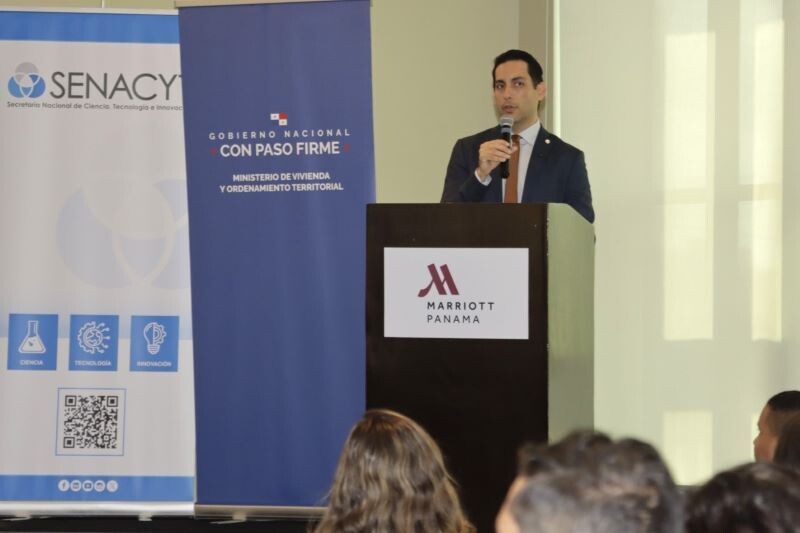
The Ministry of Housing and Territorial Planning (Miviot) and the Secretariat of Science, Technology, and Innovation (Senacyt) held the forum 'Panama Towards a Sustainable City'. The event aimed to exchange visions and generate recommendations to strengthen public policies focused on a sustainable city. Specialists in urban planning, climate change, mobility, and infrastructure participated in the event. Vice Minister of Territorial Planning, Frank Osorio, representing Miviot, noted that Panama's rapid growth poses complex challenges in areas such as mobility, access to basic services, quality of public space, and climate risk management. He emphasized that climate must be the fundamental framework for decision-making in modern urban planning. Senacyt Secretary General Eduardo Ortega recalled that Sustainable Development Goal 11 sets precise targets to achieve inclusive and resilient urban models. Osorio stated that these problems do not admit isolated solutions, so the institution has adopted a territorial management model based on evidence and articulation between the State, academia, and other international organizations. Significant advances in this area were highlighted, including the implementation of the Open Data Geoportal and the results of the first National Mapathon. The Vice Minister explained that these joint efforts seek to overcome the individual capacities of institutions through synergistic work. Miviot is currently updating the territorial planning regulations in coordination with the Japan International Cooperation Agency (JICA), the Panama Metro, and the Municipality of Arraiján. This process includes the integration of risk management and climate adaptation criteria, with the technical support of the Inter-American Development Bank. This initiative, developed in conjunction with the Technological University of Panama, enabled the collaborative mapping of 742 plots and 199 territorial ordering schemes, demonstrating the value of scientific cooperation. Within the framework of the forum, the execution of the transport-oriented development model for Line 3 of the Panama Metro was detailed in detail. Finally, Vice Minister Osorio thanked Senacyt for facilitating this space for convergence between science and public management, aimed at building smarter and fairer cities for all inhabitants of the country.