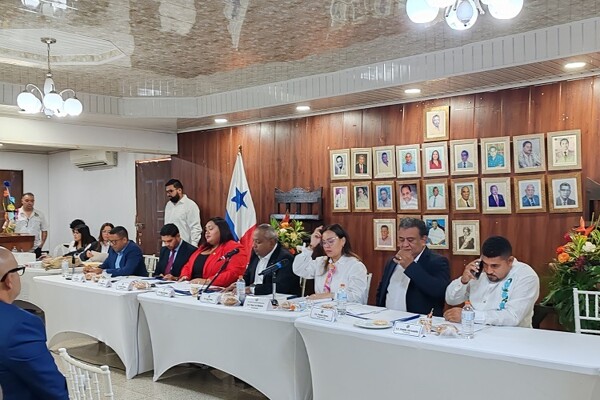
Panama's Minister of Economy and Finance, Felipe Chapman, and the Comptroller General of the Republic, Anel Flores, held a joint press conference this Thursday to address public scrutiny over transfers from the Ministry of Economy and Finance (MEF) to various community boards and municipalities. Chapman opened with a direct message: "We take the observations made with absolute seriousness. This corresponds exclusively to the Comptroller's Office." He assured that all transfers are "properly regulated" but admitted the process is perfectible: "Responsible pointers have allowed us to focus on improvements. If any municipality misappropriated funds, we share the citizen's concern." He added that the government aspires for these resources to be dedicated exclusively to priority investments such as drinking water, roads, aqueducts, and other essential infrastructure. Regarding how requests are approved or rejected, the minister confessed that upon taking office, he was surprised to find that historically, allocations were made without technical criteria. "The typical answer in Panama was: 'it's done this way because it's always been done this way.' And, as always, Panama is watching. Listening, analyzing, and correcting is an essential part of democracy." Meanwhile, the Comptroller's Office promises audits "with the same rigor as always." The spotlight is on the municipalities and their community boards. Chapman stated that the MEF has already presented a 16-page document to the National Assembly with recommendations to reform the Decentralization Law, including the use of the Multidimensional Poverty Index to classify districts and allocate resources scientifically. In a final message, Chapman said: "Our obligation is to care for public resources and protect the credibility of institutions." Flores added that if audits confirm abuses or the political use of funds, the findings will be referred to the Public Ministry. When asked about prior oversight of these transfers, Chapman was categorical: "The Ministry of Economy and Finance does not have the constitutional or legal authority to conduct audits. The law is clear on that." Chapman emphasized that the MEF does not decide the final use of the funds: "Municipalities request them, the requests are evaluated, and the process continues." He highlighted the significant reduction in transfers: "In 2013, B/.196.3 million was transferred; in 2015, B/.88.4 million; and in 2023, B/.145 million. The historical average is B/.143 million. In contrast, the MEF executed B/.6.9 million in 2024 and B/.4.69 million in 2025. We are talking about a fraction of what was done in the past. We have not eliminated it entirely, but we have reduced it by 96%."

Panama's Minister and Comptorer Confirm Legality of Municipal Transfers
Panama's finance minister and comptroller defended the legality of municipal transfers, noting a 96% reduction from past practices and promising audits to ensure funds are used correctly.