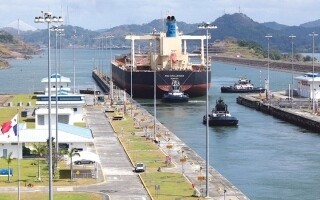
Shipping costs have risen, and agricultural product prices have fallen. But in the end, the rain returned, the water level rose, and ships resumed their passage through the canal, which has returned to its former status as a natural passage for American vessels. The canal provides many economic benefits, but what is most appreciated is the immense effort that is put into it, and the canal is undoubtedly one of the greatest engineering and construction achievements of all time. U.S. President Donald Trump sparked controversy at the beginning of this year when he spoke about the possibility of reclaiming the canal. This is partly due to the fact that the ports at its ends are owned by a company based in Hong Kong. An American investment company is competing to buy these ports, while China requires that a Chinese company own 51% of its shares. This is not the last controversy related to the Panama Canal, and the Panamanian people were never happy with U.S. control of the canal and the 10-mile-wide zone surrounding it. This huge number of deaths was a major reason for France's failure. There were other reasons for France's failure, such as its unrealistic plan to build a sea-level canal without locks through Panama's mountainous terrain. One of the reasons for the American success was the ability of Dr. William Gorgas, from Alabama, to eradicate yellow fever and control malaria. Thanks to the organizational efficiency of Colonel George Washington Goethals, the chief engineer of the project, the canal was completed ahead of schedule and at a cost of $23 million less than the budget. During our six-day tour, we saw 139 species that we had never seen before. But the day we spent watching the locks that lift ships to 85 feet above sea level, and then other locks lower them, was undoubtedly the highlight of the trip. While preparing for our trip, we read a book by American historian David McCullough, published in 1977, titled "The Path Between the Seas: The Creation of the Panama Canal, 1870-1914." McCullough begins his epic tale with a detailed account of France's 20-year failed attempt to build the canal and the political battle in Washington over its location and type, and then moves on to recount the details of the 10 grueling years it took to make the canal a reality. Between 1904 and 1914, Americans excavated more than 232 million cubic yards of earth and rock. However, the intervention of American lawyer William Cromwell, who represented French interests, and the main French investor, Jean Bonduarte, with Roosevelt, was crucial to completing the project in Panama. This decisive step taken by the American lawyer and the French investor saved the French company from bankruptcy, as the United States purchased its assets in Panama. For a farmer in Nebraska or a retailer in New York, the Panama Canal is like air that one only notices when it is gone. Farmers noticed this in 2023. The drought caused water levels in the canal to drop, which is why ships carrying U.S. agricultural exports could not use it. Some estimates suggest that between 25 and 30% of U.S. grain exports usually pass through the canal. The work was so masterful that the original locks and control system are still in use today. In addition to the canal, the United States helped build the nation of Panama. Panama was part of Colombia, but when the Colombians became inflexible in negotiations with the United States, President Theodore Roosevelt, having lost his patience, sent warships to support Panama's declaration of independence. Many members of Congress, including the chairman of the Senate committee, wanted to build the canal in Nicaragua. Its huge gates can be opened and closed in just two minutes. The project cost about $352 million at the time, equivalent to $10.8 billion in today's money, and cost about 5,600 workers their lives, most of whom were black workers brought in from the Caribbean islands. Despite the severity of these losses, the French effort cost 20,000 lives. At one point, diggers had to dig to a depth of nearly 300 feet. The three sets of locks built by the Americans represent a stunning engineering feat, acting as giant water elevators powered by gravity, not pumps, using tunnels to move water. During the drought, no ship passed through the canal. Urban Lehner, Wall Street Journal correspondent in Asia, for Asia Times. In 1977, former U.S. President Jimmy Carter signed a treaty to regain control of the Panama Canal by 1999. For global companies, the Panama Canal is a common issue, but for the two current great powers, China and the United States, it represents the core of both countries' interests. On the other hand, Panama is a paradise for bird lovers. Recently, I and my wife returned from a 10-day trip to Panama.