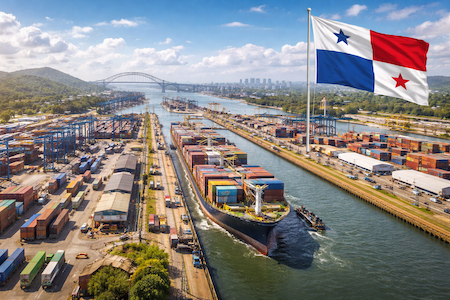
The operation becomes more predictable. For Mercosur, Panama represents much more than a logistics point. It cannot operate due to demand, and often not due to financing capacity or cash flow either. This is where Panama changes the equation. For a Mercosur company, operating from Panama allows access to logistically complex markets without assuming unnecessary risks. It is a concrete way to open markets, build brand presence in Central America and the Caribbean, and do so with controlled costs and more stable operational execution. In a context where regional growth demands precision, Panama becomes a strategic enabler, not just a transit point. The question is no longer whether to expand to new markets. The question is from where to do it intelligently. The author is a renowned international expert in supply chain management. The opinions expressed in this article are the sole responsibility of the author. Panama functions as a regional platform to intelligently manage inventory: deconsolidating cargo, adapting orders, and dispatching to customers or distributors in quantities aligned with their actual demand, not with the rigid logic of the full container. This logistical adjustment immediately translates into business results. Distributors buy what they actually sell, not what fills a container. Cash flow improves because capital is not trapped in slow-moving inventory. Distribution centers avoid saturation with products that take six months or more to move. From Panama, companies can work with regionalized inventory, respond to real market orders, and adjust volumes with speed. Demostenes Pérez. A few weeks ago, I received a group of entrepreneurs from a Brazilian business association in Panama. The conclusion they reached was as simple as it was powerful: for many Mercosur companies, growing regionally is not a commercial problem. Central America and the Caribbean do not behave like large markets in terms of volume, frequency, infrastructure, and operational rules. It is a logistical problem. Operating outside of integrated markets implies facing realities more complex than many expansion plans anticipate. In most cases, a Caribbean island or a small country in the region cannot absorb a full container of a product. The commercial risk decreases. They requested a 'Why Panama' type of presentation, an exercise I have performed for over 20 years, with names and components that evolve but with a constant essence: a proven recipe for well-executed regional expansion. This group, particularly insightful and analytical, took the conversation beyond the usual narrative. Expansion becomes more disciplined. After the presentation, we had an intense and valuable debate. These opinions cannot be considered as a position of this medium.