Economist and university professor Olmedo Estrada issued a serious warning about the management of public spending in Panama, stating that the country cannot continue to sustain subsidies that do not benefit the most vulnerable population and only maintain privileges entrenched in the state structure.
According to Estrada, subsidy policy must undergo a deep, technical, and social review because today a large part of the resources is diluted among poorly directed support, unproductive companies, and the public financing of politics.
«The problem is not to subsidize, the problem is to subsidize badly,» summarized the economist as he analyzed how state money does not always reach those who need it most.
In his opinion, Panama faces a dangerous contradiction: while talking about efficiency and growth, it continues to finance structures that do not generate a real impact on employment, productivity, or social welfare.
Estrada warned that if public spending is not ordered, the country will remain trapped in a circle where the budget is consumed without improving the quality of life for the majority of citizens.
Gasoline: a subsidy that does not reach the poorest
One of the first points Estrada raised was the gasoline subsidy, which he described as socially unjust and economically inefficient.
As he explained, this benefit mainly favors those who own their own vehicle, while the most affected population depends on public transport and services that continue to be deficient.
«The most affected people today are those who do not have a car. Not with the money of Panamanians,» stated Estrada.
He recalled that while millions are destined for party structures, there are communities without drinking water, with transportation problems, and with collapsed public services.
«We are subsidizing a political caste that lives doing politics twelve months a year, while there are people who do not even have the basics,» he added.
Estrada questioned why the State continues to finance industries that are not efficient or do not significantly contribute to economic development.
He added that these resources should be used to support productive ventures, technological innovation, and sectors that can truly dynamize the national economy.
For Estrada, subsidizing inefficiencies only delays the changes Panama needs to compete in an increasingly demanding economic environment.
Political parties: the most controversial subsidy
The economist was also firm in referring to the public financing of political parties, which he described as one of the most questionable items in the national budget.
«If someone wants to be a politician, let them find their own financing,» he stated.
In his view, state financing of politics distorts the priorities of public spending.
«Money must go to employment, health, education, and real social support, not to maintaining electoral machines,» he added.
Estrada maintained that reviewing this item is not an attack on democracy, but a way to make it more responsible to the citizen.
Surgery on public spending
For the university professor, Panama needs a true economic surgery that reviews, one by one, the state's subsidy programs and expenses.
He indicated that optimizing the use of public resources is not a political option, but a fiscal and social obligation.
«When the country does not have a surplus, it cannot afford to finance everything,» he noted.
Estrada explained that reviewing subsidies does not mean punishing the population, but protecting it from a model that wastes money without solving structural problems.
«The State must focus on what does have an impact: employment, productivity, basic services, and poverty reduction,» he affirmed.
He warned that if this adjustment is not made, the citizen will continue to pay the bill through higher taxes, more debt, or fewer services.
List of some of the most controversial subsidies
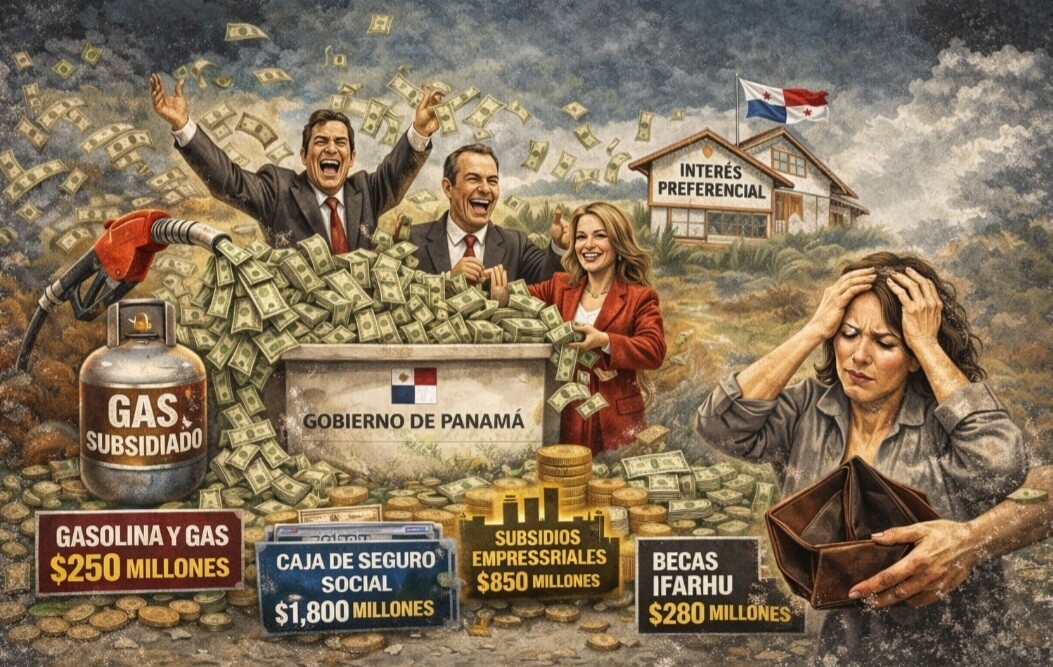
Gasoline and fuel subsidy ➤ ≈ 250 – 300 million Maintains artificial prices even though the poorest population does not have a car.
Electricity subsidy (energy tariff) ➤ ≈ 120 – 180 million Compensates bills, but ends up benefiting the middle class and companies more.
Domestic gas use (25 lb tank) ➤ ≈ 130 million It is social, but poorly targeted: it is also received by households that do not need it.
Preferential interest on housing ➤ ≈ 400 – 500 million It ends up subsidizing banks, promoters, and housing that are not precisely «popular».
120 at 65 Program ➤ ≈ 170 – 180 million One of the few subsidies that are clearly social.
Public transport subsidy (Metro and MiBus) ➤ ≈ 200 million Maintains fares, but with low operational efficiency.
Subsidies and exemptions for the business sector ➤ ≈ 800 – 900 million «Protected» companies from the 80s that do not modernize because «dad state» pays.
Public financing of political parties
Estrada pointed out that the subsidy design does not discriminate by income level and ends up becoming a regressive aid.
«The one who consumes the most gasoline is the one who receives the most subsidy. That is exactly the opposite of a well-made social policy,» he added.
For the university professor, those resources should be redirected to programs that have a direct impact on the poorest communities and job creation.
Companies in the «comfort zone»
Another target of Estrada's criticism are subsidies to the business and industrial sector, many of which have been in force since the 1980s.
The economist indicated that there are companies that survive not because of their competitiveness, but because they receive state support every year that keeps them in a comfortable «comfort zone».
«Every year 'dad government' passes them the check and that way there is no incentive to invest, innovate, or modernize,» he stated.
«So it is not logical for the State to spend millions subsidizing fuel when there are priorities such as employment, drinking water, health, and transportation,» he concluded.