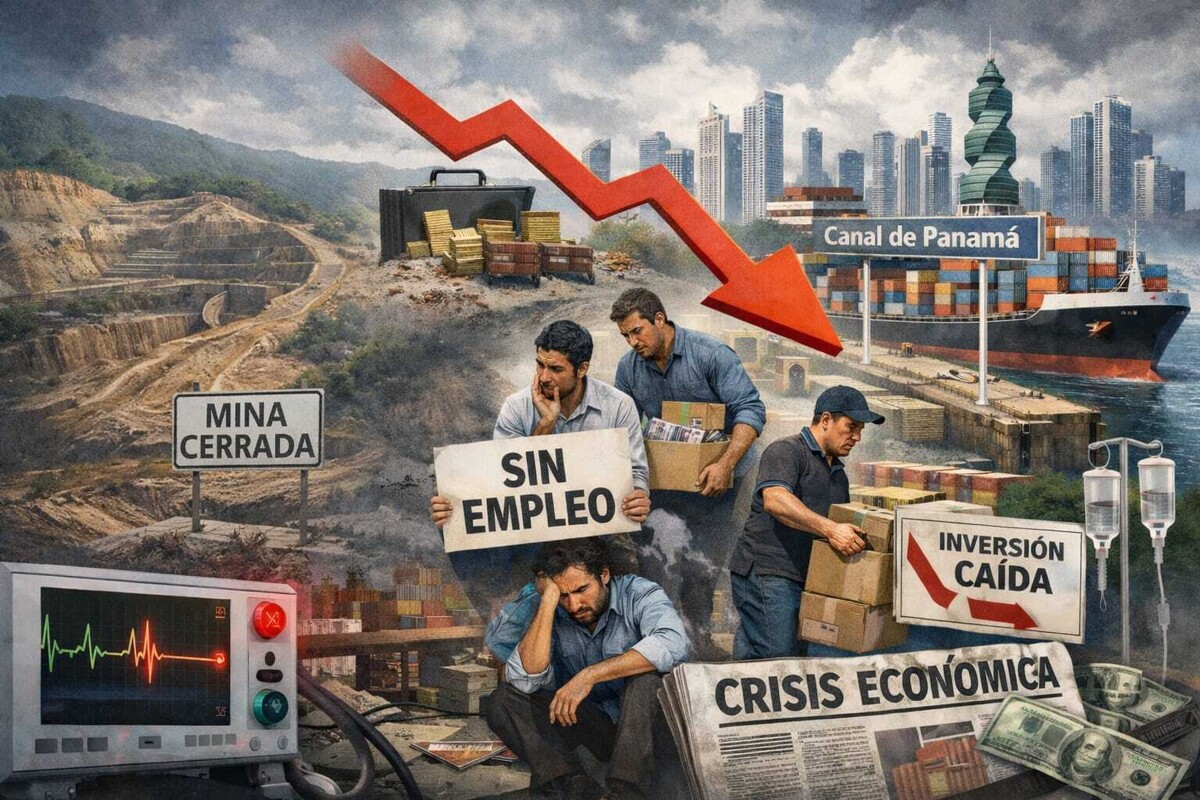
According to consultant René Quevedo, Panama must immediately take three actions to avoid deepening the economic crisis: reduce bureaucracy, inject liquidity into the economy, and establish clear limits on subsidies and exemptions. The analyst also insisted on the need to rebuild confidence to attract private investment, warning that without this factor, there will be no real recovery. "The money is not on the streets, it is in private investment," he emphasized. To this, he added a key warning: while Panama hesitates, other countries like the Dominican Republic, Costa Rica, and Guatemala are aggressively competing to attract foreign capital by offering more attractive incentives and conditions.
Quevedo questioned the current environment for the private sector, pointing out that the excess of paperwork and credit restrictions is suffocating small businesses. According to his data, 83.5% of companies registered with the social security system have fewer than 10 workers, yet they only access 12% of bank financing, which limits their growth. "The private sector is drowning in bureaucracy," he stated, while also criticizing a political discourse that he said has historically demonized private enterprise.
The impact is already being felt on the streets. He indicated that in 2024, 100,000 fewer labor contracts were processed than in 2019, reflecting a slowdown in the labor market. This is compounded by a decrease in mobility: transportation systems like the Panama Metro recorded 196,000 fewer users, a 23% decrease, which shows lower economic activity.
Despite the investments made, including the expansion of the Panama Canal, the logistics sector has not generated the expected impact on formal employment. Between 2014 and 2024, more than 20,000 jobs were created, but all in the informal sector, while 1,784 formal workers lost their positions. "Without investment, there are no quality jobs; what we are generating is precariousness," he warned.
Quevedo was emphatic in pointing out that recent decisions, such as the closure of the mine following a ruling of unconstitutionality, have had severe consequences: the loss of thousands of jobs, over $4.6 billion in private investment, a $1.6 billion drop in foreign investment, a $2.165 billion reduction in bank financing, and a $900 million impact on local suppliers. "This is not rhetoric, it is hard data," he stated.
The economist described the current moment as a stage of fragile recovery. "We have left intensive care, but we are still in recovery. There are signs of improvement, but we are not out of danger," he explained. He also questioned the approach to public decision-making: "We are trying to solve mathematical problems with emotional responses." Quevedo concluded that the country must focus on rebuilding confidence and creating stable conditions for investment. He warned that the loss of the investment grade, the increase in debt exceeding $40 billion, and the drop in consumption keep the economy in a complex situation.