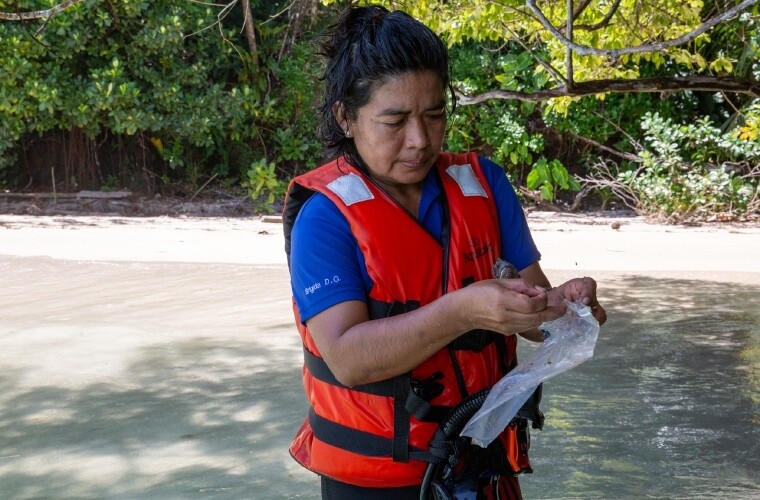
The Smithsonian Tropical Research Institute (STRI) reported on Monday the discovery of four new fish species that lived millions of years ago in the current Caribbean waters of Panama. One of them was named 'Hoplostethus boyae' in honor of Brígida de Gracia, the 'only marine paleontologist of the Ngäbe people in the world'.
This is an 'extinct orange clock', a small deep-water fish belonging to the Trachichthyidae family, which lived in the productive coastal waters of the Caribbean during the late Miocene, explains the Panama-based scientific institute. The etymology also recognizes how the Ngäbe people and their ancestors have inhabited the Isthmus of Panama for millennia, developing traditional ecological knowledge deeply connected to marine productivity cycles, creating a bridge between then and now, states marine paleobiologist Aaron O'Dea.
The other named species are Chiloconger aflorens sp.nov., Malakichthys schwarzhansi sp.nov., and Dasyscopelus inopinatus sp.nov.
'We chose the name 'Hoplostethus boyae' because 'Boya' is Brígida's traditional name in Ngäbere, the language of the Ngäbe.'