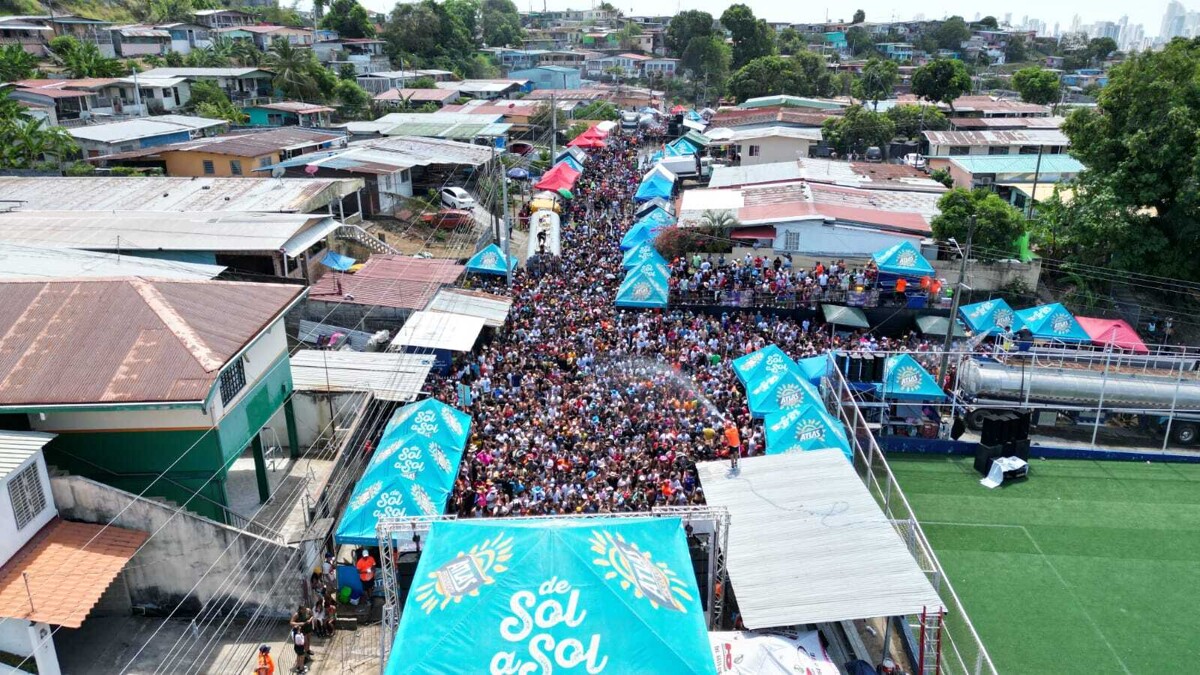
By sea, the Maritime Authority of Panama reported in 2025 a movement of 85,607 passengers to different coastal and island points in the country. The heart of the party: culecos, tunas, and tradition The Panamanian Carnival, especially in Los Santos and Herrera, is characterized by traditional culecos, where tanker trucks spray water on crowds dancing under the sun; rival tunas with queens competing in luxury and choreography; and night parades filled with murga and fireworks. Las Tablas prepares for the traditional confrontation between Calle Arriba and Calle Abajo, while other cities fine-tune logistics and security to receive thousands of visitors. Hotels and residences report high occupancy, boosting the local economy. The million on the move The calculation that brought the country close to a million displacements in 2025 comes from the sum of: 158,000 vehicles mobilized to the interior. An average estimate of 3 people per vehicle (474,000 people). 218,000 passengers at the Albrook Terminal. 85,607 travelers by sea. 190,000 passengers mobilized at Tocumen. The total sum amounts to 967,607 people on the move during Carnival 2025. Based on that statistic, 2026 begins with the expectation of surpassing that figure. The capital begins to empty while the interior fills with music, water, tradition, and family reunions. Carnival is not just a party. It is, literally, a country on the move. The entry The Carnival that mobilizes almost a million Panamanians was first published in La Verdad Panamá. “My children have to know what a mojadera in Las Tablas and a real tuna are,” expressed one resident. Also, Ana Rodríguez, a resident of Madrid, stated that she planned her trip since November. “Carnival is identity. There may be a line, but this is part of the ritual,” commented Ricardo Ortega, who was traveling with his family to Penonomé. Road operation and special measures The Ministry of Public Works (MOP) temporarily suspended road works until February 19 to facilitate circulation. The ATTT restricts the circulation of heavy cargo vehicles during the critical days of the exodus. Checkpoints and verification points remain active to reinforce road safety. More than land: air and sea also on the move In 2025, Tocumen International Airport mobilized nearly 190,000 passengers between departures and arrivals during the Carnival period. Among the passengers who arrived this Thursday was Carlos Mendoza, a Panamanian resident of New York. “I can spend Christmas abroad, but not Carnival. My family and the Calle Abajo tuna are waiting for me there,” he said while waiting for the call to board the bus. Further on, Luis Batista, heading to Chitré, explained that he requested vacation months in advance. “This is tradition. Javier Collins Agnew La Verdad Panamá In 2025, a total of 967,607 people were mobilized by land, sea, and air during the Carnival festivities in Panama, according to official statistics and estimates based on institutional records. The figure that approached a million displacements makes this celebration one of the largest internal human movements in the country. For 2026, authorities project that number could be surpassed, taking into account the sustained growth in vehicle flow, the increase in air reservations, and the high demand recorded today in the main transport terminals. Panama has been experiencing this morning an intense movement of travelers leaving the capital and main urban centers for the country's interior provinces on the occasion of the start of the 2026 Carnival, which officially kicks off this Friday, the 13th, and runs until Tuesday, the 17th of February. Albrook Terminal and public transport in full swing The Gran Terminal Nacional de Transporte de Albrook, the main departure point for interprovincial buses, registers a massive flow of users from the early morning and throughout the day, with long lines of people and luggage ready to depart to almost all provinces of the country. During the 2025 Carnival, 218,000 passengers were mobilized from this terminal to the interior, a figure that serves today as a reference to gauge the current exodus. This year, the most congested routes, as in previous periods, continue to be Los Santos, Herrera, Coclé, Chiriquí, Colón, and East Panama, where thousands of families reunite with relatives, attend cultural events, or simply enjoy the holiday. Among the travelers was María González, who was traveling to Las Tablas with three suitcases and a blue cooler. “One can miss many things, but not Carnival in the interior. The traffic doesn't matter, what matters is arriving before the first culeco”. The atmosphere mixes haste and enthusiasm: children with t-shirts related to comparsas, young people coordinating lodging by phone, and adults carrying bags with costumes form part of the human landscape of the exodus. Lane investments to flow to the interior The National Directorate of Traffic Operations (DNOT) reported that during the 2025 Carnival, 158,000 vehicles were displaced to the interior of the country. For this year, lane investments will be activated at strategic points, especially from Avenida de los Mártires towards Howard, as well as on sections of the Pan-American Highway, Capira, and San Carlos. Drivers consulted recognize that traffic is heavy, but manageable. “We left at 5:00 in the morning to avoid the worst. From ‘pela’o’ I go every year”.