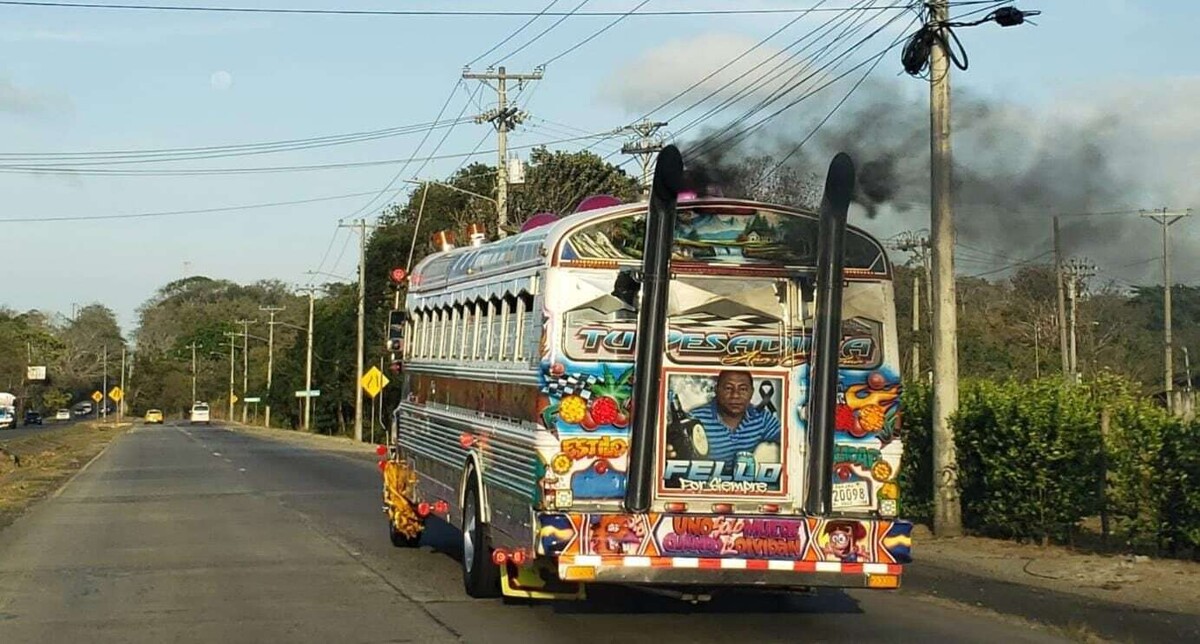
Panamanian authorities are considering shortening bus routes to reduce their entry into the city, officials have stated. The population growth in the East Panama region also creates additional pressure on the transportation system. In six months, between October 2025 and March 2026, three serious incidents occurred that resulted in five deaths and 39 injuries, once again raising questions about the safety of public transport in this area, where so-called "green devils" are still in operation. These cases have reignited the debate on oversight, system modernization, and persistent risks on these routes. On October 9, 2025, a bus traveling from Chepo overturned with 60 passengers on board in La Unión de Azuero. This service operates routes in Chepo and Pacora, as well as in the Chepo corridors that reach 5 de Mayo. Currently, these routes are not concessioned to the state company Transporte Masivo de Panamá, S.A., which operates the Metrobus system. "He has a great opportunity to resolve some things that the public is demanding and that users are requesting to improve the service," stated one official. It is worth recalling that the transformation of the capital's transport system—with the final implementation of the Metro and Metrobus to replace the so-called "red devils"—was not a spontaneous decision, but a response to a chain of events that revealed the risks of the previous model. The most emblematic occurred on October 23, 2006, when bus 8B-06 caught fire on the Transístmica highway. "In terms of traffic, incidents are always going to happen, but we seek to minimize them," an official noted. Gaps Persist. The official explained that the Chepo district was not included in the transport modernization plan, which has allowed these buses to remain in operation. He also indicated that many users choose to get off at points like 24 de Diciembre to continue their journey on the Metro, which has prompted route adjustments. "The transport operator does whatever he wants with us," a user affirmed. ATTT Defends Controls Despite Accidents. The director of the ATTT, Nicolás Brea, assured that they continue to carry out oversight operations on buses entering from Chepo towards the city, in areas where Metrobus does not operate. "We are overseeing to guarantee that the vehicles entering the capital district are in compliance," he indicated. "In both the overturning and the case of the cleaning worker, the buses were in compliance, with policies, permits, and drivers with valid licenses," he maintained. The incident left three dead, including a 15-year-old student from the Instituto Profesional y Técnico de México. On January 12, 2026, a bus on the Tanara–Vía España (Chepo) route overturned on the Pacora River. One of the victims died after several days in the hospital. These events have revived concerns about the safety of users and pedestrians, as well as the regulation of public transport. Music, Modifications, and Speed. For users, the circulation of these buses represents a constant necessity. From 5:00 a.m., high demand from users heading towards the Metro is already observed. In the area, routes from Cabra, Nuevo Tocumen, Las Garzas, and Pacora converge, operated by different providers. As part of the actions to improve mobility, the ATTT announced a pilot project for investment in lanes in Cabra, to be applied during morning peak hours, from the departure of that sector to the roundabout at 24 de Diciembre. Transporters Respond. In this scenario, leaders of the transport sector called on the ATTT to resume modernization initiatives and strengthen service regulation. Transport leader Esteban Rodríguez pointed out that there is a willingness to improve the service. A 50-year-old woman died and 13 people were injured, some with serious injuries. On March 5, 2026, a bus from the Chepo San Cristóbal Cooperative ran over two cleaning women crossing at a crosswalk on José Agustín Arango Avenue, at the height of the Tabernáculo de la Fe, in Juan Díaz. The service is provided by the Chepo San Cristóbal Cooperative R.L., which was intervened by the Panamanian Autonomous Cooperative Institute (Ipacoop) after detecting alleged administrative and financial irregularities and improper handling of funds in July and August of last year. Public transport users have expressed their concern for safety, especially given the recurrence of fatal accidents. The incident left 18 people dead and dozens injured, marking a turning point in the discussion on public transport safety in Panama. "There are many transporters who do want to do it," he stated in a local medium. He also recalled that the current director of the ATTT participated in a National Plan for the Improvement of Selective and Collective Transport that was never executed. Among the main causes cited are excessive speed, loud music, illegal modifications to vehicles, and chaotic driving. Moisés Forsythe, a user representative on the board of directors of the Transit and Land Transport Authority (ATTT), attributed these problems to a lack of oversight and limitations in modernizing the fleet, especially in the case of the "green devil" buses. He explained that the government restricted the entry of these vehicles due to irregularities in the compensation system, which has slowed the renewal of units. According to data from the National Institute of Statistics and Census (INEC), the Pacora district has over 70,000 inhabitants, while the Chepo district exceeds 66,000 people. The ATTT estimates that about 26,000 vehicles move every morning from sectors like Nuevo Tocumen and Cabra towards the city, with a similar flow in the afternoon. This is compounded by the difficulty of obtaining parts and performing maintenance, increasing the risk of mechanical failures. He also warned that, due to weak controls, some operators function without meeting regulations, apply irregular charges, and maintain a disordered service. He added that inspections are also carried out to detect illegal modifications. Nevertheless, he affirmed that in recent cases the vehicles met the requirements. Even, he specified that in one of the incidents, the owner was driving the unit. Even so, he acknowledged the challenge: preventing the loss of lives.