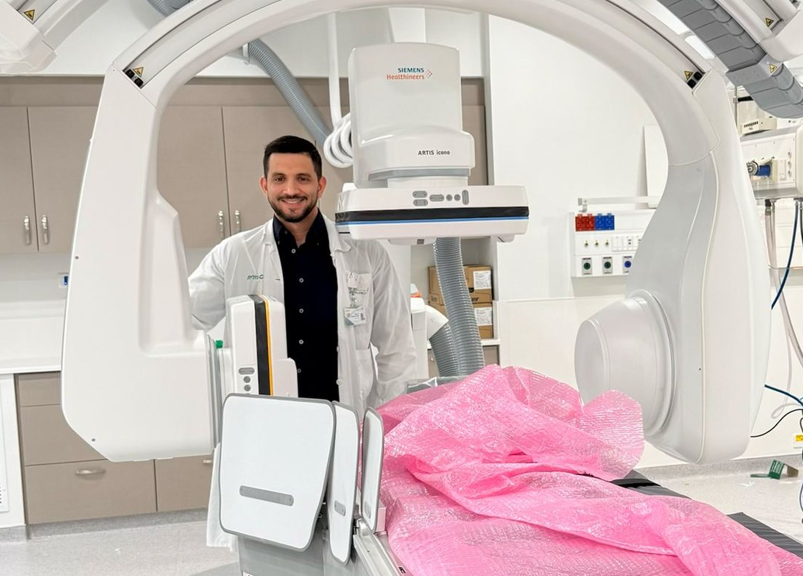
A significant advancement in interventional neurology is being led by Panamanian doctor José Domingo De Obaldía at Rabin Medical Center - Beilinson in Israel. According to the National Secretariat of Science, Technology, and Innovation, the doctor and an international team have redefined the use of the Comaneci device, successfully reversing distal cerebral vasospasm with 92.7% efficacy—a fatal complication that affects patients after an aneurysm rupture. This contribution by De Obaldía is distinguished by its immediate clinical impact: saving the lives of patients suffering from Subarachnoid Hemorrhage (SAH).
After this type of bleeding, brain arteries tend to constrict (vasospasm), which often causes massive cerebral infarctions or death. The standard treatment (balloon angioplasty) is risky, especially in the deeper, thinner distal segments of the brain. Unlike the balloon, which occludes the artery, the Comaneci device expands gently while doctors administer vasodilator medications. These characteristics are ideal for dilating vessels in spasm without the aggressiveness of a traditional balloon, which has been the norm for many years, explains the doctor.
The study, published as a preliminary experience, used a 'hybrid mechanical opening' approach where the device is introduced through a microcatheter to the farthest parts of the brain. However, the clinical vision of the interventional team, with De Obaldía's participation, allowed for identifying a new life-saving purpose by applying it to delayed cerebral vasospasm (DCVS). The DCVS, which occurs in up to 70% of patients with aneurysmal SAH, remains one of the leading causes of disability and mortality by preventing oxygen flow to the brain.
"The idea arose from recognizing that the Comaneci device offers an expandable and controllable structure that allows for maintaining blood flow," states De Obaldía. The device was originally designed only to assist in the treatment of wide-neck aneurysms. In contrast, assistance with the Comaneci allows for incremental expansion, preserving blood flow and being 'gentler' on the arterial wall.
"The main challenge was technical and conceptual: adapting a device designed to 'support' an aneurysm to the task of dilating long and fragile arterial segments," says De Obaldía. This required defining how to dose the force to avoid over-expansion and establishing a protocol for dilation from distal to proximal. A retrospective study conducted on 94 blood vessels from 14 critical patients demonstrated that the technique is feasible, safe, and effective. The results showed a significant improvement in vasospasm in 92.7% of the treated vessels, with no permanent complications or vascular perforations.
Despite the high expected mortality in these cases, more than half of the patients (51.5%) achieved a favorable functional outcome at six months of follow-up, a crucial data point that demonstrates the clinical impact of the technique. Dr. De Obaldía highlights the importance of safety protocols, which included strict anticoagulation to maintain the Activated Clotting Time (ACT) within the therapeutic range. Patients were also selected rigorously, including only those with confirmed symptomatic vasospasm that was refractory to optimal medical therapy, which underscores the severity of the cases treated.
"We learned that although the device preserves blood flow, constant monitoring is crucial," concludes the physician.