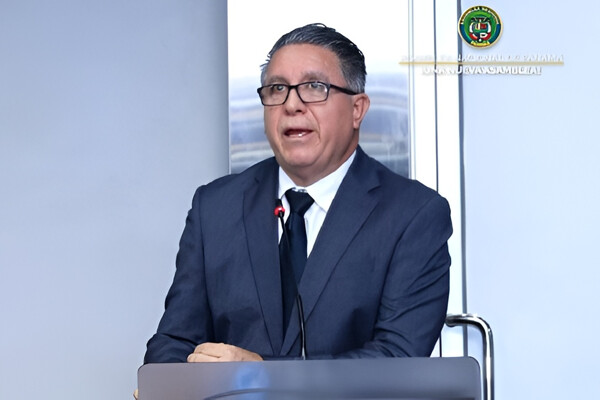
The Budget Committee of the National Assembly of Panama authorized this Thursday a series of additional credits and transfers of items destined for the General Comptroller's Office, the Ministry of Public Works (MOP), and the Legislative Branch itself, summing an important capital injection for the 2026 fiscal cycle. Funds for the General Comptroller's Office The General Comptroller's Office was granted $24,332,572 to guarantee its operations and investment projects. The approved budget is divided as follows: Operating expenses: $21.7 million (90% of the total). Institutional investment: $2.6 million (10% of the total). The General Comptroller, Anel Flores, along with Deputy Comptroller Omar Castillo, substantiated the request arguing that the institution faces severe limitations after budget cuts applied to the current fiscal year. Boost to infrastructure in the Ngäbe-Buglé region Meanwhile, the Vice Minister of Public Works, Iván De Ycaza, secured the approval of an additional credit of $17,889,987. These resources will be incorporated into the investment budget to execute the first phase of an ambitious rural connectivity plan. De Ycaza detailed that the funds will be allocated to the construction of the first 50 'zarzos' (suspension bridges), of a total of 100 announced, to facilitate access to schools and hard-to-reach communities in the Ngäbe-Buglé region. Transfer of item for the National Assembly Finally, the president of the Legislative Branch, Jorge Luis Herrera, substantiated a transfer of an item for an amount of $12,133,320. According to Herrera, these funds will allow the National Assembly to face budgetary shortcomings and comply with essential fixed commitments for the functioning of the State.