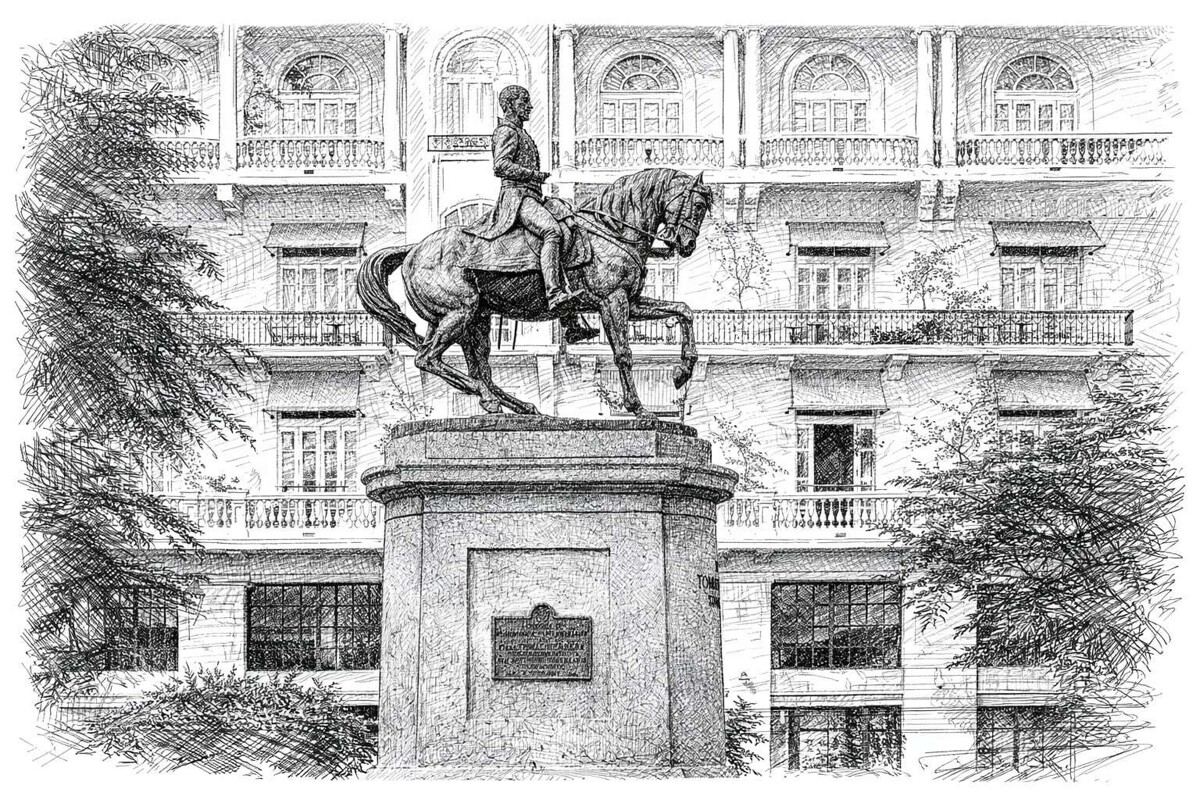
In 1839, the government of New Granada (modern-day Colombia) closed several religious convents in the Pasto department. This decision prompted various regional groups to take up arms against the central government, an event known as the War of the Convents. As the war paralyzed regional trade and military expenditures were high, the New Granada government ordered the Panama department to exponentially increase taxes on its citizens and send that revenue to Bogotá to finance the war against insurgent regions. This fiscal pressure, added to the precarious economic situation in Panama due to the halted commerce, created an unsustainable financial crisis. In response, the Panamanian commercial elite, frustrated by the lack of vision from Colombian rulers regarding the isthmus's potential as an interoceanic route, became active in rejecting Bogotá's central policies. A movement known as the Society of the Country's Friends advocated for greater autonomy. In 1840, seeking to avoid the conflict, the Panamanian political and commercial class had sufficient reasons to proclaim independence on November 18, leading to the establishment of the State of the Isthmus. Although this first experiment in sovereignty was brief (from November 18, 1840, to December 31, 1841), its relevance was considerable. The new state had a constitution, an autonomous government, an army, foreign relations, and national administration without Bogotá's tutelage. At the helm, Tomás Herrera demanded that Bogotá assume the sovereign debt incurred by the Isthmus State, respect judicial rulings issued during the sovereign period, and grant amnesty to all who participated in the isthmus administration. Although Panama did not achieve the autonomous status it sought, Bogotá accepted the other conditions. This conflict is also known as the War of the Supremes, named for the regional caudillos who led the rebellions, such as José María Obando in the Cauca department and Tomás Herrera in Panama. In the Fundamental Law of March 18, 1841, the new Isthmus State established the possibility of voluntarily rejoining New Granada, provided it adopted a federal system of government. By the end of 1841, the rapid advance of central government troops under Tomás Cipriano de Mosquera made it clear they would soon defeat the insurgent forces of Pasto and other departments. Consequently, the Panamanian government began negotiations to reintegrate Panama into New Granada. After reunification, the desire for autonomy remained strong among the population, fueled by the eloquent and visionary writings of Justo Arosemena. In conclusion, since 1903, we are not the first, but the second republic of Panama. Panama demanded recognition of an autonomous regime, especially in commercial and fiscal matters, to implement the necessary economic policies and take advantage of its geographical location. During this sovereign experiment, Costa Rica recognized us in a border treaty, and on June 8, 1841, we approved a Political Constitution. Shortly after, General Tomás Herrera assumed the presidency of the new republic after serving as civil head. Notably, special laws were enacted for the first time to promote free trade, establishing fiscal incentives for investments, especially in the maritime transport sector. The State of the Isthmus was our first sovereign experiment: it had a constitution, an autonomous government, an army, foreign relations, and national administration without Bogotá's control. This little-known precursor, the State of the Isthmus (1840-1841), deserves to be an indispensable starting point for the national narrative. The author is a lawyer.