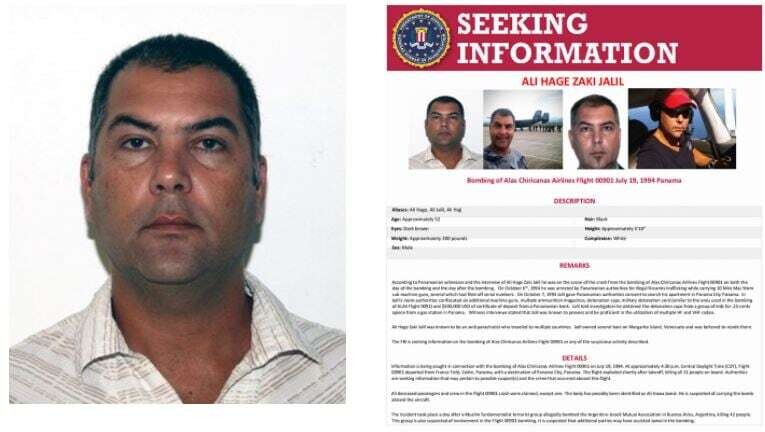
Both incidents have been the subject of investigations that have explored possible links, including indications of networks associated with Iran and Hezbollah, due to the temporal proximity and the profiles of the victims, although there is no final judicial ruling establishing a direct connection between the two events. In 2020, the Federal Bureau of Investigation (FBI) issued a wanted person alert for Ali Zaki Hage Jalil, whom it considered a person with relevant information about the attack, in which citizens of Panama, Israel, the United States, and Colombia were traveling. Information obtained by the prosecution reveals that Ali Zaki Hage Jalil was in Panama before the attack and traveled to the province of Colón in the days leading up to the event. Among the victims were businesspeople from the Jewish community established in Panama. The attack occurred one day after the bombing of the Argentine Israeli Mutual Association (AMIA) in Buenos Aires, in which 85 people were killed. In a message posted on his X account, he stated that this measure represents a significant advance and will shed light on his alleged links with Hezbollah. “It is expected that this measure will promote the discovery of the truth and shed light on his links with the terrorist organization Hezbollah, which also acts to spread terrorism in Latin America and represents a threat not only to Israel, Lebanon, and the Middle East, but to the peace of the entire world,” he expressed. The case was reopened at the request of the Panama Supreme Prosecutor's Office in August 2019, which led to the suspect's arrest in Venezuela in November 2025. The attack, considered the most serious in the country's history, left no survivors. The first two were detained in Panama, but were later released after filing legal appeals and left the country. Israeli Minister of Foreign Affairs Gideon Saar celebrated the decision to extradite Jalil. The Panamanian government awaits official notification from Venezuelan authorities regarding the decision to extradite Ali Zaki Hage Jalil, suspected of the explosion of a Panamanian commercial airplane in July 1994, which left 21 dead and has been linked to the Lebanese Shiite organization Hezbollah. Judicial sources explained that the Ministry of Foreign Affairs, as the channel for carrying out this procedure, must receive the official documents by which Venezuela agrees to the delivery of Zaki Hage Jalil, in order to then initiate the formal procedures for his transfer to Panamanian territory. The Venezuelan court validated Panama's request based on the principle of dual criminality, by verifying that the imputed crimes—qualified homicide and crimes against collective security—are typified in both the Penal Code of Panama and that of Venezuela. The sources indicated that once this phase is concluded, security forces must be commissioned for his physical transfer to the country, due to the profile of the investigated. Once in Panama, Ali Zaki Hage Jalil must be placed at the orders of the Judicial Branch, which must set a trial date to debate his alleged involvement in the explosion of the Alas Chiricanas company airplane, which occurred on July 19, 1994. The Supreme Prosecutor's Office of the Public Ministry maintains charges against Mohmoud Moutan Mohammad, Mahamad Tha Moutan, and Gilberto Tomás Yangüez.