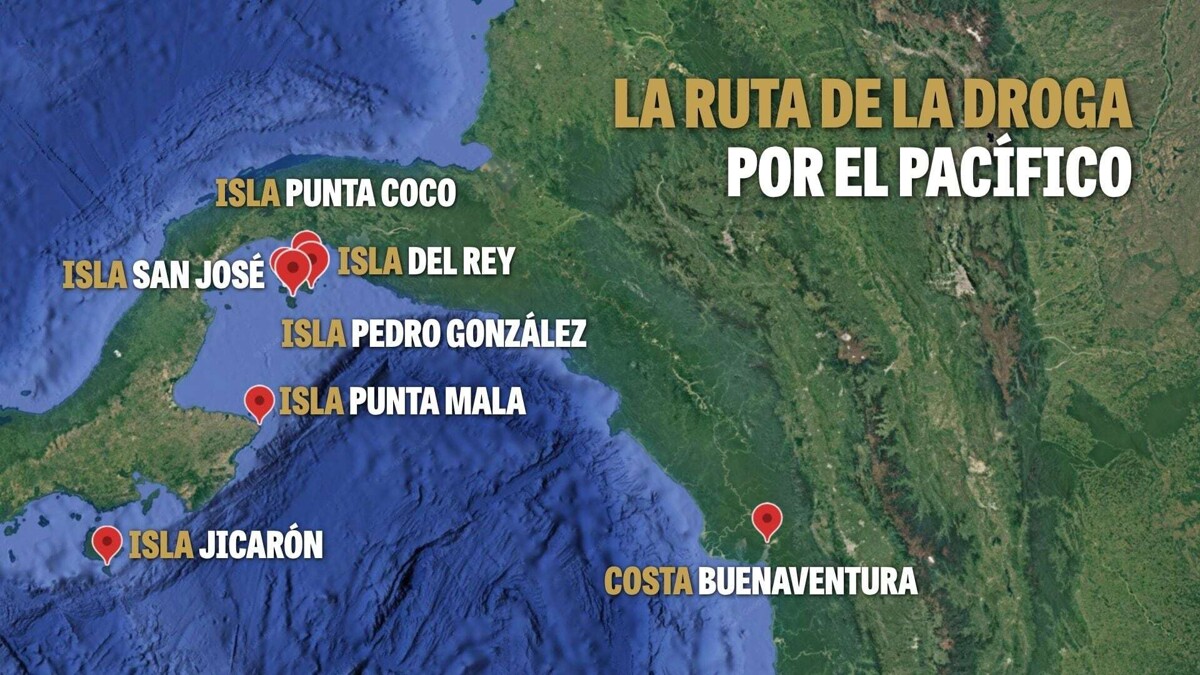
Beyond its role as a transit area, Las Perlas has transformed into an insular logistics platform where temporary warehousing and re-shipment activities converge, backed by alliances with global criminal networks. This pattern projects it as a key node in the articulation of shipments destined for North America and Europe. The report recognizes that the intensification of controls in main ports, such as Colón (Atlantic side) and Balboa (in the Pacific), pushed criminal groups to diversify routes and seek alternative spaces with less surveillance. In this context, this group of islands emerges as an ideal enclave to reduce risks in transportation and facilitate maritime transshipment operations, reiterates the report from the International Center for Research and Analysis against Maritime Drug Control, an organization that works with the United Nations Office on Drugs and Crime (UNODC). In fact, the UNODC's World Drug Report 2025 includes Panama in a list of countries that form the main water-based cocaine trafficking routes in America for the 2023-2024 period. And the Colombian Navy's report reaffirms this. These sites were used for intermediate storage, while fishing vessels were used as a logistical facade in 3 events. According to the Colombian authorities' report, the most critical points were located in the south of San José Island, at Punta Coco, and in the vicinity of Rey Island. The seizures made confirm that the archipelago functions as a hybrid platform: that is, an area of temporary storage, transshipment of large loads, and dispersion of smaller loads destined to diversify risks and complicate detection. The document concludes that this scenario poses logistical and operational challenges for Panamanian maritime security, as it is a dispersed territory, difficult to access, and with a number of islands and islets that complicates permanent surveillance. This, the document adds, increases the need to strengthen aerial, maritime, and satellite monitoring mechanisms, as well as to deepen international cooperation in terms of interdiction. Among the findings of the World Drug Report 2025 are that the production, seizures, and consumption of cocaine reached new highs in 2023, becoming the illicit drug with the highest market growth. Similarly, it reflects that illegal production skyrocketed to 3,708 tons, almost 34% more than in 2022. The archipelago of Las Perlas has consolidated itself as a strategic enclave of maritime drug trafficking that uses Panama as a link for the transfer of drugs to the United States and Europe. This is highlighted in a July 2025 report from the International Center for Research and Analysis against Maritime Drug Control, which seeks to establish alternatives to the phenomenon of drug trafficking. The document, prepared by the Colombian Navy and shared with Panamanian authorities, takes a detailed look at the Las Perlas archipelago, located in the Gulf of Panama. The document states that Panama has historically maintained its condition as a main corridor for drug trafficking in Central America, due to its strategic geographical position and the connectivity that the Panama Canal gives it. According to the United Nations Office on Drugs and Crime, 70% of the cocaine entering North America transits through the Central American corridor, with Panama being one of the most relevant transit points due to its logistical and maritime capacity. Seizures of drugs in the Archipelago of Las Perlas between 2023 and 2025 evidence its consolidation as a strategic enclave of drug trafficking in the Panamanian Pacific. In the analyzed period, 14.3 tons of drugs were seized, of which 10.7 tons were cocaine (71.7%) and 4 tons marijuana (28.3%) in a total of 32 operations in which 47 people were apprehended. The most common modalities for drug trafficking are the use of fast-type boats. There were 12 events, with loads that exceeded 1.2 tons. Illegal deposits on beaches and estuaries represented 8 events. It mentions, among other aspects, that it is made up of about 200 islands and islets, of which only a small fraction has a permanent population. Traditionally recognized for its tourist appeal and low demographic density, this insular space is characterized by extensive jungle areas, hard-to-access coasts, and limited infrastructure. The report indicates that these conditions, added to the geographical dispersion and the absence of sustained surveillance, have turned the archipelago into a vulnerable environment against illicit activities and that, in recent years, these characteristics have been taken advantage of by transnational crime organizations —including Mexican cartels, Colombian networks, and consortia dedicated to illicit maritime transport— to use the islands as points of accumulation, concealment, and transshipment of drugs destined for international routes. In this way, the archipelago has consolidated itself as a strategic enclave within the dynamics of maritime drug trafficking in Panama. As a reflection of this dynamic, global seizures marked a record of 2,275 tons, a 68% increase compared to the period 2019-2023. At the same time, consumption skyrocketed by 8 million in a decade, going from 17 million users in 2013 to 25 million in 2023.