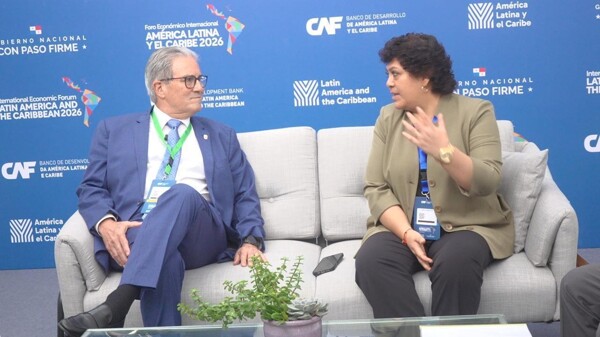
As Latin America seeks to consolidate its presence in international trade, attract investment, and boost tourism, Panama emerges as an example of how a country can articulate a comprehensive commercial promotion strategy, according to María Camila Castellanos, a renowned expert in international business.
“Panama is demonstrating that it is possible to diversify beyond logistics and finance, integrating tourism, services, and sustainability as part of the same strategy,” she emphasizes.
For Castellanos, Panama has leveraged its geographical and institutional advantages to position itself as a logistics and financial hub, while simultaneously promoting emerging sectors such as premium tourism and the digital economy.
According to Castellanos, Panama has built a path that starts by recognizing its natural strengths as a center for maritime and air connectivity, and then transforming them into an attractive and coherent country narrative.
The case of Panama, in the expert's view, should be seen as an inspiration for Central America and Latin America: “If the region adopts integral and professional promotion methodologies, it can compete not only as isolated countries, but as a block with solid and differentiated value propositions.”
For María Camila Castellanos, Panama is not an isolated case, but proof that Latin America can make a qualitative leap in how it projects itself to the world: “We need to move from tactical actions to state policies in commercial promotion.”
To this are added reforms and policies that have allowed Panama to maintain its competitiveness in international rankings, confirming that consistency and follow-through are as important as the initial vision.
Castellanos especially highlights the boom in luxury tourism in Panama, with a growth of over 70% in business and first-class passengers in 2025, as well as the development of premium experiences in Panama City and exclusive beach destinations.
“Panama reminds us that when thinking strategically, the region can be on par with the most demanding markets in the world,” she says.
The Canal, its financial ecosystem, and its strategic geographical position have become pieces of a solid value proposition, to which are added the consolidation of its air hub through Copa Airlines, the strengthening of international agreements, and a favorable investment climate.
At the same time, the country has projected an image of modernity and security, enriched by the development of premium tourist experiences in the capital and its beach destinations.
“The Panamanian case demonstrates that when there is a long-term vision, institutional coordination, and a coherent country narrative, results arrive quickly and sustainably,” she affirms.