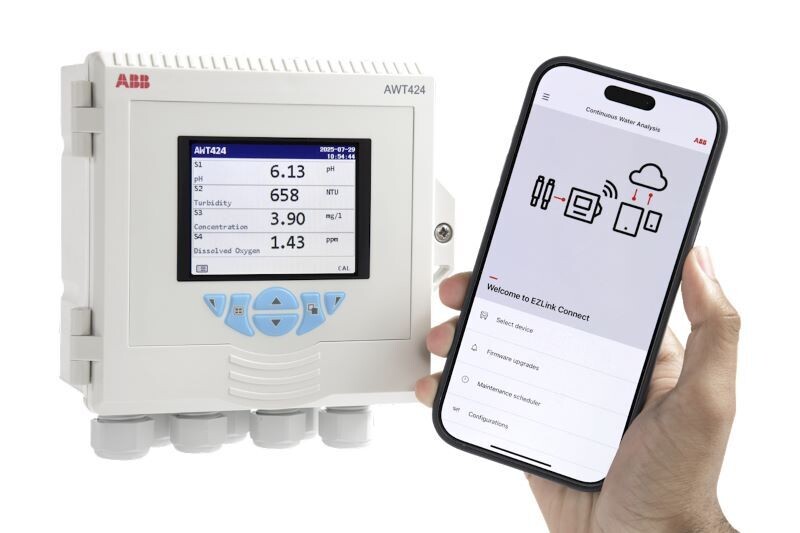
ABB, a global leader in automation, has announced two new technologies designed to transform continuous water quality analysis. The dissolved oxygen sensor family, AeroStar™, and the multi-entry transmitter AWT424 are designed for industrial processes in the energy, food, and semiconductor sectors. Thanks to their optical design for luminescence quenching, these devices offer superior stability and extend the sensor cap life by up to two years. Jorge Vázquez, Head of Instrumentation, Control Systems, and Excitation Systems at ABB in Panama, explained that this technology reduces maintenance requirements by up to 70% compared to traditional electrochemical methods. The sensors, made of stainless steel with a hygienic finish, integrate via the EZLink™ platform, enabling predictive maintenance alerts through mobile devices. The AWT424 transmitter complements this by unifying water quality measurements, allowing for the simultaneous connection of up to four sensors. Its modular design facilitates the upgrading of communication modules and sensors, optimizing spare parts inventory for operators. The device features a color TFT screen, Bluetooth™ connectivity, and MODBUS TCP communication, simplifying its integration into plant control systems. While the ULTRA model measures up to 4 parts per billion (ppb), the ULTRA TRACE model achieves capabilities below one part per billion, providing a comprehensive view of key parameters such as pH/ORP, conductivity, turbidity, and chlorine.