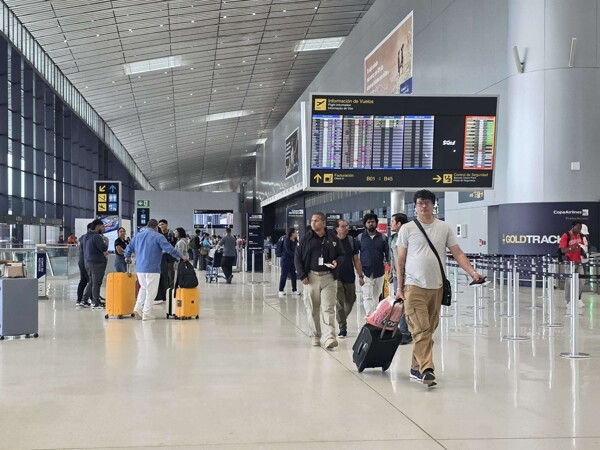
The Panama Tourism Authority warned that the proposal to increase the fee for transit passengers could reduce the country's competitiveness at a time when the tourism sector is beginning to consolidate its results. Gloria De León stated that the focus must be on attracting more airlines, improving connectivity, and strengthening the country's competitiveness. She noted that the Tourism Authority was not consulted during the drafting of the bill. De León stated that this would make Panama more expensive at a time when all prices are rising and fuel is affecting everyone. The president of the Association of Airlines of Panama (ALAP), Carlos Conde, expressed that the legislative initiative constitutes a direct threat to Panama's competitiveness as an air connection hub. "The economic architecture of Panama depends on its role as a global logistics node; consequently, any increase in operating costs puts us at a clear disadvantage compared to regional competitors that are currently executing aggressive strategies to capture the air traffic that traditionally chooses our country," Conde expressed. He indicated that it is vital that the National Assembly's Economy and Finance Commission understands the relevance of a sector that is a backbone of national stability. He recalled that aeronautical activity injects 8.2% of the Gross Domestic Product (GDP), representing a figure close to $6.8 billion in contributions. The president of ALAP also expressed the impact that the aviation industry has on the country's workforce: The sector guarantees the livelihood of more than 194,000 workers, dynamizing key areas such as logistics, tourism, and the permanence of multinational headquarters. He explained that considering that more than 70% of Tocumen users are connecting passengers, the creation of this tax would cause an immediate drop in the volume of travelers, resulting in a loss of frequencies, cancellation of routes, and the weakening of successful programs such as the Panama Stopover. In summary, he warned that the application of this extra charge to the transit passenger would compromise the viability of the "Hub of the Americas" and generate a net economic harm that would significantly exceed any tax collection projection. To these warnings was joined by the general manager of Tocumen International Airport, José Ruiz Blanco, by indicating that it would be a "dangerous" measure that would drive international airlines and travelers away from the country. He indicated that just the fact of intending to debate the bill has generated great concern among airlines and the aviation sector in general. "It is a very serious, very dangerous issue for the country." He pointed out that Panama has been advancing in its international positioning during the last year and a half, so he questioned the need to promote measures that could affect that progress. "We are starting to position ourselves and we are on the right track, with strategies that have given results." "We definitely see it as very negative," he affirmed, recalling the effort made to position Panama as a tourist destination. Maduro emphasized that transit passengers represent a key opportunity for tourism. "Last year, the airport recorded a growth of 9%," he said. Ruiz Blanco specified that it is estimated that by 2030, 30 million passengers could be reached, a projection that could be affected by the proposal of deputy Benicio Robinson Jr., of Bocas del Toro. Ruiz Blanco reiterated that Panama is a transit airport, with a volume reaching 74% of passengers passing through the airport and going to other destinations. "It is detrimental to the tourism industry," he stated, pointing out that any change in the rules of the game can cause airlines to opt for other destinations. Pardo explained that both passengers and airlines are highly sensitive to costs. "There are many around who are willing to become a hub like Panama," he said, and added that "these 10 dollars, which may seem few, can tip the balance towards other destinations." Likewise, he warned that the international context already pressures the costs of air transport upwards, so introducing a new charge could make the destination even more expensive. "Why deprive ourselves of that competitiveness?" he posed. The Administrator of the Panama Tourism Authority, Gloria De León, warned that the proposal to increase the fee for transit passengers could reduce the country's competitiveness. She added that the focus should be on promoting initiatives that strengthen air connectivity, attract new airlines and translate into a greater flow of visitors to the country, instead of applying measures that could negatively impact the sector. De León agreed that even the discussion of the issue generates a negative perception internationally. "The airport is growing." "They are potential tourists for Panama... if we put a tax on them, we are closing a lot of business," she indicated. The tourism and aviation sectors unanimously raise their voice of rejection against bill 131, presented by Benicio Robinson (son), substitute for his father Benicio Robinson, from the PRD, which seeks to raise the fee charged for the transit service to passengers in Panamanian airports such as Tocumen International to $10. The proposal, called "Transit Airport Facility Usage Fee", aims to capture part of the high flow of international passengers who use Panama as a hub to formally enter the country and generate new income. It may have to go up, but if it happens, it must be for the growth of the airport. "By affecting this segment, airlines begin to withdraw or slow their growth." He specified that this week he has received messages from different airlines concerned about the issue, even from Japan, a country with which a new connectivity is being analyzed. "There are countries that charge zero dollars for transit." However, the tourism guild, the airlines, the Panama Tourism Authority, the National Tourism Council and Promtur, have raised their alert voice so that this project does not prosper, or they can put the growth of this industry at risk. The president of the National Tourism Council, Sara Pardo, warned that the initiative introduces uncertainty at a key moment for the sector's recovery. "Currently, the airport contributes resources to the State, including the Civil Aviation," said the Tocumen manager. He added that the measure affects the country's competitiveness: "it is a point of distrust because they changed the rules of the game." In the same line, the president of the board of the National Tourism Promotion Fund (Promtur), Demetrio Maduro, stated that the proposal would have negative effects on the advances achieved in the country's international promotion. He pointed out that thanks to initiatives such as the Copa Airlines stopover, around 200,000 additional visitors have entered the country in the last year. The executive warned that the measure could affect competitiveness against other regional hubs. "This should not be part of the conversation. The concern is not only that the measure is being proposed, but that it is being talked about." "We say 10 dollars, but a family of six people is already 60 dollars," he indicated. Panama charges $1.25.