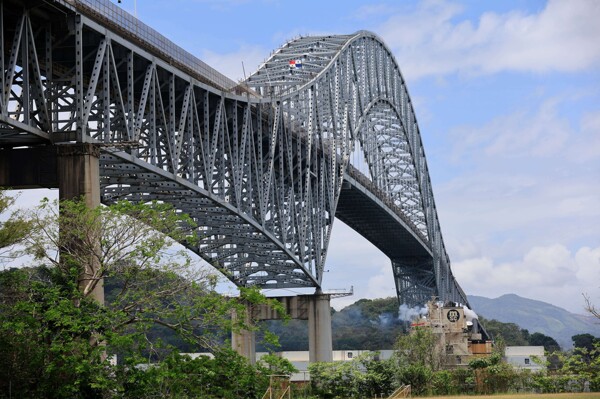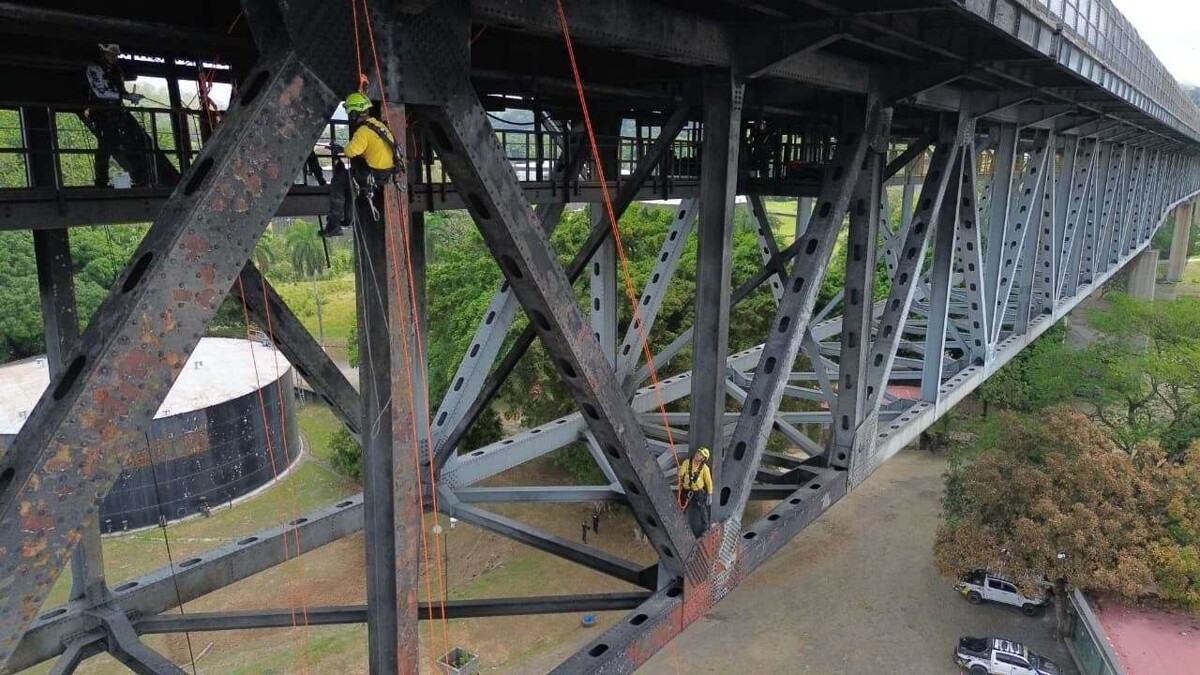
Regarding the road deck—reinforced with carbon fiber—no failures in adhesion or integrity were evidenced. Authorities highlighted that these results fully coincide with previous evaluations carried out by Panamanian technical teams. Recommendations from the study The study also establishes a series of actions and recommendations for the MOP, to ensure the maintenance and monitoring of the bridge. Among these, the performance of a structural scan of the concrete piles, both in the affected area and in the rest of the columns, is highlighted. In the case of pile 10, which was exposed to fire, it is recommended to do so in the short term, while for the rest of the piles, it is suggested to do so in the long term. Similarly, it was recommended for the steel superstructure the repair and repainting of the areas impacted by the fire, as well as the installation of extensometers at 28 points on the bridge to monitor possible deformations. Laboratory tests on the road deck and an evaluation of the carbon fiber will also have to be carried out, with a view to its possible replacement in the medium term. The MOP reported that, since the end of last year, a joint technical evaluation with the University of Panama and the Panama Canal Authority has been developed, with the objective of establishing a short, medium, and long-term maintenance program. Among the most immediate actions, the cleaning and repainting of the areas affected by the fire are contemplated, while the contracting mechanism for carrying out these works is defined. As for the required investment, Lewis indicated that the amount has not yet been determined, since the technical studies that will define the scope of the necessary interventions must first be concluded. Despite public concerns about the state of the bridge, the MOP reiterated that “there are no critical findings that compromise its operation”, although it insisted on the need to maintain restrictions and advance its preventive maintenance. Meanwhile, Karen Caballero, deputy director of Studies and Designs of the institution, highlighted that the report was prepared with the participation of a multidisciplinary team that included the Technological University of Panama, together with security and response entities. The authorities reiterated that, although no immediate risks were detected, the recommended measures aim to preserve the integrity of this key infrastructure for the country's connectivity and guarantee user safety in the long term. Following the specialized technical evaluation of the structure of the Bridge of the Americas, carried out by the U.S. Army Corps of Engineers and the Ministry of Public Works (MOP), the report revealed that no critical structural damage was presented after the explosion and fire of tank trucks registered on April 6. The report, based on specialized inspections, acoustic analyses, and thermal images, focused on three key areas to which the team had access: the concrete pile near the incident, the metal superstructure, and the road deck. Among the main findings, specialists determined that no critical structural deficiencies were identified that pose an immediate risk to the safety of the bridge. However, the national director of Study and Design of the MOP, Edwin Lewis, explained that despite the favorable results, it is recommended to maintain the current restrictions for the transit of heavy vehicles. In this sense, it was confirmed that the 10-ton limit per vehicle continues, a measure established in 2009, and that it will be reinforced in coordination with the Transit and Land Transportation Authority (ATTT) and the Traffic Operations Directorate of the National Police. Lewis clarified that this limitation is not a response to the incident that occurred on April 6, where three tank trucks exploded on the lower part of the bridge and where one person died, but to a provision established after previous evaluations determined the progressive deterioration of the structure due to the passage of time. “The objective is to prevent greater wear and tear on the bridge and guarantee its useful life,” he stated, while emphasizing that traffic currently flows normally, except for heavy vehicles that exceed the established limit. Main findings of the inspection According to the report presented by Lewis in a press conference at the Council of Ministers, no significant cracks or damage were detected in concrete pile 10; only minor and localized delamination, with no structural impact. In the metal superstructure, American specialists did not observe deformations, connection failures, or loose rivets. Lewis pointed out that the damage detected in the metal structure is mainly superficial, limited to the exterior and interior paint.