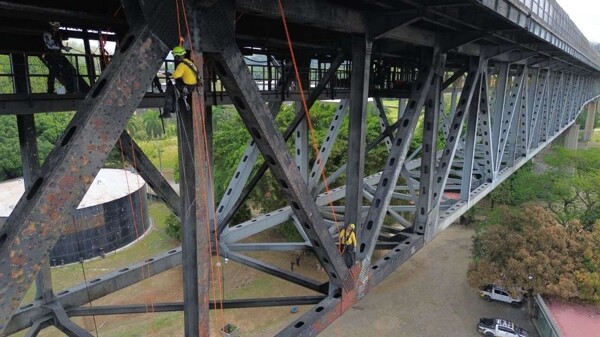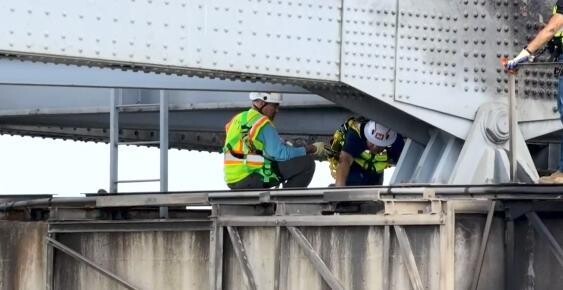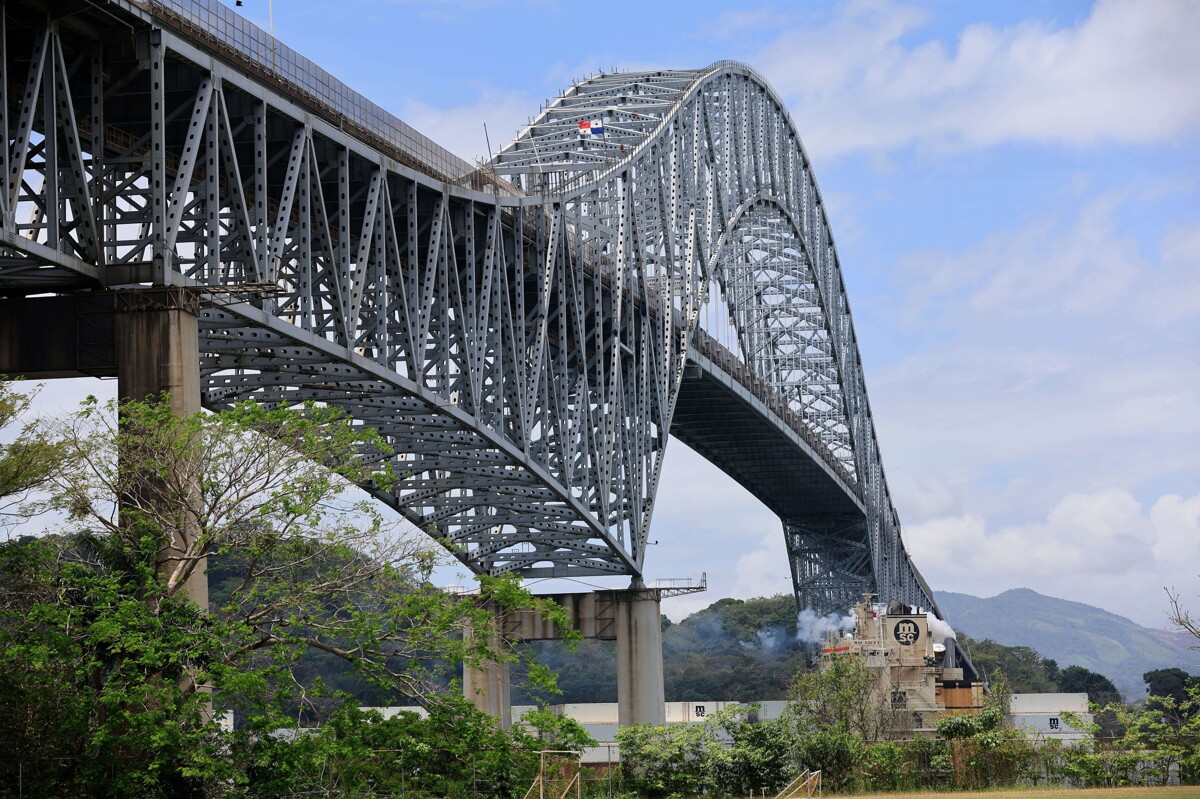
In the 1980s and 1990s, proposals for crossings across the Bay of Panama were put forward, but discarded due to their high cost and environmental impact; while tunnels under the Canal were studied, deemed unfeasible at the time for technical and financial reasons. Before the Fourth Bridge, the country accumulated announcements and deadlines that failed to materialize in steel and concrete. In the case of the West, several governments crossed over to the next, leaving behind beams, changed designs, and high costs, as if the blame could stay on the previous side of the river, generating a heavy burden for the next. Multiple journalistic sources help connect this with modern attempts to improve connectivity with this sector of the country. These changes were justified by the need to separate technical risks between the Metro and the bridge, as well as for operational and financial savings; however, the schedule was reorganized, leading to costs exceeding USD 1.8 billion and operational delays of over four years. But the saga has more chapters. In Panama, only 1 in 5 citizens reports having direct contact with bribes in public services, which confirms that corruption is not socially normalized. Every poorly decided bridge becomes a social burden, and every postponed decision reappears as a daily crisis for those of us who cross this narrow isthmus and work in the capital and its surroundings to build up Panama. Its antecedents speak of this fragility. This also tells us that the problem has not been the lack of projects, but the little ability to complete them. In a timeline, what has been said has generated a negative cumulative impact on a sector of the country that houses about 700,000 Panamanians; and of them, 80,000 vehicles. This is evidenced when we analyze the 6x5 formula; it shows a path where Panama has tried six options to connect with its West over nearly five decades, of which five were never realized and the sixth has not yet arrived. Approximately 180,000 people depend on only two bridges to enter and leave this province, which, translated into cowboy language from the West, means crossing them from 2:00 a.m. to go to work every day, almost the same as living to work. As Raúl Leis called it in his work "The City and the Poor", the centripetal effect that the magic of cities exerts on the countryside is explained because the Interoceanic Region is the main space of production and consumption under a concentrating model that operates in a country where decentralization has not yet arrived and which disperses resources instead of delivering autonomy and power at the municipal and local level. What about the managers of this type of critical infrastructure? In other words: insufficient managers, politically loyal, a very bad combination. Panama requires a kilogram of commitment and a kilogram of wisdom for the country. From a public contracting perspective, these responsibilities cannot be diluted by forming committees, administrative resolutions, arbitral awards, or a very common one, time and financial addendums. On one occasion, I heard a high-ranking state official say that he preferred a gram of loyalty to a kilogram of wisdom; here is part of the error. Thinking about how, and not about who assumes responsibility, Albert Bandura warns that it is no longer enough to deny blame to shelter under the effect of moral disconnection and not to accept failures or faults. Between 1978 and 1980, Panama announced its first major solution to connect with the West of the city of Panama: the Van Dam Bridge, contracted in 1980 along with the Panama–Arraijan highway, but suspended in 1983 after paying million-dollar advances without leaving any work. The design was modified (2023–2024), removing the monorail from the bridge for a base amount of USD 1.372 billion and a real cost for financing of USD 2.138 billion. The Fourth Bridge with integrated Metro Line 3 (2014–2018) was planned and awarded, but not executed as designed. The Fourth Bridge over the Canal, in its first reference (2010–2012), with an original contractual design in 2018 for an amount of USD 1.518 billion, included Metro Line 3 (monorail). The perception measured by expert opinion is not a linear equivalent to citizen behavior, and here there is an important ethical distinction that allows us not to criminalize ourselves as a society. What we cannot allow is that, in a minimalist country in population and extension, broken bridges —as in the kingdom of Narnia— continue to be the endless story, and as in Shakespeare, a few rise by sin while others fall by virtue. The author is a researcher and coordinator of the historical memory of the Panama Canal. The Bridge of the Americas, which had an investment for maintenance and structural rehabilitation of 600 beams for a value of USD 3 million, suffered the theft of these, only 81 were recovered, which has delayed the corrective solution for this work, recently tested with the explosion of which we are not yet sure if it has compromised its structure. Neither the live-fast value nor corruption are attributes that characterize Panamanians, nor can we call them generalized evils, because this stigma from Transparency International does not represent the majority. Although we do not analyze in this space if its action is of illegal cut or the opposite, it is worth mentioning that the legal is not always moral; if not, ask slavery. This is the story of a country where the root cause of reduced social mobility in road matters towards the west of the capital city and vice versa is widely diagnosed and questioned. But the story has memory, and it does not forget. Hopefully beautiful projects, like the extension of the Amador–Howard Coastal Strip (2010–2013), which included a fourth bridge with a railway component, did not go beyond conceptual studies. Precisely because of the "Peter Principle", administrations appoint officials at hierarchical levels that exceed them and that, in many evident cases within the public administration, reach their level of incompetence.