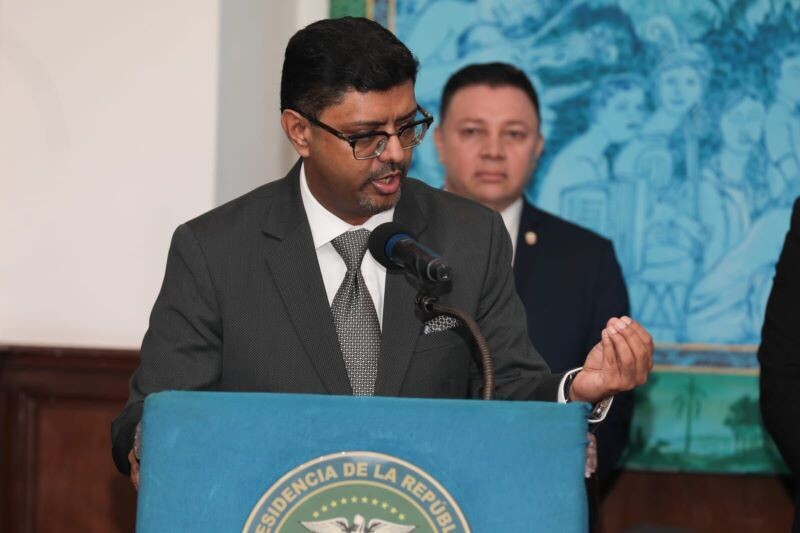
The governments of Panama and India formalized the signing of five Memoranda of Understanding (MOU) for the implementation of Rapid Impact Projects. These agreements are part of the previously agreed-upon grant assistance between the two nations, which was arranged in February of this year. The ceremonial signing took place at the Palace of Las Garzas and was attended by key figures. Representing Panama were the Minister of the Presidency, Juan Carlos Orillac, and the Secretary of National Science, Technology, and Innovation (Senacyt), Eduardo Ortega Barría. From India, Ambassador Sumit Seth was present. As honorary witnesses, Minister of Foreign Affairs Javier Martínez-Acha and the First Lady, Maricel Cohen de Mulino, participated. The First Lady, Cohen de Mulino, highlighted the social impact of the agreements, which will facilitate investment in projects for vulnerable communities. She specifically mentioned a food security and community sustainability plan in schools, emphasizing that the benefit goes beyond infrastructure and focuses on organization, food management, and child nutrition. Ambassador Sumit Seth expressed his satisfaction in signing these agreements, whose objective is to improve the daily lives of Panamanians in the sectors of health, education, technology, and infrastructure. The diplomat also reiterated the interest in strengthening bilateral relations in the future.
Ambassador Seth emphasized that India is working for a greater rapprochement with Panama, with relations based on traditions and culture. He mentioned the intention to increase trade, business, and investment in Panama, as well as to open the vast Indian market, with more than 1.4 billion inhabitants, to Panamanian companies. Additionally, he highlighted the potential to bring in artificial intelligence and semiconductor technology and to boost tourism. He indicated that the number of scholarships for talented young Panamanians has been increased from 25 to 30 this year, with the expectation of raising it to 50 or 100.
Minister Juan Carlos Orillac signed four of the five agreements. The projects, financed with financial contributions from the Government of India, will focus on infrastructure and food security. The projects include a food security and sustainability plan at the Amelia Denis de Icaza School, a similar plan at the Samaria Sinai Basic Education Center, streamlining the Santa Rita river course to reduce flooding risk, building a small vehicle bridge in the same area, and implementing a network of nine artificial intelligence and data science experimental stations through Senacyt.