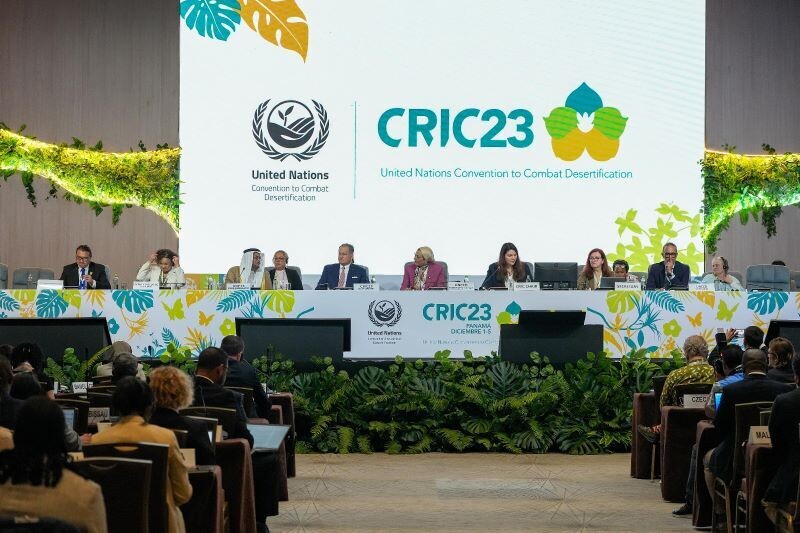
Panama hosts a UN summit to address the loss of fertile land and extreme droughts. Panama, a signatory to the UN Convention to Combat Desertification (UNCCD) since 1996, aims to achieve land degradation neutrality by 2030 and has become the first country to host the meetings of the three Rio Conventions in the same year. The loss of fertile land worldwide and the increase in extreme droughts are the central focus of the 23rd session of the Committee to Review the Implementation of the Convention (CRIC23), which brings together in Panama the 197 Parties to the United Nations Convention to Combat Desertification (UNCCD). The meeting takes place at a critical time, as two-thirds of the planet have become permanently drier due to soil deterioration over the last three decades. The recommendations that emerge from CRIC23 will be the basis for decision-making by the 196 Parties and the European Union before the next COP17 of the UNCCD, to be held in Ulaanbaatar (Mongolia) in August 2026. The Panama Pact with Nature As the host country, Panama officially presented its "Pact with Nature", a pioneering roadmap that unifies national efforts to combat land degradation, biodiversity loss, and climate change. As part of this Pact, Panama has committed to restoring 100,000 hectares of degraded ecosystems by 2035. Panama's Minister of the Environment, Juan Carlos Navarro, emphasized the economic value of conservation. The UNCCD warns that if current trends continue, by 2050, an area of 16 million square kilometers—a size almost equivalent to that of South America—will be in the process of degradation, while global demand for resources continues to rise. An Imperative for Development and Stability Yasmine Fouad, Executive Secretary of the UNCCD, emphasized the direct link between soil health and global stability. This session will also serve to debate the Convention's roadmap for the post-2030 period. During the meeting, thematic sessions on land tenure, the second meeting of the Gender Group, and the first informal dialogue on drought resilience will be held. "Investing in sustainable land management, land restoration, and nature-based solutions is not only an environmental necessity, but also an imperative for development and a strategic investment in stability, prosperity, and peace," it was stated. From Riyadh to Ulaanbaatar: UNCCD Roadmap CRIC23 aims to examine the progress made in the implementation of the decisions adopted at the 16th Conference of the Parties (COP16), held in Riyadh (Saudi Arabia) in 2024. "The resilience of our communities, economies, and ecosystems depends on the health of our land. However, we continue to degrade an area the size of Egypt every year," Fouad pointed out. The Executive Secretary highlighted that this degradation erodes the land's capacity to produce food, store water, and protect populations from extreme weather events. "Nature is the backbone of the world economy."