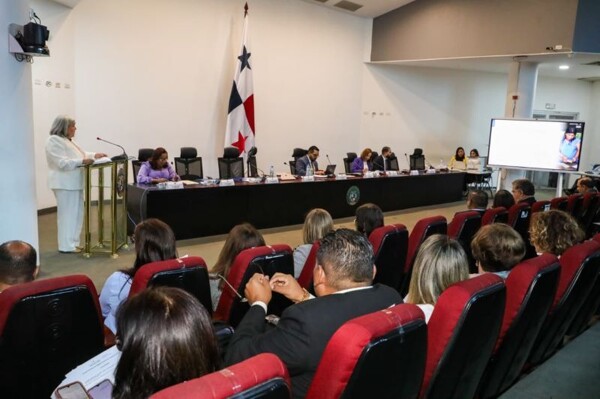
Deputy King did not stop fighting in all forums until the government agreed to change the name with which the structure was popularly known. Thelma King is remembered as a militant who never feared to fight for the equality and rights of women, and for the sovereignty of Panama in the 50s and 60s. The journalist and social activist Thelma King. Her leadership led her quickly to journalism and political activity. Velásquez pointed out that King's voice was heard with force in the halls of the Legislative Palace due to her energetic timbre. Thelma King died at the age of 72 on November 17, 1993, leaving a legacy of social struggles. As part of the activities carried out by the Panama Journalists Union (SPP) to honor outstanding women in this country, columnist Alberto “Toty” Velásquez highlighted the career of the late journalist Thelma King Harrison, who was one of the most fervent promoters of the nationalist struggle of the isthmians to achieve full sovereignty in the former Canal Zone, then tutored by the United States. Before a group of journalists gathered at the SPP headquarters, in the Ancón sector, Velásquez explained that the social fighter Thelma King, born on January 31, 1921, in the city of Panama, was one of the most singular figures in Panamanian public life. She stood out as a lawyer, journalist, teacher, and political activist. At just 16 years of age, she completed high school and subsequently trained as a teacher at the Normal School for Teachers. Her denunciations in favor of workers during the 1962 banana strike resonated strongly in local media. For this reason, she was given a prominent place among the leaders of popular sectors. In 1967, from the city of Colón, she embarked on a media campaign against the Robles-Johnson treaty project, which was finally rejected. Initially, the bridge was named Thatcher Ferry Bridge, but since its opening, the Panamanian population rejected that designation and began to call it the “Bridge of the Americas”. Her support for peasants in disputes with landowners was notable. As the only woman elected during the years 1960 to 1964, she left a mark of national vindication in the parliamentary sphere. In the years of her service as a deputy of the Republic, she firmly opposed the bridge connecting both banks of the interoceanic canal bearing the name of Thatcher Bridge, in honor of a US senator linked to the former Canal Zone. The United States inaugurated that work on October 12, 1962, at a cost close to 20 million dollars.

Deputy King: Fighting Spirit for Panamanian Sovereignty
In honor of the outstanding Panamanian journalist and politician Thelma King Harrison, who fought for national sovereignty and women's rights. Her struggle to rename the bridge to 'Bridge of the Americas' became a symbol of national dignity.