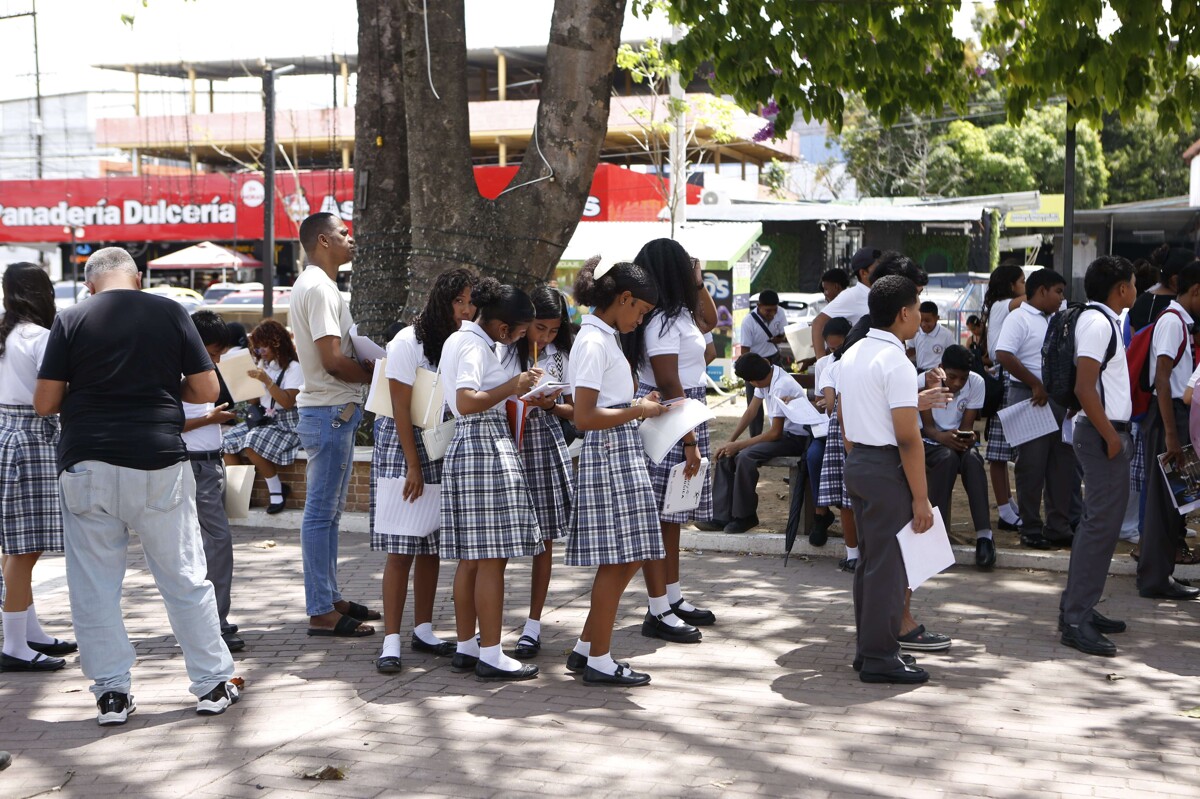
Over 2,000 students enrolled in this educational center receive their instruction through modules, as face-to-face classes were suspended last November by the Ministry of Education (Meduca) due to the poor condition of the structure where the school operated. The damage affects classrooms, furniture, and common areas, leading to a demolition order. When students had to vacate the facilities in 2025, they were promised a reconstruction that is still pending, as is the temporary solution announced for the current school year. A mother who requested anonymity stated that the modular classrooms where the children were to be located, which were to be on the field adjacent to the campus, have not been installed because they have not yet arrived in the country. At the beginning of the year, Meduca communicated that these structures would house students during the construction of the new Elena Chávez de Pinate School. Parents report that there has been disorganization since the start of the school year. Graduating students are being sent to Ernesto T. Lefevre. Among the affected students is Yessica González, a twelfth-grade student who aspires to study pharmacy in university. In this educational center, there are nine classrooms available, which will be used to prevent graduating students from continuing under the module system, a requirement recently raised by parents during a protest. Temporary Reorganization at Pinate School. The regional director of Education for Panama Centro, Mireya Pino, announced that a temporary reorganization will be implemented to ensure in-person classes while two parallel projects to improve infrastructure are underway. Pino noted that the modular classroom project is expected to be completed in approximately five months and could even be done in a shorter timeframe for subsequent delivery to the school's administration. As an immediate measure, students from seventh to eleventh grade will be attended to at the Buen Pastor School. Currently, maintenance work is being carried out at this private institution, which will be rented by Meduca, in order to complete the relocation in the coming days. The official explained that a 'transitory organization' is being carried out to divide students into two groups and assign teachers appropriately in both spaces, with the aim of guaranteeing the continuity of the educational process. Authorities aim for in-person classes at Buen Pastor to also begin next Monday, the 30th, although they acknowledge that the logistics are complex due to the redistribution of students and teachers, as well as the necessary adaptations in the receiving campuses. 'What takes priority here is the students... we have to join efforts as an educational community to be able to help them,' she expressed, reiterating the commitment to guarantee adequate conditions for learning while the definitive solutions are finalized. Some are reviewing their notes; others are completing research projects that they will later have to submit in folders as part of the study modules distributed by their teachers. They attend once a week to hand in their assignments and receive the next module for each subject. Subjects like math, sciences, social studies, geography, history, and Spanish have been studied from home. Amidst this context, on Friday, March 27, teachers, school administrators, and the Regional Directorate of Panama Centro announced, through an announcement made in the Heliodoro Patiño park, that classes will return to in-person, albeit at alternate locations. As communicated to parents, twelfth-grade students (the graduates) have been relocated to the Ernesto T. Lefevre campus, where they will begin receiving classes starting Monday, March 30. The schedule will be in the morning shift, from 7:30 a.m. to 11:00 a.m., divided into nine groups. Sitting in a park, under an unrelenting sun and without desks, dozens of graduating students from the Elena Chávez de Pinate School, located in the Juan Díaz district, write on their laps, trying to make progress on their assignments. In the park, teachers take the opportunity to explain to those who have doubts about the material. This scene has been repeating since the start of the school year. According to the young woman, the module system limits learning as it lacks direct interaction with teachers, which generates constant doubts. Her biggest fear is not having the necessary knowledge to pass a university entrance exam and not being able to study the career she wants. Other students, from seventh to eleventh grade, were lining up in the park—some accompanied by their parents—to pick up new booklets, whose delivery is scheduled for the upcoming April 6. Work to prepare the facilities will continue over the weekend. Among the pending tasks are the installation of air conditioners, adapting the electrical system, and conditioning the bathrooms, among other essential improvements. The regional director made a call to the educational community to prioritize the well-being of students over other interests.