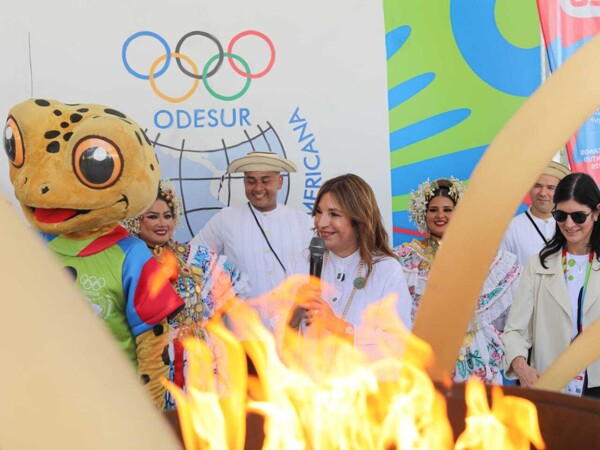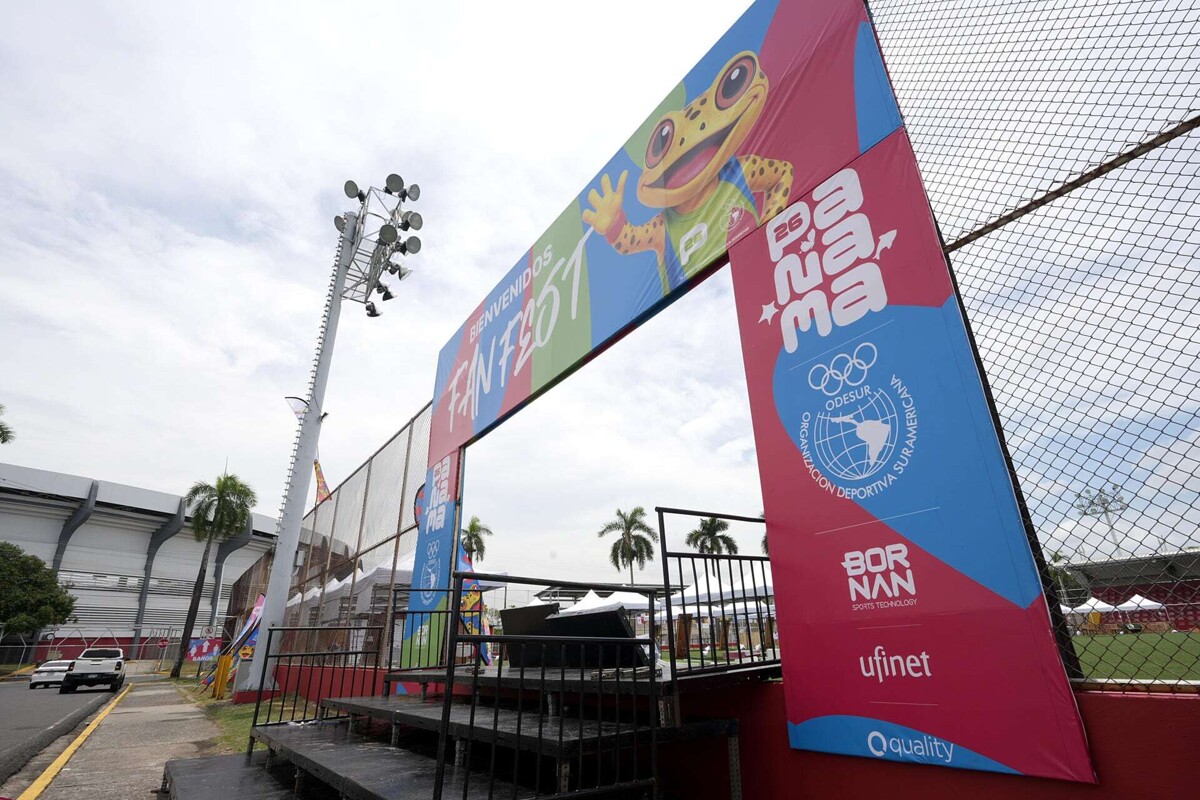
For the opening day, there will be no parking available at the Rommel Fernández Stadium, so public transport is recommended. Additionally, fans can follow the competition through the mobile app “Panama 2026,” which offers a schedule, real-time results, and details by discipline. Beyond the torch lighting, these Games serve as an organizational test. Last Thursday, the South American torch arrived in the city of Panama after traversing the national territory from Volcán, in the province of Chiriquí, to Yaviza, in Darién, on a route that sought to connect different communities with the sporting event. In terms of competition, the Panamanian delegation will be made up of 247 athletes and 81 coaches. Panama met the registration deadline on March 31st, and it will be in June that the candidacies will be formalized, before the vote of the national committees. The flag bearers will be Raúl Antadillas, in swimming, and Desirée Frías, in karate. Antadillas arrives with experience and medals in regional events, while Frías ranks as number one on the continent and second in the world in her category. Panama's historical performance in this type of competition has been discreet in terms of medal volume, but with advances in specific disciplines, which makes this edition an opportunity to measure local sports development with a large delegation and as the host country. Beyond the competition, the Games represent a bet on infrastructure. The National Government is already evaluating presenting its candidacy for the 2029 Junior Pan American Games. To the ten countries of South America, Panama joins as host, along with Aruba, Curaçao, Suriname, and Guyana. The designation of Panama as host was formalized in February 2025, after a meeting between the National Government and the South American Sports Organization (Odesur), which activated an accelerated schedule of adaptations and investments to meet the event's standards. One of the symbols of the start of the Games has already toured the country. Tonight, the Rommel Fernández Gutiérrez Stadium will mark the official opening of the IV South American Youth Games, when the cauldron that symbolizes the start of the main youth multisport event of the continent in this Olympic cycle will be lit. It will be a ceremony that will combine sport and spectacle. Puerto Rican artist Farruko will head the international lineup, accompanied by local figures such as Jonathan Chávez and Los Triunfadores, in an event that will be broadcast globally through the YouTube channel of Panam Sports. The inauguration will officially kick off Games that will bring together 2,000 athletes from 15 countries, who will compete in 23 sports between April 12th and 25th at various venues in the capital. The sports program includes disciplines such as athletics, swimming, boxing, cycling, gymnastics, judo, wrestling, taekwondo, triathlon, tennis, table tennis, football, futsal, baseball, golf, surfing, fencing, weightlifting, archery, flag football, badminton, chess, and 3x3 basketball. The multipurpose complex now hosts both basketball and a regulation futsal field of 40 meters by 20 meters, the first of its kind in the country, in addition to areas dedicated to combat sports. Other venues were also intervened. Within the specific budget for the Games, some 11 million were allocated for additional adjustments at this complex. The modifications included the construction of a warm-up pool, the installation of an electronic timing system, air conditioning of the aquatic area, new bleachers, and the redistribution of sports spaces. The High Performance Center (CAR) Luis Tejada will be formally used for the first time in an international event, after a total investment of 58 million dollars. The Emilio Royo Stadium, in the Irving Saladino Sports City, received nearly 3 million dollars in improvements to host flag football. One of the most noticeable changes is the grandstand with new seats and the lighting system, which went from less than 300 lumens to approximately 1,200 lumens. In general terms, the total cost of organizing the Games is 30 million dollars. Of that amount, around 17 million correspond to infrastructure, while the rest is distributed in logistics, equipment (3.1 million), backup energy (1.7 million), temporary structures (3.6 million), and security systems, including a monitoring center valued at about 200 thousand dollars. The projected economic impact is at least 75 million dollars, driven by the arrival of more than 6,000 visitors between athletes, officials, and companions, as well as the associated tourist movement. For the public, the organization has defined a free access model. All competitions will be free, but interested parties must register on the Panatickets digital ticket platform, obtain a QR code, and present it at the access points. Authorities have insisted on avoiding resale, especially for high-demand events like the inauguration. The transport logistics is also part of the operation. The MiBus system enabled special routes to venues such as the Coastal Strip, the Irving Saladino Sports City, and the ITSE, with extended hours from 3:00 a.m. until the early morning of the following day on some routes. The fares remain at 0.25 dollars for trunk routes and 0.75 dollars in corridors. Among the changes stands out the implementation of a robotic system for line marking, which allows adapting the field to different disciplines with technical precision, replacing manual processes. In parallel, the Fred Maduro National Tennis Center, in Llanos de Curundú, was renovated with a similar investment, also close to 3 million dollars.