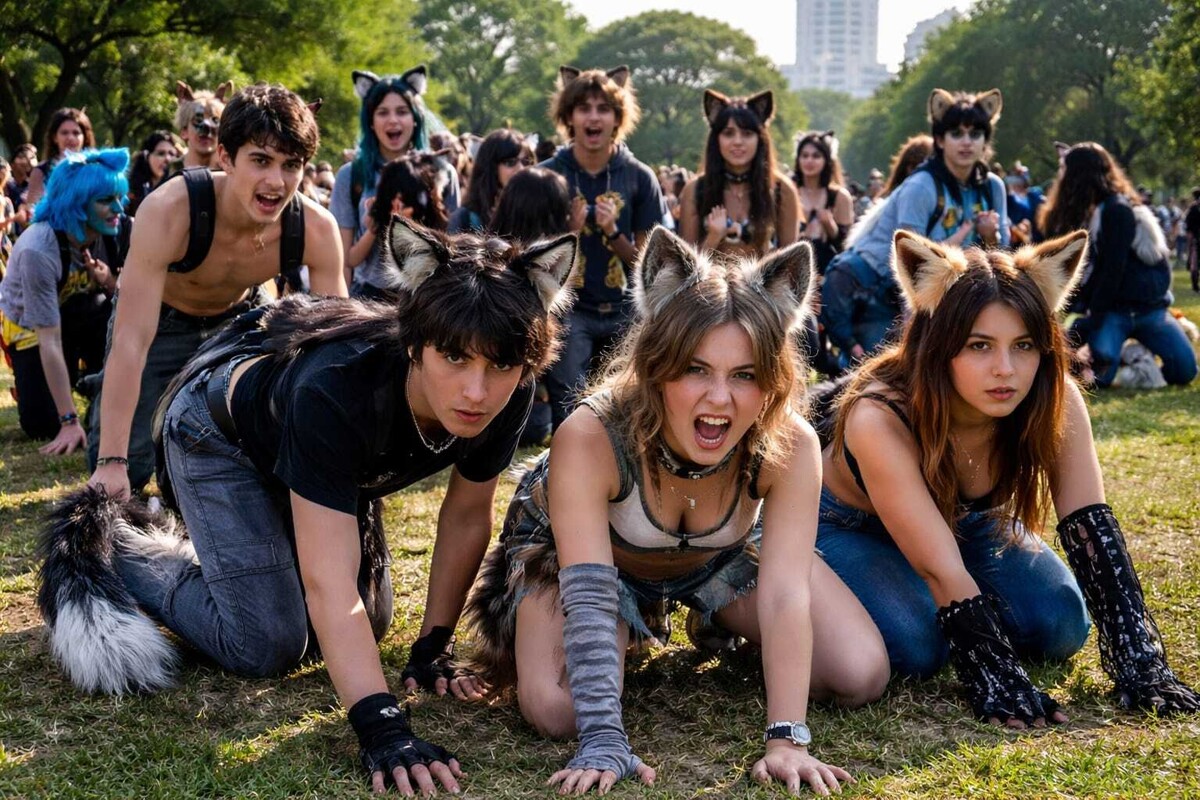
The phenomenon of young people who claim to spiritually identify with animals, known as 'therians', has moved from being a simple topic of conversation on social networks to the realm of academic analysis. Sociologist José Lasso, director of the Sociology Department at the Faculty of Humanities, emphasizes that what is happening today cannot be taken lightly. 'More and more people say they feel like dogs, cats, or have an identity distinct from the human one,' he explained. However, he clarified that the current context is different. 'This is an internal recognition, acknowledged by the individual themselves about the animal. That is to say, the person does not adopt the identity as an accessory, but affirms that it is part of them,' Lasso specified. For Lasso, this element marks a substantial difference: it is not a game or a temporary performance, but an assumed identity construction. 'In tribes and communities of the past, the relationship with the animal had an important spiritual connotation. It was part of the worldview,' he noted. He stressed that this is not simply about people who dress up. 'We are not talking about someone who puts on a costume as in the furry world. Here it is not a costume as such,' the sociologist explained. Lasso considers that this type of manifestation breaks classic personal identification patterns. 'We are on quite unknown ground as to whether this will have greater effects. There are no clear precedents beyond specific moments in history where certain identity projections were amplified,' he warned. In his opinion, the phenomenon does not necessarily immediately disrupt social coexistence, as long as the established rules are maintained. 'If the basic rules of civic coexistence are maintained, there should not be major effects,' he pointed out. Mainly because in recent years, similar phenomena associated with identities that barely a decade ago did not have such a strong exposure component have emerged. 'Although similar communities have existed on the internet since the 1990s, the phenomenon has gained notoriety in recent years thanks to digital platforms where young people share experiences, symbols, and public encounters. What used to remain in closed forums is now exposed in open spaces and generates social discussion,' he explained. The academic raised the possibility that it could be an identity projection driven by the digital environment. 'We have seen how various identities that previously did not have that visibility have appeared. The first thing to understand is that identification with animals is not a new topic,' he explained. Ancient identification, modern phenomenon. Lasso recalled that in multiple ancient cultures, there was a deep connection between humans and nature, where the animal represented spirit, strength, or collective identity. 'In tribes and communities of the past, the relationship with the animal had an important spiritual connotation. It was part of the worldview,' he said. He emphasized that it is not simply about people who dress up. 'We are not talking about someone who puts on a costume as in the furry world. Here it is not a costume as such,' the sociologist explained. Lasso considers that this type of manifestation breaks classic personal identification patterns. 'We are on quite unknown ground as to whether this will have greater effects. There are no clear precedents beyond specific moments in history where certain identity projections were amplified,' he warned. In his opinion, the phenomenon does not necessarily immediately disrupt social coexistence, as long as the established rules are maintained. 'If the basic rules of civic coexistence are maintained, there should not be major effects,' he pointed out. Mainly because in recent years, similar phenomena associated with identities that barely a decade ago did not have such a strong exposure component have emerged. 'Although similar communities have existed on the internet since the 1990s, the phenomenon has gained notoriety in recent years thanks to digital platforms where young people share experiences, symbols, and public encounters. What used to remain in closed forums is now exposed in open spaces and generates social discussion,' he explained. The academic raised the possibility that it could be an identity projection driven by the digital environment. 'We have seen how various identities that previously did not have that visibility have appeared. The first thing to understand is that identification with animals is not a new topic,' he explained. The question that remains on the table is whether we are facing a temporary trend amplified by algorithms or a deeper transformation in contemporary forms of identity. As part of that academic interest, Lasso will participate along with a full classroom of students in the meeting that the therians will hold in the coming days. 'The students will formulate questions directly to the group to understand first-hand what is behind this new form of identification. One has to listen to the protagonists and analyze the phenomenon in its own context,' he maintained.