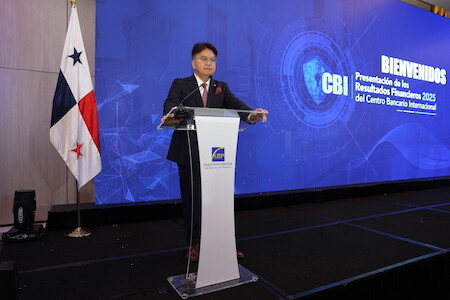
The Superintendent of Banks of Panama warned about the need to maintain a balance in the collection of bank commissions and called on financial institutions to avoid passing excessive charges on to clients, especially for services that affect segments that still depend on cash.
In a conversation with SNIP News during the event to announce the results of the banking sector in 2025, he also announced that the Superintendency is evaluating measures to limit auto financing terms, proposing that loans should not exceed six years and that those exceeding that period could require additional provisions from the banks.
"If you exaggerate with the charges, a will come when the regulator will have to get involved," Ayón said, who also questioned long-term auto loans and warned that more measures are being considered.
Interest income rose from $8,895 million in 2024 to $9,161 million in 2025, an increase of 3%, mainly driven by credit.
"Five is ideal, I will accept six."
The superintendent announced that loans exceeding that term could face additional provisioning requirements from the banks, a topic still under analysis.
"Whatever you pass me over six years, I am going to ask you to make a provision, and that does hit the results directly."
He explained that this measure could modify the behavior of financial institutions in this credit segment.
"I do believe that is going to happen."
Banking center results exceed expectations
During the conversation, Ayón also referred to the results of the banking center in 2025, which ended up being better than anticipated at the end of the year.
"Look, the 2025 results... in October, November we thought it was going to be worse than last year.
Last year it was 2,800 million; this year we thought it would be 2,700, but they went over the 3,000 million mark."
"We don't like to get involved, because we always see it as free competition, but I have already passed the message," affirmed Ayón.
Among the charges he believes should be reviewed, he mentioned some related to promotions or mortgages, and expressed concern about the possibility of charging for cash deposits.
"But yes, some banks now want to charge for cash deposits, they want to charge the customer a fee.
"Despite the NIM, which is the net interest margin, that is, the margin, which is what really dictates things," he stated.
The figures from the banking system also support what the Superintendent of Banks, Milton Ayón, said about the pressure facing the financial margin.
But something happened between November and December that results began to improve," he explained.
According to him, a decrease in the banking system's profits was initially expected.
"If you are using cash, it is for that reason, not because you don't want to use electronic banking."
Pressure on financial results
The high collection of commissions could be linked to the pressure that banking institutions face, as seen in the results, even though the banks made a profit.
Loan income rose 4.6%, from $6,755 million to $7,063 million.
Other income grew 7.9%, rising from $3,402 million to $3,669 million.
The regulator also addressed the growing weight of commissions within bank income.
Commissions and bank charges
Ayón pointed out that, under pressure on the net interest margin (NIM), some entities have resorted to increasing other charges to sustain their income, a trend about which the regulator has already expressed concern.
"They have looked for ways to make other charges, but that's why I already told them... Let's seek a balance, don't exaggerate with the charges," he said.
The superintendent warned that if entities exaggerate with this type of charge, the regulator might be forced to intervene, something he said he prefers to avoid in favor of competition.
"If you exaggerate with the charges, a will come when the regulator will have to get involved.
Within that category, commissions stand out, which increased by 10.1%, from $1,292 million to $1,423 million, a rate more than three times higher than the growth of interest income.
Banking center results exceed expectations
The superintendent noted that this result occurred despite pressure on the net interest margin (NIM), an indicator that measures the difference between what banks pay for deposits and what they charge for loans.
"For me, those loans should be a maximum of six years; five is ideal."
The traditional interest business grew, but at a moderate pace.
However, the cost of attracting resources continued to rise: paid interest grew 5.1%, from $5,022 million to $5,276 million, which led to net interest income barely growing, going from $3,466 million to $3,453 million, a slight decrease of 0.4%.
In parallel, the figures show that banks have compensated for that pressure by increasing income through other channels, in line with what Ayón mentioned about the greater weight of commissions and charges.
This behavior reflects a greater weight of services and charges within the income structure of the banking system.
Auto financing terms under review
Another topic addressed was the duration of some consumer loans, particularly auto financings, whose terms the regulator considers excessive in some cases.
Ayón indicated that the Superintendency of Banks has already begun to demand higher capitalization levels from entities and that now the focus could be on the duration of these loans.
"For me, loans over so many years, which I think should be a maximum of six years, should not be financed.
That is not right.
I think it is not right, I have already told them so."
Ayón explained that those who use cash usually belong to segments that still rely on this means of payment due to the nature of their activities.
"The one who uses cash is still a segment of the population that needs it the most."