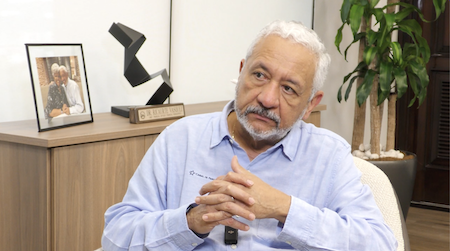
The Panama Canal is closely monitoring the effects the situation in the Middle East could have on international maritime trade, although the impact for the Canal will depend mainly on the duration of the conflict and how shipping companies react to changes in costs and routes. There could be larger ships and more transshipment. One of the possible scenarios is that the Panama route increases in value by being shorter and more reliable. In an exclusive interview with SNIP Noticias, the administrator of the Panama Canal, Ricaurte Vásquez, explained how the interoceanic route is reading this situation and that the effects on global trade can manifest at different levels and do not necessarily imply a direct increase in transit through the interoceanic route. "If the conflict ends relatively quickly and things normalize within the first three weeks or the first month, the impact is much smaller," he explained. When fuel prices rise, shorter routes become more valuable for shipping companies, which can influence their logistical decisions. "As crude and fuel prices rise, shipping costs are higher, and if the Panama route is shorter, it becomes a more attractive route," he said. This adjustment would not necessarily translate into more transits, but into changes in how cargo is moved. This, according to the administrator, "does not necessarily increase the number of transits, but increase the size of the ship, which for the Panama Canal represents a marginal income, because we charge by the size of the ship." He explained that this could also involve container repositioning or adjustments in service routes. Part of these logistical decisions may also involve transshipment operations at Panama's port terminals, as part of optimizing shipping companies' routes. The administrator also noted that one of the segments where greater movement could be seen is liquefied natural gas (LNG). According to Vásquez, shipping companies could opt to assign larger ships or reorganize container distribution. What could be affected are three things: cargo, manufacturing, and container repositioning, which instead of going by the longer route, will come by the Panama route, and in that case it is very likely that what the shipping company will do is assign a larger ship. However, he warned that if the situation prolongs, "then it is possible that there will be a reassignment of routes." Vásquez explained that the Canal is not part of the main oil route affected by the situation in the Middle East, so the direct impact on that segment would be limited. "We are really not on the oil route that is being affected in the Middle East," he indicated. The most relevant effect could come indirectly through the costs of maritime transport. "The volume of traffic through the Panama Canal in terms of oil is low. If the supply from the Middle East to Asia is affected, that market could be supplied more from the United States. "Then the United States would have to supply that market and having a short route becomes more important," he explained. Even so, Vásquez insisted that the behavior of trade will depend on how the geopolitical situation evolves and the decisions shipping companies make in the coming weeks. "One thing is if it is short-term, another thing is if it is a situation that is maintained for a long time," he affirmed. The Panama Canal, he added, maintains constant monitoring of maritime trade movements to detect changes in routes or fleet allocation. "We see who passed, who didn't pass, what cargo, what ships. We try to make intelligent use of that information," he indicated. Regarding operational capacity, Vásquez noted that the system remains reliable from a hydraulic point of view, although the market usually adjusts more by the size of the ships than by the number of transits. "In the case of containers, where there is more flexibility, they simply send a slightly larger ship," he explained. "It is simply a disturbance in the market of a temporary nature that readjusts to a new reality," he pointed out.