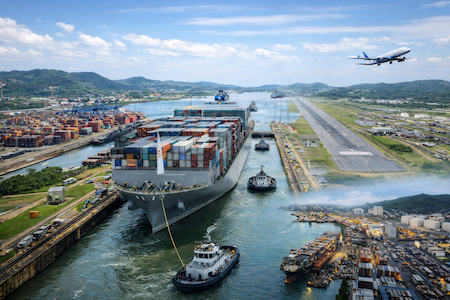
Historically, many operations in Panama have relied on fixed-rate agreements that are now unsustainable due to war surcharges and diversions imposed by shipping lines. It is vital for the logistics business to evolve towards greater flexibility, incorporating contingency clauses that allow for the transparent transfer of extraordinary costs. By digitizing processes and reducing administrative bureaucracy, Panama can present itself to the world as a hub of efficiency capable of mitigating the effects of any external crisis. Ultimately, the sector's success will depend on our ability to stop being simple observers of transit and become intelligent risk managers, leveraging every piece of infrastructure to provide certainty in stormy times. The author is the president of the Business Logistics Council (COEL). The opinions expressed in this article are the sole responsibility of the author. This is the ideal juncture to capture flows that previously preferred the Suez Canal, positioning Panama not just as a geographical shortcut, but as an ally that guarantees cargo integrity and crew safety. While other sea lanes are threatened by military conflicts, our canal is projected as a safe and stable passage for international trade. The geopolitical instability in the Middle East, marked by tensions in the Red Sea and the Strait of Hormuz, has ceased to be a distant conflict and has become a determining factor in world trade. For the logistics sector in Panama, this scenario represents not just an operational challenge, but a test of resilience and a unique opportunity to reaffirm our position as the heart of the Americas. Faced with massive delays on traditional maritime routes, our free zones and distribution centers can transform into the secure warehouses for Latin America. Likewise, there is an urgent need to elevate the culture of cargo insurance in the country; understanding that standard policies often exclude war risks and delays is fundamental to avoid asset losses that could jeopardize the continuity of local companies. On the other hand, operational risk management must be much more rigorous. In this context, the sector must be prepared with solid legal protocols and impeccable documentation that allows for managing these incidents without incurring third-party debts for storage or delays. Transparency in communication with end customers becomes the most valuable asset here: whoever can clearly explain the risks and anticipate route changes will be the one to maintain confidence in a market saturated with doubts. Panama as a world stability alternative. Despite these challenges, the crisis in the Middle East highlights Panama's competitive value as a low geopolitical risk route. Our institutional and physical stability is, today more than ever, an export product. The Multimodal Hub as the region's 'Plan B'. The true opportunity for the Panamanian Hub lies in its ability to offer integral solutions that go beyond transit through the Canal. Instead of relying on direct shipments from Asia that take months to arrive, regional companies can find in Panama a strategic inventory ready for distribution. This advantage is powered by our air connectivity. What happens in the Suez Canal directly impacts the rhythm of our Canal and the efficiency of our port system, forcing all supply chain actors to rethink their security and profitability strategies. Operational shield against uncertainty. In this context of volatility, the sector's first task is to strengthen its contractual and financial response capacity. The global increase in freight rates increases the likelihood that low-margin goods will be abandoned in our ports as they cannot cover the accumulated costs. The ability to combine maritime and air transport through Tocumen allows for offering urgent alternatives that very few countries can replicate. These cannot be considered as a position of this medium.