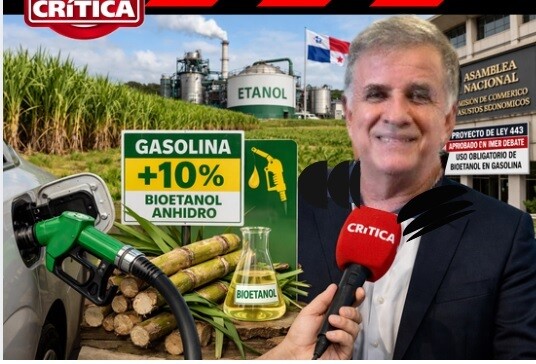
Panama spends over 120 million dollars on gasoline, a figure that could be kept within the country with the bioethanol blend in Panama, as proposed by the project. Likewise, it was warned that for the plan to work, clear state regulation and integration of the productive sector are required. The Commerce and Economic Affairs Commission of the National Assembly approved in its first debate bill 443, which establishes that all gasoline sold in the country must contain 10% of anhydrous bioethanol, a vegetable additive used as an oxygenate. During the debate, businessman David Virzi stepped in to counter criticisms and defended the initiative, stating that it could represent an opportunity for the interior of the country, especially for the agricultural sector. Virzi indicated that if the law is properly structured, it does not have to benefit some and harm others. The businessman considers that a well-made law can become a tool to support the most vulnerable classes by promoting ethanol in Panama. The proposal comes after the elimination of the corn subsidy, which has left land unused. According to his explanation, this land can be destined for the production of ethanol, a biodegradable product that would also be more economical for the consumer, with a difference of up to 50 cents compared to the current dollar cost. Another point he highlighted is the country's dependence on imported fuel. He indicated that this sector currently represents only 3.5% to 5% of the economy, but 30% of the population depends on it, which shows the existing inequality. Virzi also responded to the statements by deputy Alexandra Brenes, of the Vamos bloc, who asks to eliminate the mandatory nature of the measure. He added that an investment of close to 400 million dollars would be needed, including the planting of cane and the construction of plants, which would generate jobs for professionals such as engineers and all the Panamanian workforce. Virzi insisted that the mandatory character of ethanol use is key to attracting investment, as it would guarantee a domestic market and help stop capital flight. The discussion now moves to the plenary, amid conflicting positions.