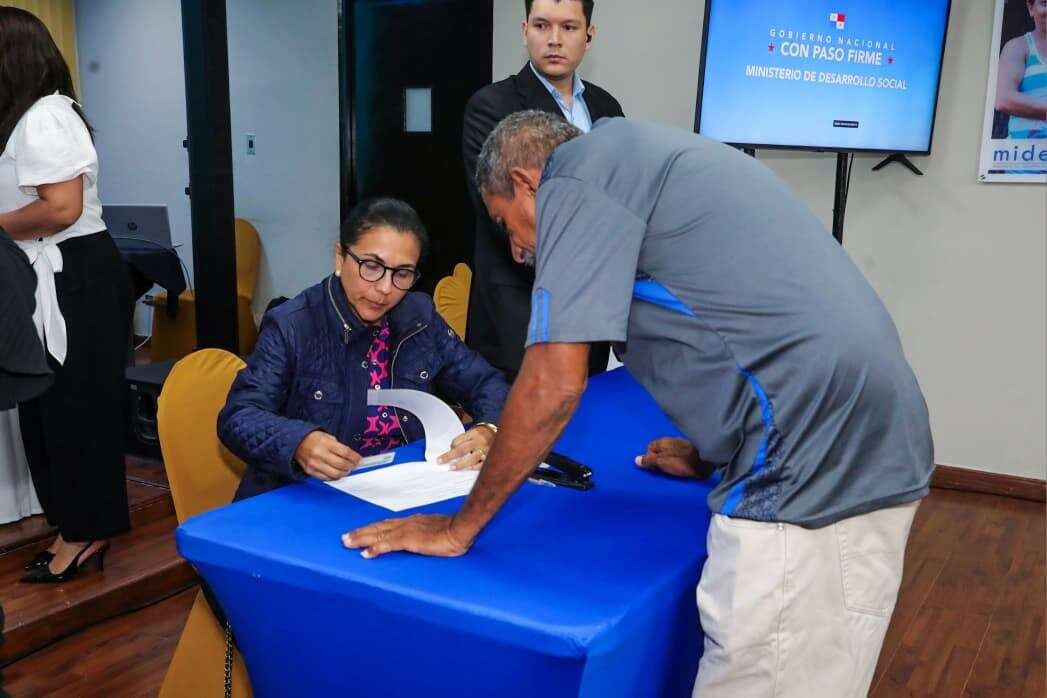
Throughout this period, the annual amounts show variations that reflect adjustments in the transfer policy aimed at vulnerable populations. In 2019, the program had $231.2 million. 'Of course, and that's exactly it... we have a finite resource, and that's what allows us to include people who actually meet all the requirements,' she stated, emphasizing that the cleanup aims to ensure that funds effectively reach those who qualify for the programs. Business groups, such as the Chamber of Commerce, Industries, and Agriculture of Panama, have insisted over the years on the need to rethink the state subsidy scheme, proposing a thorough review that would improve targeting and reduce its scope. 'We have already cleaned up 85% of the registry, with all the information required for each beneficiary, and we are continuing in that process,' she explained, while highlighting that the technical team has deployed field visits to directly verify the conditions of those receiving state aid. The official also confirmed that this process has led to the exclusion of people who did not meet the requirements. These are faces that enter and leave the lists, in a dynamic that accompanies the system's changes and redefines, year after year, who remains within that circle of state support. Disorder and the cleanup. Upon taking office, the Minister of Social Development, Beatriz Carles de Arango, indicated that of the approximately 191,000 registered in these programs, about 100,000 did not have a socioeconomic study certifying their eligibility to receive this aid. In fact, the minister acknowledged that at the beginning of the current administration, conditional cash transfer programs operated with significant gaps in beneficiary information, which limited the verification of eligibility criteria. 'Since we arrived, we found a lack of information. In 2019, around 200,000 people were part of these programs; today, the figure is around 191,000. More than half of our beneficiaries had no type of record certifying their eligibility for the programs,' she stated. Faced with this scenario, the entity initiated a process of data cleansing and updating that, according to the minister, has already reached significant progress. The following year, the amount stood at $230.5 million, and in 2021 it reached $227.5 million. For 2022, the budget was set at $224.2 million, marking a contained pace without surprises in resource allocation. In 2023, $225.4 million was allocated, followed by $223.7 million in 2024, in an oscillation that remains within narrow margins, without breaking the period's inertia. For 2025, the projection sets the allocation at $217.6 million. What for years was a persistent rumor came to light this week, when the Ministry of Social Development (Mides) recognized that people who do not meet vulnerability and eligibility criteria are benefiting from transfer programs. A data cross-check between Mides and the Transit and Land Transport Authority (ATTT) revealed that 8,010 beneficiaries of the Conditional Cash Transfer Programs have some vehicle registration: 7,976 with vehicle plates and 205 with public transport slots, which activated a review process. According to official criteria, owning a transport slot is a direct cause for exclusion, as it is a proven source of income, while vehicle plate ownership serves as a referential indicator that does not imply automatic removal from the program but does open the door for a review. Annual allocation. Amid this new finding, a fundamental question arises: how much do the country's cash transfer programs, such as Ángel Guardián, 120 a los 65, Red de Oportunidades, and the food bonus, cost the country each year? Between 2019 and 2025, these transfers accumulated a total allocation of $1,580.1 million, evidencing the continuity of this mechanism within state social spending. From their perspective, the current model not only presents flaws in resource allocation but also exerts increasing pressure on public finances. The private sector warns that current subsidy levels are difficult to sustain over time and end up configuring a significant burden for state spending. These figures, rather than speaking of ruptures, draw a continuous trajectory, a way of sustaining the program over time while adjusting its limits and scope. In parallel, the number of beneficiaries also has its own story.