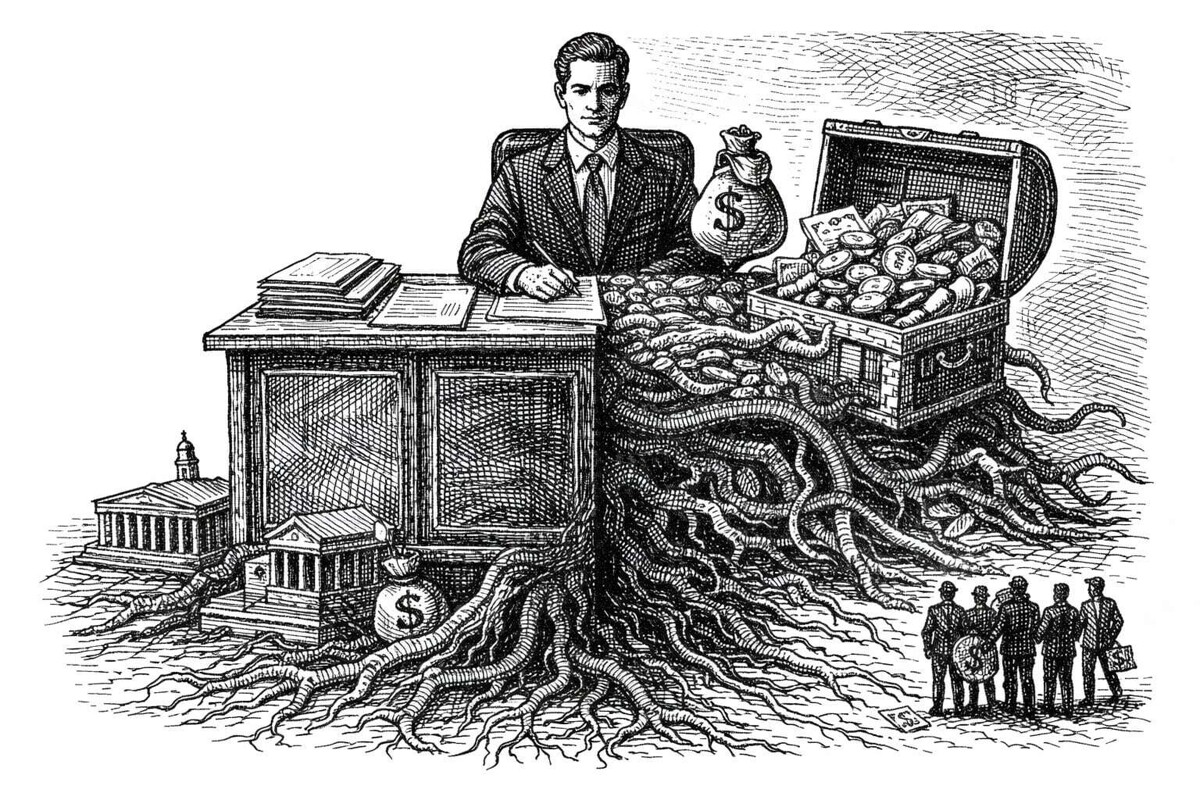
When operating outside formal rules, patrimonialism is reinforced through opacity and discretion, demonstrating that it is not an archaic form of government, but a persistent and adaptive pattern. In this line, Francis Fukuyama, in 'Political Order and Political Decay,' explains that economic growth and institutional modernization do not guarantee the overcoming of patrimonial practices. When political power becomes a means to obtain economic advantages, that separation is broken and forms of unjust domination are generated. The one who wields power needs clear limits that his team remembers and respects; he must flee flattery and approach those who keep him grounded, willing to dissent and aware that politics is a public service, not a means to serve oneself. Panamanians have lived under a political class that oscillates between consolidated plutocracy and endemic patrimonialism, a reality so frequent that it is sometimes confused with the business success of the rulers in power. The entrepreneur who creates employment through his effort should not be equated with the one who prospers thanks to a public office, without ethics or scruples. Authority is legitimized by tradition and by ties of personal loyalty, more than by the impersonal and rational norms of the modern State. Neopatrimonialism adapts this scheme to contemporary contexts where formal institutions—elections, constitutions, and bureaucracies—coexist with informal networks of patronage. In these regimes, power is concentrated in personalist figures, norms are applied selectively, and institutions are instrumentalized to sustain clientele. It is not a transient anomaly, but a form of power organization that adapts and persists even in formal democracies. From normative political theory, Michael Walzer, in 'Spheres of Justice,' provides an essential key to understanding this distortion. That centrality turns decisions about infrastructure and concessions into critical points where political and economic interests converge, which can drive development or, on the contrary, reproduce clientelistic networks. Recent conflicts over strategic concessions and judicial processes for alleged illicit enrichment have evidenced the fragility of transparency mechanisms when rules are applied selectively. Many States can grow while maintaining power structures captured by political and economic elites, especially when control mechanisms do not evolve at the same pace as the economy. Civil society and the media have been key to making these tensions visible, but, without independent institutions, protection for whistleblowers, and impartial investigations, anti-corruption initiatives run the risk of becoming political control instruments. Breaking these dynamics requires clearly separating the public from the private, professionalizing administration through meritocratic criteria, strengthening oversight bodies, and guaranteeing effective transparency in the management of strategic resources. In these cases, corruption and clientelism are not anomalies, but symptoms of an incomplete political order, where institutions exist but lack real autonomy. Panama combines strategic advantages—its geographical position, the Canal, and a developed logistics and financial sector—with institutional vulnerabilities. Understanding patrimonialism and its contemporary manifestations is essential to strengthen the rule of law and ensure that Panama's advantages translate into inclusive and sustainable development, and not into the perpetuation of power networks that limit competition, innovation, and justice. The author is a lawyer, teacher, and doctor of law. Each social sphere—politics, the economy, or justice—should be governed by its own criteria and not be colonized by alien logics. This confusion is not only moral but also structural, and it directly affects the quality of democracy and the rule of law. Patrimonialism, a classic concept developed by Max Weber, describes a way of exercising power as an extension of the ruler's personal patrimony. In politics, a ruler must surround himself with people more prepared and capable than he is: professionals with solid training, intelligence, and, above all, with the courage to express opposing opinions when appropriate. It is not about accumulating uncritical backing, but about summoning sincere and well-founded voices. In this model, the State and public administration are confused with the leader's private sphere, and public resources are managed as personal goods. This perspective allows for a clear distinction between the entrepreneur who prospers through innovation and competition, and the one who uses the public office as a lever for personal enrichment, emptying the public function of its content. Informality, far from being a simple organizational defect, can become a deliberate strategy for power reproduction.