Artists and set designers often collaborate with scientists to ensure accuracy while maintaining visual appeal. This balance between science and creativity makes inflatable planets a powerful storytelling medium; they can educate, inspire, and entertain all at once.
Connecting People to the Cosmos There’s a universal fascination with looking up at the night sky, and inflatable planets tap into that sense of wonder. These large-scale, air-filled replicas of celestial bodies have become an increasingly popular feature in both educational and entertainment settings, blending scientific accuracy with artistic design to create experiences that capture the imagination.
The Art and Science Behind Inflatable Planet Design Creating a realistic inflatable planet requires more than just a printed sphere. Designers carefully combine art, data, and engineering to capture the distinctive look of each celestial body. High-resolution imagery from space agencies is often used to map the surface features of planets, moons, and stars. These images are then digitally stitched to create a seamless 3D effect that wraps around the inflatable’s surface. The result is an accurate representation that can range from a classroom-sized globe to an enormous outdoor installation.
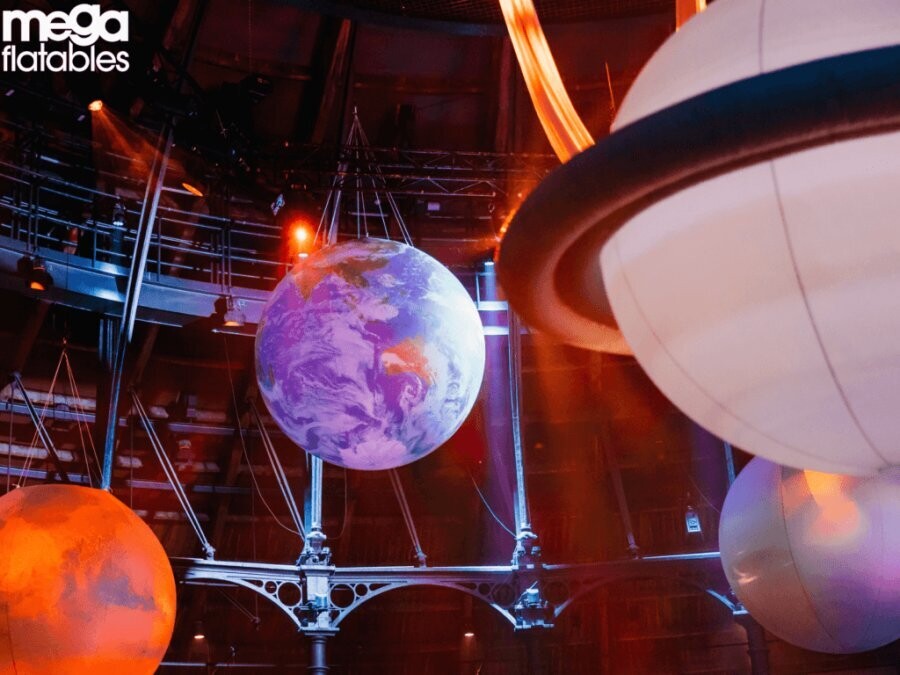
A Visual Statement at Public Events Beyond the classroom, inflatable planets have become a striking feature at public events, festivals, and exhibitions. Their sheer size and visual appeal make them ideal for attracting attention and setting a theme. At outdoor events, a glowing inflatable moon or Earth can create a surreal, atmospheric effect after dark. They bridge the gap between distant science and everyday experience, making space feel a little closer to home.
A New Era of Space Education In educational contexts, inflatable planets have transformed how astronomy is taught. Rather than relying solely on textbooks or static models, teachers and science communicators can now offer interactive, full-scale demonstrations that immerse students in the solar system. A large inflatable Earth, for example, can help students visualize geography, climate zones, and ecosystems. Meanwhile, models of Mars or Saturn allow lessons about planetary formation, surface composition, and space exploration to feel immediate and tactile. When combined with projection systems or augmented reality tools, these inflatables create immersive environments where learners can “travel” through space without leaving the classroom.
Customization and Creativity in Design One of the biggest advantages of inflatable planets is their flexibility. Designers can scale them from small handheld models for children to massive spheres suspended in concert venues or museums. They can also be customized with specific lighting effects, transparent panels, or even motion elements that make them rotate gently. Some designs feature multiple planets displayed together to recreate the solar system, while others focus on a single celestial body for dramatic impact.
The Future of Inflatable Space Displays As technology advances, inflatable planet designs are becoming more sophisticated. Interactive lighting, motion sensors, and digital projections are turning these displays into fully immersive experiences. Future iterations could blend physical inflatables with virtual elements, creating hybrid environments that simulate travel through space.
Connecting with Culture and Art In the entertainment world, inflatable planets also tie into broader creative trends, from immersive art installations to eco-conscious festivals. In art galleries, festivals, and classrooms alike, inflatable planets encourage people to pause, look closer, and appreciate the scale of the cosmos. They blend education, aesthetics, and emotion, turning any space into an environment that feels otherworldly yet connected to our shared curiosity about the cosmos.
What began as a niche educational tool has evolved into a versatile medium for communication, creativity, and cultural expression. Inflatable planets remind us that learning about space doesn’t have to be confined to books or telescopes; sometimes, it can be as simple as standing beneath a glowing globe that mirrors the world we live on, or the ones we dream of reaching someday. Whether in a science lab, a city square, or a festival field, inflatable planets continue to prove that the intersection of knowledge and imagination is where the magic truly happens.