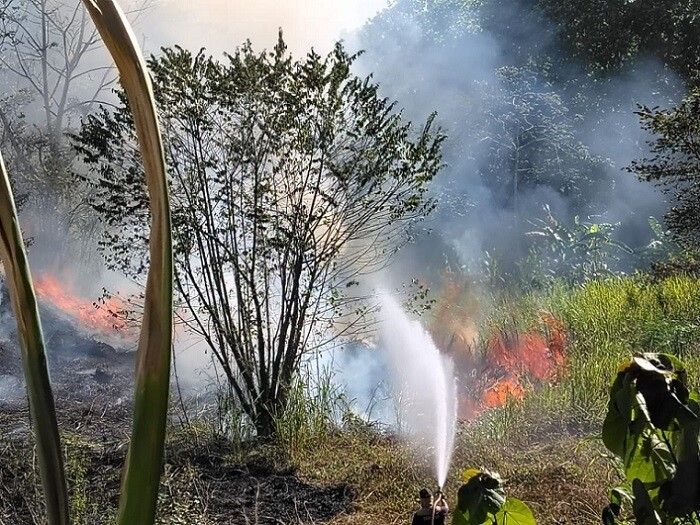
Dry stubble and grasses become a latent danger that facilitates the rapid spread of fire. Specialists explain that fires not only devour vegetation but also test the endurance of forest firefighters. The combination of high temperatures, dry vegetation, and extensive terrain increases the risk that flames will reach residential areas, turning into structural fires. While nature provides the conditions, the human hand is the protagonist in the tragedy. The units are equipped with forest backpacks, fire beaters, pulaskis (a tool that combines an axe and a hoe in one head), machetes, blowers, chainsaws, and communication systems to face the emergency. The institution insists that the population must act responsibly. "Fire often does not arise alone; someone provokes it," they emphasize. You might be interested: Alarming statistics: A vegetation fire is reported every 2 hours March 01, 2026 Hitmen attack and kill a man in Alto de Los Lagos March 01, 2026 No trace of missing minor Ñürün: Sinaproc suspends operation March 01, 2026 Tragedy: minor dies in bull riding in Herrera March 01, 2026 No leads on the murder of a digital platform driver March 01, 2026 The Fire Department announced that it has reinforced its strategy with training, drills, and specialized equipment. A significant part of the fires are of anthropic origin, that is, uncontrolled burns, carelessness, and inadequate agricultural practices. "Most of these fires can be prevented," firefighters reiterate, reaffirming their commitment to saving lives, protecting property, and preserving the environment. Panama - Every two hours, at some point in Panamanian territory, a new vegetation fire occurs, according to statistics from the Honorable Fire Corps, which highlight that in just the first 59 days of this year, they have attended to more than 750 emergencies of this type. Of this total, 594 have occurred in remains of dry stalks and leaves (stubble) left on the ground, and 156 in areas with herbaceous, occasionally woody plants, known as grasses, which become the perfect fuel for a fire during the dry season and scorching heat. These figures reflect the magnitude of the problem: "We are talking about an emergency every two hours, which implies a permanent deployment of our specialized units throughout the country," explained Major Andrés Espinosa, national head of the Emergency and Communication Department of the National Directorate of Operations for Extinction, Search, and Rescue. In turn, Major Jorge Carreño, of the National Directorate of Consequent Calamities, detailed the nature of the material that feeds the flames: "Fuel is any material capable of burning: dry vegetation, leaves, branches, grass, and agricultural waste. In January, a drill was held at the Tanara Fair, Chepo, and in February another in Tierras Altas, Chiriquí, with inter-institutional participation. Many occur in corrals and hard-to-reach slopes, where the movement of personnel and equipment requires extreme physical effort and specialized strategies."