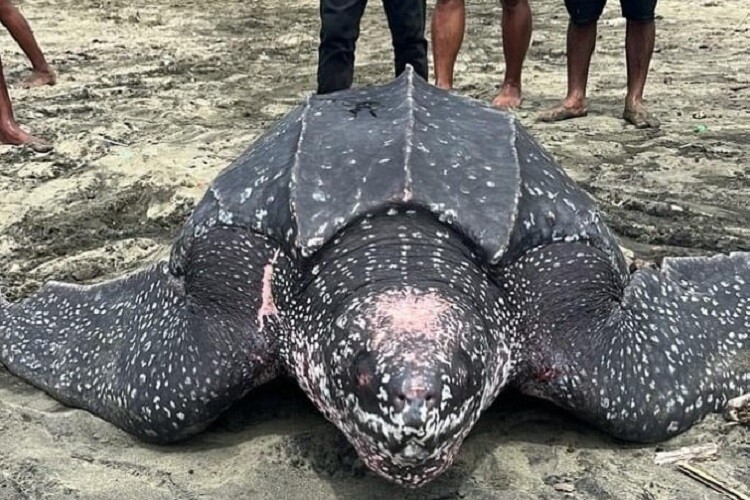
Residents of the Piña community, located in the Chagres district on the Abajo Coast of Colón province, found a leatherback turtle on the town's beach this weekend. Apparently, the turtle came ashore to lay eggs in the early morning, and upon returning to the beach, it became disoriented and headed towards the mouth of the Piña River. According to information provided, some residents were cleaning the beach from sargassum when they saw the reptile and proceeded to help it return to the sea. Octavio Ortiz, a biologist from the Coasts and Seas section of the Regional Directorate of the Ministry of Environment (MiAmbiente) in Colón province, reported that the observed event was likely a failed nesting attempt, a behavior documented in sea turtles during the oviposition phase. Ortiz added that the female did not manage to lay eggs, which can occur for multiple factors associated with the selection of nesting habitats. The most common causes are the presence of humans, predators, or artificial lighting, as well as inadequate physical-environmental conditions of the substrate, which is perceived as a risk by these marine animals. The official also explained that, as part of the conservation strategy, various environmental education campaigns have been carried out to guide residents on how to act in these types of cases. 'Sensitization workshops have been developed in conjunction with Community-Based Organizations (OBC) in the region to expand knowledge and empower residents on the importance of conserving their community's ecosystems,' expressed Ortiz. It was detailed that this species of sea turtle is one of the largest in the world, reaching up to 2.5 meters and 900 kg. It is characterized by its leathery shell instead of a hard one, is in critical danger of extinction, and nests mainly in the Caribbean.