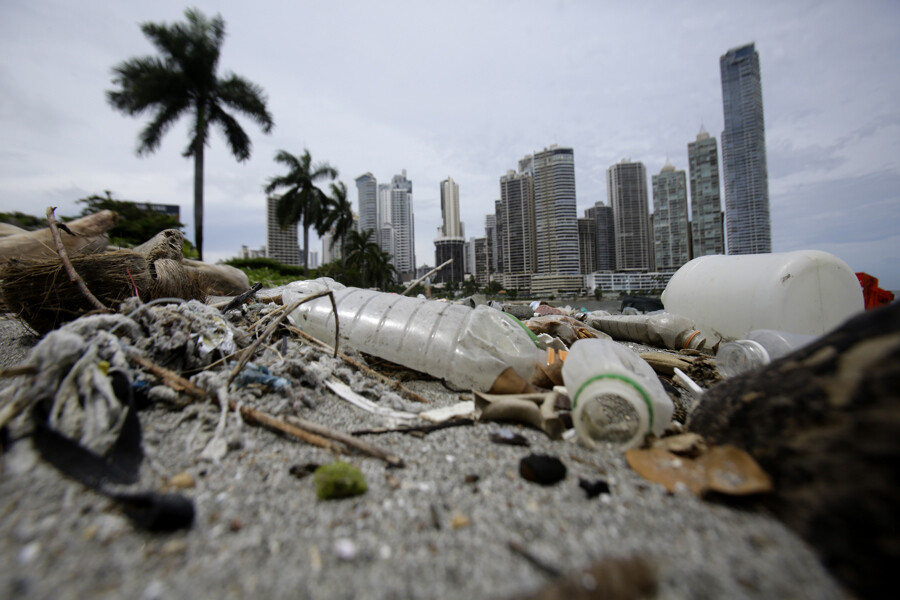
COP30 has the challenge of devising solutions to reduce plastic pollution, a material 'demonized' in the environmental context that should, instead, be addressed as an 'optimal and recyclable' element, according to some experts.
Achieving a global Plastics Treaty remains a pending task for various governments, which have spent the last three years trying to agree on formulas to combat plastic pollution. Differing views on the issue became evident during the last round of negotiations held in Geneva in August, where no progress was made due to pressure from oil-producing countries and powers like China, reluctant to include cuts in the production of this material or lists of prohibited products.
Experts in the sector believe this COP30 could be an opportunity to steer the talks towards forging an agreement to regulate the plastic chain—most of which is made from fossil fuels with their consequent greenhouse gas emissions.
An 'Optimal' Element The managing director of Cartonplast Iberia—a manufacturer of reusable transport packaging—José María Carrasco, believes there is a 'demonization of plastic in general' and tells EFE he would like this issue to be addressed at COP30 'in a more academic and professional manner'. According to him, that material should be seen 'as an option, as long as it is a reusable and recyclable element, and always as long as it is associated with the concept of 'ecodesign', within a shared, closed model. We must achieve that recycled materials are attractive in a sector with many challenges'.
Isabel Abascal, founder of Compostree—a manufacturer of tree and shrub protectors made from 100 percent compostable materials based on agro-industry waste—tells EFE it is 'urgent to put on the table the problem of the use of plastics in nurseries and rural areas, in crops'. A finalist in the 'Ideation' category at the Women Start up Awards 2025, Abascal hopes that countries 'will propose measures to combat its use, just as has been done with microplastics, in transport, or with the use of straws or in packaging, and that biodegradable solutions will be favored'. Her company, where 'coherence and responsibility with the environment' are paramount, aims to 'reduce plastics in nature' although she does not want to 'demonize the sector'. Instead of that, 'there are a lack of measures, alternatives or research into more sustainable materials with a longer-term vision, not short-term'.
Skepticism towards COP Meanwhile, the Pamplona native Amaia Rodríguez, managing director and co-founder of the company Gravity Wave, wonders 'if it is really possible to substitute virgin materials and stop extracting resources to use materials that are already produced'. This entrepreneur, who has removed over a million kilos of plastic from the Mediterranean to transform them into sustainable materials, detects 'a very big gap between the prices of virgin materials, with all the interests behind it, which is almost impossible to compete with those giants' compared to recycled materials. Ahead of the summit, Rodríguez trusts—she tells EFE—'that a change will begin to be seen in the system we currently have, of not only penalizing companies that do things wrong and pollute, but also to start subsidizing, rewarding those who want to do it well'.
But to this day, she considers it 'really impossible' to achieve objectives such as the one the European Union aims for by 2030: to ensure that all plastics are recyclable and that 55% is recycled. 'There is always such a big gap between what Europe wants and what reaches the businesses'.