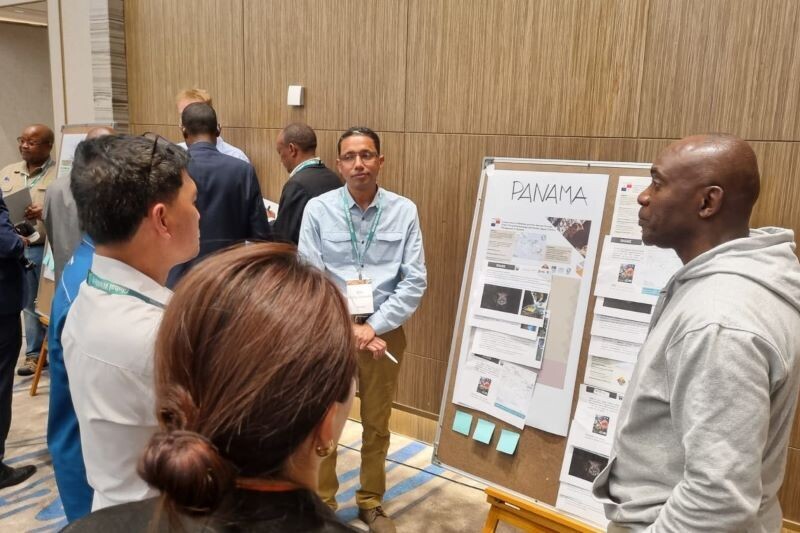
Panama's Ministry of the Environment (MiAMBIENTE) and the Yaguará Panamá Foundation participated in the Annual Meeting of the Global Wildlife Programme (GWP 2025), held in Addis Ababa, Ethiopia. The event brought together delegations from over 38 countries to exchange experiences on biodiversity conservation, natural resource management, and reducing human-wildlife conflict. During the international event, Panama presented detailed results of the National Jaguar and Terrestrial Mammals Census. Preliminary estimates indicate a jaguar density of 370, along with the abundance of other wild cat species and mammals such as the giant anteater, tapirs, and peccaries. From a communication and outreach perspective, the project has reached over 9,000 people (52% women) through talks and workshops in cities and communities. The project, implemented by MiAMBIENTE and executed by the Yaguará Panamá Foundation, aims to strengthen jaguar conservation and connectivity between the Chagres and Darién National Parks through public-private partnerships. Additionally, the initiative has generated a media impact of 100 million people, counted through 245 publications on social media, television, radio, magazines, and scientific articles since 2022. Ricardo Moreno, president of the Yaguará Panamá Foundation, commented that “Technology does not replace the work we do in the communities. Rather, it is an addition to our work of building relationships, being in contact with the community, and talking to our producers.” Moreno also highlighted the importance of participating in events like the GWP to share lessons learned and improve practices. Erick Núñez, head of the Biodiversity Department of the Ministry of the Environment, stated that the data obtained facilitates the decision-making process for MiAMBIENTE as the institution responsible for the management and conservation of the country's natural resources and biodiversity. In the final phase of the project, work is underway to validate the information and implement actions focused on reducing human-jaguar conflicts, especially in livestock areas. This analysis focused on land use, forest carbon baseline, restoration, and connectivity, observing temporal changes between 2018 and 2023. The first phase of the jaguar and terrestrial mammal census was conducted in nine minimum convex polygons covering 141,000 hectares. For the study, 794 camera traps were installed at 355 stations. Measures include the adoption of solar-powered electric fences, promoting sustainable farms, and restoring biological corridors.