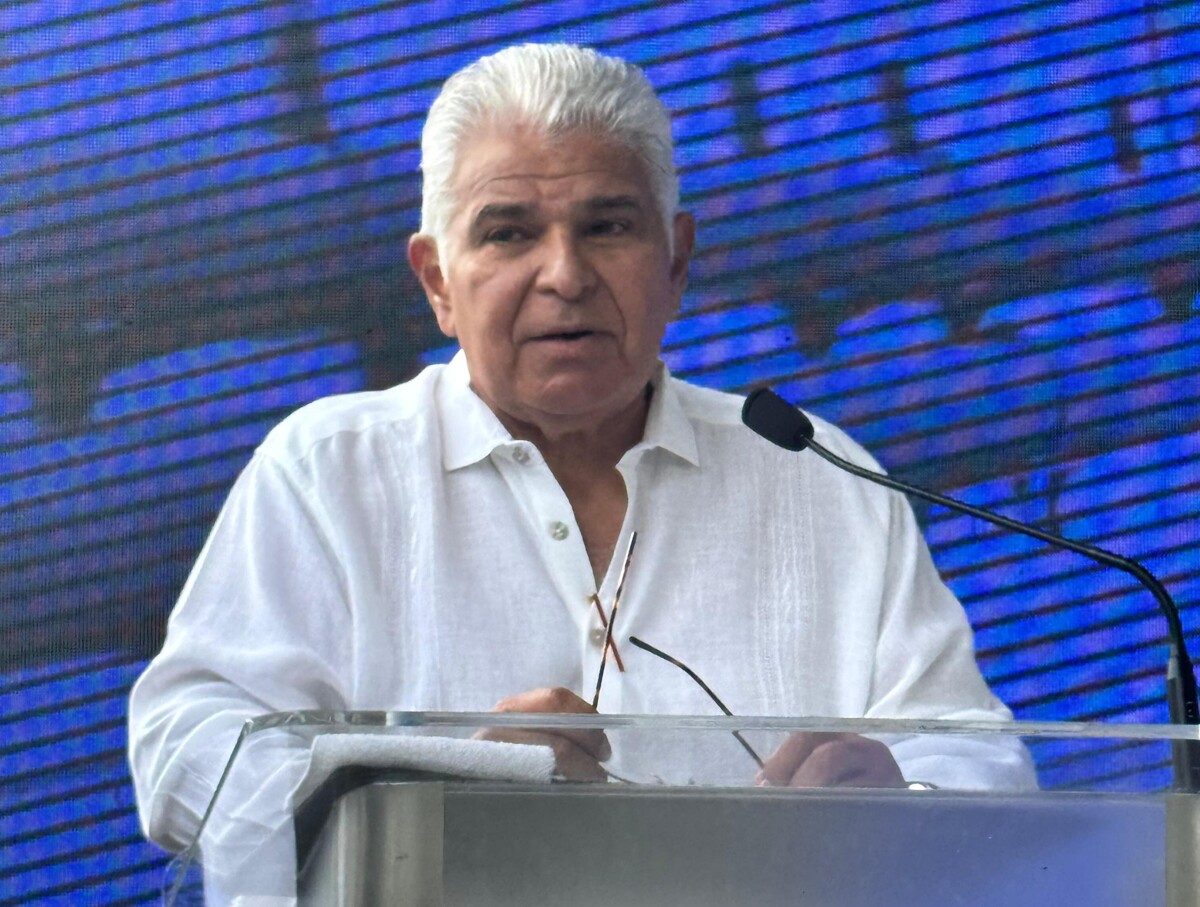
Panama's President José Raúl Mulino announced on Thursday that he has been invited by Venezuelan opposition leader María Corina Machado to accompany her to the Nobel Peace Prize ceremony, where she will be honored on December 10 in Oslo, Norway.
«For me, it is very significant for Panama to accompany this warrior, a great leader and leader of the Venezuelan people, whom I wish, as soon as possible, a return to democracy,» stated Mulino in media comments.
The head of state said he will travel between December 6 and 7 and return to the country on December 11.
In other news, President Mulino highlighted the progress of the Panama Metro Line 3, a project he considers of enormous importance for the country.
«This project is like another canal, due to its magnitude and the work under the Panama Canal,» he expressed.
The president reaffirmed his commitment that Line 3 will be completed by 2028 and added that one of his goals is to set the future Metro Line 2A on track.
In turn, the general manager of the Panama Metro, Engineer César A. Pinzón, presented a report on the project's progress, highlighting that the underground section of Line 3 has reached a 45% completion rate. Pinzón also presented a video with the project's most important milestones, which will transform mobility between West Panama and the capital.
Meanwhile, Carlos Cedeño, Metro's projects director, revealed that «The original cost of Line 3 was $2.8 trillion, due to all modifications, the separation of projects, the current contractually reflected value is $3.9 trillion. We are also in the process of formalizing the financing part, we have been in very strong working tables with the MEF... we have managed to obtain financing under good conditions for the underground section».
Panama's President José Raúl Mulino stated that his government is working on creating an anti-mafia law inspired by the regulations of the United States and Europe, with the objective of more effectively addressing criminal structures both inside and outside the country.
During his press conference, Mulino explained that information and international advice are being gathered from countries such as the United States, France, and Italy, whose laws have proven effective in dismantling powerful criminal organizations.
«I am trying to obtain and get information and advice from governments like those of the United States, France, and Italy to create in Panama an anti-mafia law similar to the one the United States implemented with RICO,» said the head of state, who highlighted the urgent need to strengthen the Panamanian legal framework to face modern organized crime.
In this sense, he stated that current laws are insufficient and outdated, which has hindered an effective response to the magnitude of the problem.
Mulino also questioned recent decisions by the Judicial Branch that granted house arrest to individuals linked to criminal activities, such as drug trafficking and gangs, despite having previous convictions.
In particular, he pointed out that these decisions reveal a lack of law enforcement, a significant obstacle to the effective fight against organized crime.
«We all have to work in the same direction, or we are going to poke each other's eyes out. This fight against gangs, drug trafficking, and organized crime cannot have flexibility with these convicted scoundrels,» expressed Mulino, referring to the guarantee judges who have made these decisions.
The president also reiterated the importance of a firm commitment from the Judicial Branch in the fight against crime.
«The fight against drug trafficking and crime cannot be the task of the security forces alone, we also need the commitment of society and the support of the judicial system,» he stated.
Regarding the asset forfeiture law, Mulino assured he is willing to promote its enactment, but only if it is a «good technical law» and not defective legislation like the one attempted to be passed in previous legislatures.
The president recalled his opposition to the law presented in the past quinquennium, which, according to him, contained «serious distortions» and represented a risk of being used for political purposes.
«As a citizen, I opposed that law because it was not suitable for Panama and could be an instrument of political persecution if any person in power used it improperly,» he pointed out.
The head of state emphasized that although the fight against organized crime is complex and will not yield immediate results, his government remains committed to strengthening the legal and operational tools necessary to combat this phenomenon that affects the security and well-being of citizens.
Panama's President José Raúl Mulino launched a strong message on Thursday by pointing to Washington as being responsible for sponsoring the trip of a group of National Assembly deputies to Taiwan, a visit that has strained diplomatic relations between Panama and the People's Republic of China since it was made public.
«That trip is tainted by those seeking to stir up a drumbeat here in Panama between the relationship with China,» said the head of state, assuring that his government will remain firm before any external attempt to generate bilateral friction.
«My government does not endorse that trip under any circumstances, because I know the consequences can be serious,» he warned.
The head of state also questioned the argument that the deputies were going to Taiwan to explore economic opportunities.
Panama's President José Raúl Mulino also stated that he will not allow Panama to be dragged into a problem that is not Panama's.
He reiterated that the handling of international relations is an exclusive competence of the Executive and rejected the deputies' trip to Taiwan, warning that «my government does not endorse that trip, under any perspective».
Mulino will accompany María Corina Machado at the Nobel Peace Prize delivery. The President of the Republic, José Raúl Mulino, announced this Thursday that he has been invited by the Venezuelan opposition leader María Corina Machado to accompany her at the Nobel Peace Prize delivery ceremony, which she will receive next December 10 in Oslo, Norway.
«For me it is very significant for Panama to accompany this warrior, a great leader and leader of the Venezuelan people, whom I wish, as soon as possible, the return to democracy,» stated Mulino in media comments.
The head of state said he will travel between December 6 and 7 and return to the country on December 11.
Progress of Panama Metro Line 3
In other news, President Mulino highlighted the progress of the Panama Metro Line 3, a project he considers of enormous importance for the country.
«This project is like another canal, due to its magnitude and the work under the Panama Canal,» he expressed.
The president reaffirmed his commitment that Line 3 will be completed by 2028 and added that one of his goals is to set the future Metro Line 2A on track.
In turn, the general manager of the Panama Metro, Engineer César A. Pinzón, presented a report on the project's progress, highlighting that the underground section of Line 3 has reached a 45% completion rate. Pinzón also presented a video with the project's most important milestones, which will transform mobility between West Panama and the capital.
Meanwhile, Carlos Cedeño, Metro's projects director, revealed that «The original cost of Line 3 was $2.8 trillion, due to all modifications, the separation of projects, the current contractually reflected value is $3.9 trillion. We are also in the process of formalizing the financing part, we have been in very strong working tables with the MEF... we have managed to obtain financing under good conditions for the underground section».
Commitment to fiscal transparency
Regarding fiscal matters, Mulino reiterated his government's commitment to transparency, emphasizing the efforts to meet international standards and achieve Panama's exclusion from the European Union's list of non-cooperating jurisdictions.
«One of the most relevant advances is the start of the cleansing of anonymous societies with a suspended status, a task that had been postponed for years and that we are now executing with decision and coordination between the Ministry of Economy and Finance (MEF), the Public Registry and other involved institutions,» stressed the president.