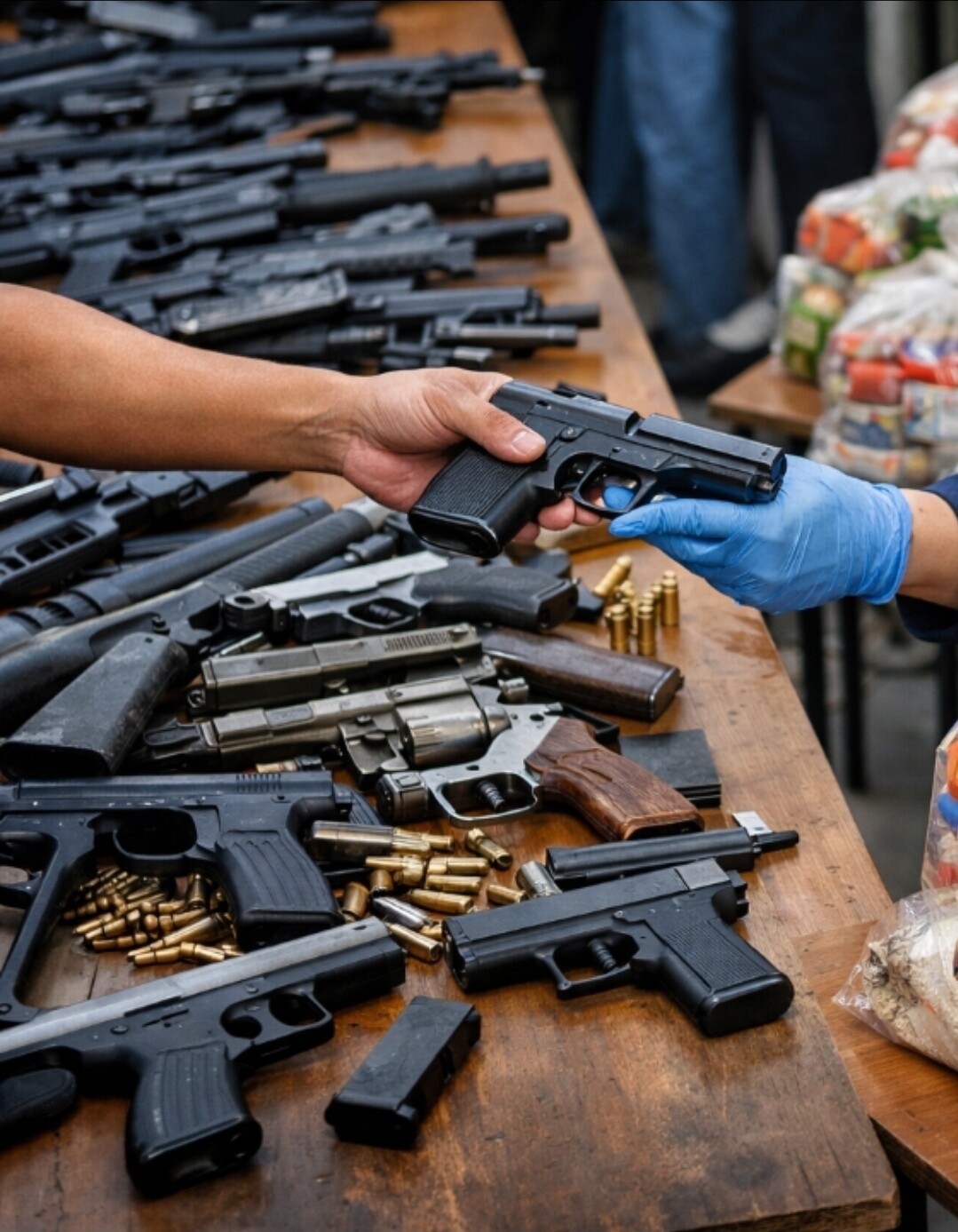
A state program for exchanging firearms for food and medicine vouchers, presented as a social disarmament strategy, could be weakening criminal investigations and fostering impunity, warned lawyer David Villarreal, a specialist in firearm possession and control.
According to the jurist, the firearms turned in during these campaigns are not just dangerous objects, but key evidence to clarify homicides committed by organized crime structures, especially in cases of contract killings.
Villarreal stated that while the program may have a social focus, it does not contribute to solving crimes, as the firearms are destroyed without a thorough analysis that would allow them to be linked to criminal offenses.
Destroyed Evidence, Unresolved Crimes
The lawyer explained that by destroying the firearms, the state eliminates the possibility of tracking their use in unsolved homicides, preventing their inclusion in the Integrated Ballistic Identification System.
That system was created precisely to link a firearm to one or more homicides through technical analysis that allows for the reconstruction of criminal patterns and structures.
“Without the firearm as evidence, the investigation is not perfected,” warned Villarreal, noting that traceability is lost, both nationally and internationally.
Intact Black Market
For the specialist, the program has failed to disarm gangs or organized crime, and has had the opposite effect by stimulating the black market for firearms.
According to Villarreal, criminal organizations continue to have access to illegal weapons, while the state fails to identify the routes through which these weapons enter the country.
The message being sent, in the specialist's view, is dangerous: a firearm can be used in one or more homicides and then be turned in for vouchers, erasing any trace of the crime.
A Wrong Message to Organized Crime
The lawyer warned that this dynamic normalizes impunity, by allowing firearms potentially linked to murders to disappear from the investigation system.
Additionally, he recalled that tracking serial numbers could enable international cooperation, even with agencies like the U.S. ATF, to determine the origin of the weaponry—a possibility that is lost when firearms are destroyed without prior investigation.
Misdirected Resources
Villarreal also questioned the use of public funds in this type of program and stated that those resources should be dedicated to strengthening criminal investigations, so that the public perceives that homicides are clarified and not archived in impunity.