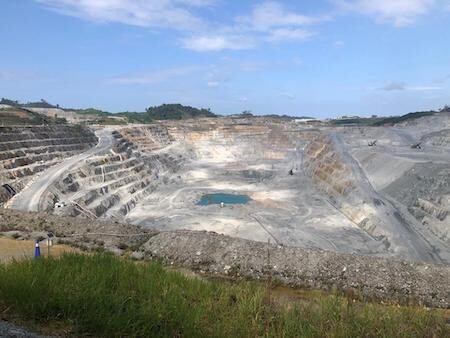
The Supreme Court of Justice declared the Ley 406 contract unconstitutional, a decision that impacts the royalty distribution from the Cobre Panamá mine. The ruling followed discussions between Minera Panamá, S.A. and the state over the basis for the $29 million paid for copper concentrate sales. Even though the contract was invalidated, the judgment is not retroactive, so it continues to apply to royalty calculations. The government maintains it does not cover maintenance costs while the mine remains closed.
Minera Panamá, S.A. claims that the costs for maintenance, processing and storage of the mine’s concentrate are entirely its responsibility. The company says that the $29 million royalties were calculated according to Ley 406’s percentage of 12%–16% of net revenue after deducting allowed costs. The contract, declared unconstitutional in November 2023, does not impose a retroactive obligation on the state. Nevertheless, the company states it will continue funding the Management and Safety Plan through revenue from concentrate sales.
The calculation method starts with the gross sales revenue, then subtracts costs permitted by regulation such as transport, smelting and marketing. The net income is the figure used to apply the 12%–16% royalty rate. This method was employed because the concentrate was extracted while Ley 406 was still in force. The company insists that the state bears no financial responsibility for these costs.
Under the current resolution, the Management and Safety Plan remains in effect as long as the mine is preserved and maintained. All expenses for infrastructure, environmental management and industrial safety fall solely on Minera Panamá, S.A. The state will not assume any financial liabilities for the plan’s execution. The plan is financed entirely from proceeds of concentrate sales.
The government has not ruled out selling the remaining concentrate stored in the mine to generate additional revenue. It is still unclear how long the mine will stay closed or how much more maintenance will be required. The discussion continues as stakeholders seek clarity on financial responsibilities.