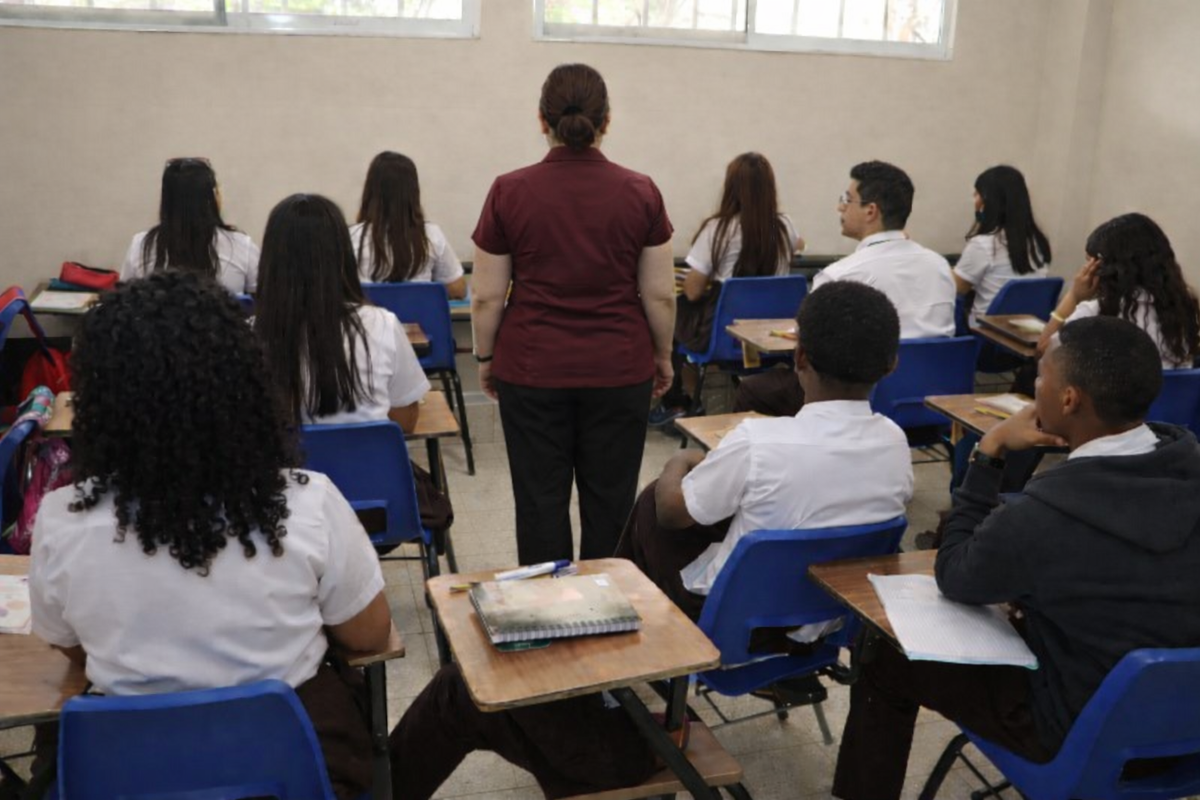
«Here, learning is not being recovered, but failure is being managed,» stated Sánchez. He explained that the problem does not arise in secondary education, but much earlier. «We have students in seventh grade who cannot comprehend what they read or have not mastered basic operations. This does not withstand the slightest administrative analysis,» he pointed out. He acknowledged that the program has become a mechanism for economic incentives for teachers, which in some cases distorts the pedagogical sense of the process. «In educational systems that have advanced, recovery is part of the regular process and does not represent additional income,» he highlighted. Institutional Defense and Contradictions In turn, teacher leader Humberto Montero defended the existence of administrative guidelines and lists of eligible teachers managed by regional directorates, but recognized profound flaws in the model. «What was not learned in a year cannot be learned in a month. In practice, when the program coordinator is transferred, retires, or leaves the school for any reason, academic rehabilitation simply stops. The 'concession' is not automatically transferred to the educational center, but disappears with the person, showing that it is not an institutional program, but a personal permission tolerated by the system. A large-scale national program Far from being a marginal mechanism, the Student Academic Recovery Program (PRAE) has a significant national reach. According to official information published by Meduca itself in the Official Gazette, for the 2025 school year, 88 educational centers were enabled throughout the country to provide academic rehabilitation to middle and high school students who failed up to three subjects. The regional distribution of these centers reveals a strong territorial concentration. The Ngäbe-Buglé Comarca leads the list with 19 enabled schools, followed by Chiriquí with 13 and West Panama with 12, regions where the volume of failing students is high. In other areas of the country, the program is developed in six schools in Bocas del Toro, five in Colón and five in Central Panama, while Darién has four centers, Coclé has three, and both East Panama and North Panama have one educational center each authorized for the process. This distribution confirms that the PRAE is not applied universally, but is focused on specific centers where high volumes of students are concentrated. «It does not correct the problem, it manages it» The educational leader Luis Sánchez was blunt in questioning the model and warned that the program has lost its original pedagogical sense. «Academic rehabilitation has become a mere formality to embellish statistics. The Failure that Repeats Panama registers tens of thousands of failing students every year, confirming that the model does not correct the lag, but reproduces it. While other countries bet on early tutoring and permanent accompaniment, the Panamanian system continues to apply late solutions, normalizing school failure and private gain within the public school. The Normative Void and Official Silence Despite its magnitude, Meduca does not have a detailed public regulation that clearly explains how coordinators are appointed, how funds are administered, or who audits the money collected. In practice, the ministry authorizes the collection but disengages from the execution, allowing academic rehabilitation to function as a tolerated educational concession within the public system. A Dangerous Illusion «That is inadmissible,» he admitted. The leader stated that although the 2 dollars per student are intended for educational materials, he recognized that the program requires a comprehensive review. «Thousands of students go through this process every year, and that cannot be normal. Trying to solve that in four or five weeks is a dangerous illusion,» he said. The educator also questioned that the ministry continues to bet on a late model. «If Meduca invested those resources in early tutoring, reinforcement during the school year and real accompaniment for the teacher, the story would be different. But it is easier to push everything to the summer and charge,» he pointed out. For Sánchez, the scope of the program evidences that the problem is already structural. A Lucrative Concession The figures explain why this 'educational concession' generates internal disputes. A teacher with 200 students can receive up to a thousand dollars in a few weeks, while in a school where 2,000 students enroll, the coordinator can earn up to 4,000 dollars, all without effective external controls. Teacher leaders recognize that the assignment of students and teachers does not always respond to academic criteria, but to internal and discretionary decisions. This scheme has also generated an absolute dependence on specific figures within the centers.