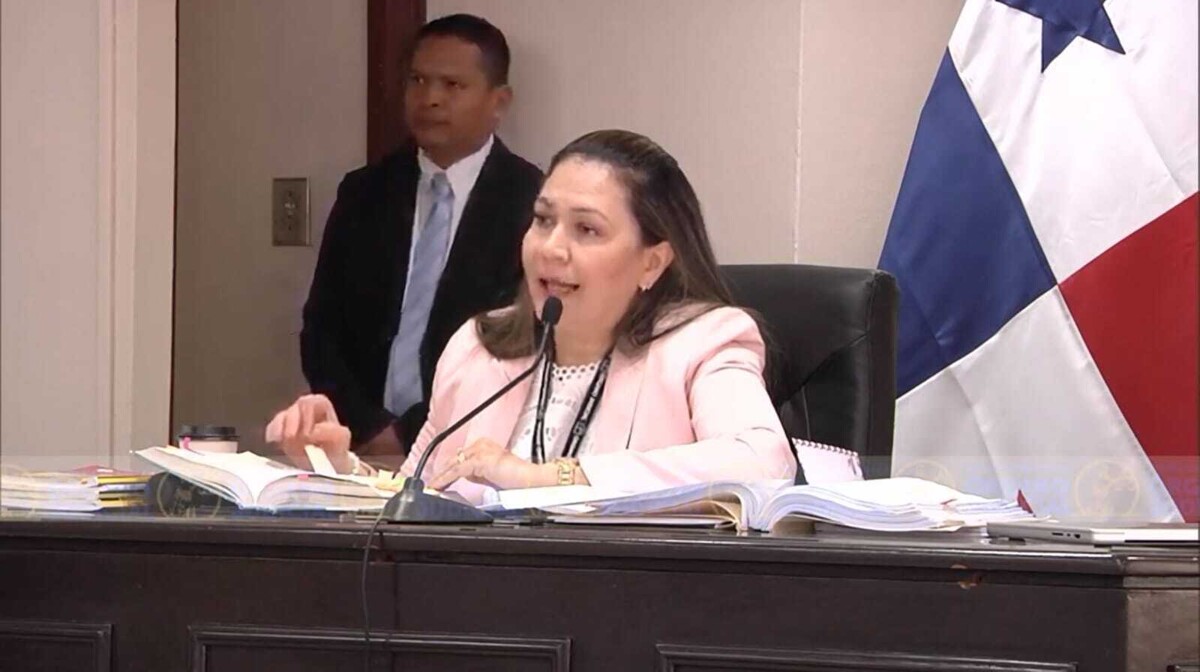
The Odebrecht case has ceased to be just a trial to become a true political-legal chess match, after on its fifth day of hearing, the Prosecutor's Office surprised by revealing the existence of a new plea deal signed with an associate of former President Ricardo Martinelli. It became known early on that between the Prosecutor's Office and one of the defenses, a deal had been 'put on the table,' whose validation hearing began in private after a recess ordered by the judge in the Odebrecht trial. During the morning, the debate focused on the new deal, as well as on the beginning of the defense lawyers' opinions on the special evidence proposed by the Public Ministry, a total of nine elements that began to be refuted by the defenses. As explained in court, the majority of the challenges were concentrated on evidence number nine, a document package from the United States containing 10,939 pages. The lawyers pointed out that it is not just about the volume, but about how that information arrived in the Panamanian process. 'It is evidence that comes from the United States and contains more than ten thousand pages. Some have objected because they believe it should not be admitted,' was heard in the hearing. In court, it was explained that the defenses objected to its admission because, in their opinion, it does not meet the procedural standards required in Panama. Some noted that it is not enough to bring foreign documentation without a rigorous control of its incorporation into the process, mainly questioning the translation of the document, its authenticity, and the manner in which it is intended to be assessed by the tribunal. For the defenses, the Prosecutor's Office cannot simply introduce a document package of that size without guaranteeing that all parties have real equality of contradiction and technical analysis. Another point that generated friction was the reference to a protected witness included within the special evidence. In the hearing, lawyers stated that an attempt is being made to sustain part of the accusation on a figure whose identity, origin, and method of obtaining have not been fully clarified. To date, justice has identified around 78 million dollars paid to politicians and operators in several administrations. According to the accusation, those funds circulated through structures designed to hide their origin and benefit different power actors. The entry 'Odebrecht trial enters a key phase: a new plea deal and a frontal clash over evidence brought from abroad' was first published in La Verdad Panamá. They indicated that it is not just about the content of the testimony, but about how it was obtained and under what rules the chain of custody was preserved. Some defense attorneys warned that the Prosecutor's Office must precisely explain who that witness is, what their role was within the investigation, and in what way their information was integrated with the other probative elements, because otherwise, the right to defense and the principle of contradiction within the trial would be violated. In that context, several lawyers invoked the doctrine of the 'fruit of the poisoned tree' to oppose both evidence number nine and other elements presented by the Public Ministry. In the hearing, they explained that if a evidence is born from an irregular procedure, everything that derives from it is also contaminated and should not be admitted. According to the defenses, a solid accusation cannot be built on documents whose obtaining, translation, or incorporation into the process is questionable. Although the Prosecutor's Office allowed the parties to review the nine probative elements on an electronic device, the lawyers made it clear that this access does not eliminate the objections of substance, since the problem is not just seeing the information, but that it meets the legal rules to be able to sustain a conviction.