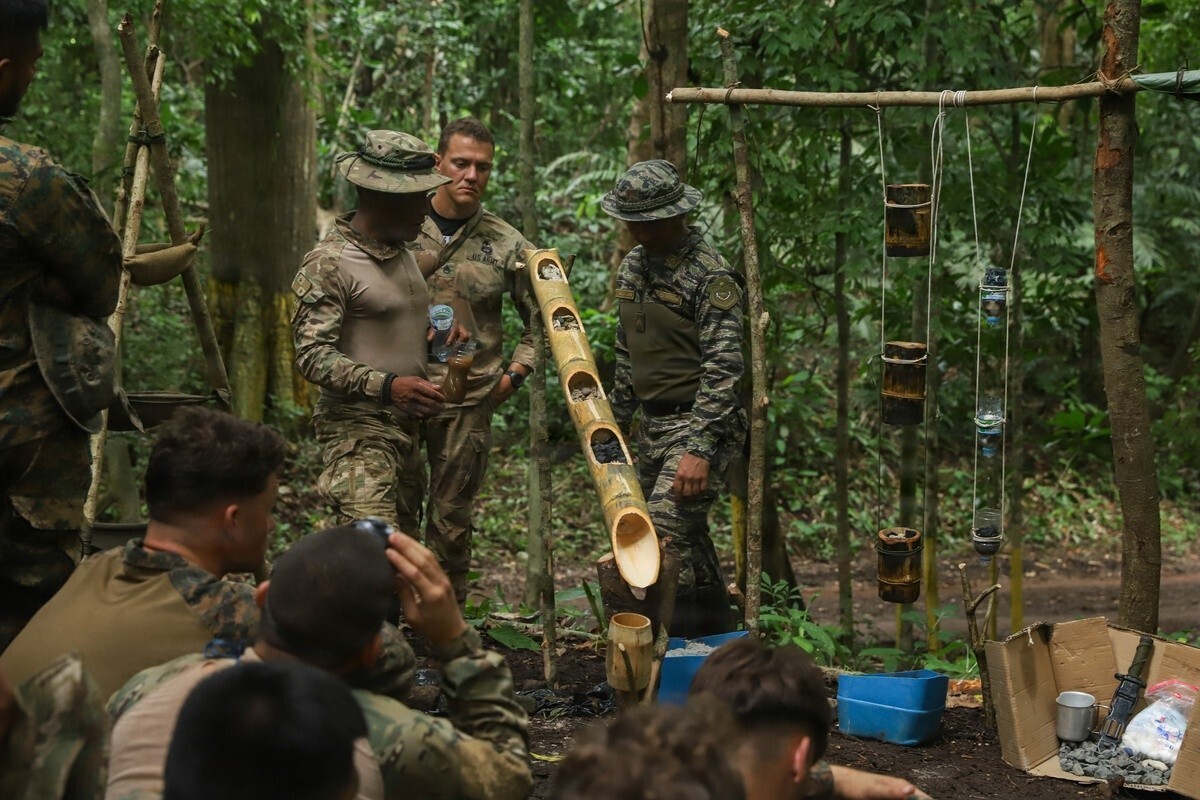
Coordinated by the Joint Security Cooperation Group-Panama, the course brings together U.S. Army soldiers from the Army Security Cooperation Group-South and the 82nd Airborne Division — with support from Joint Task Force-Bravo — as well as U.S. Marines, training side-by-side with partners from Panama’s National Border Service (SENAFRONT), National Air and Naval Service (SENAN), and National Police (PNP). Panamanian and US military personnel take part in a survival maneuver training led by the United States Army at the Jungle School in the former US military base Sherman in Colon, Panama. This iteration marks significant growth, with increased student numbers and balanced teams featuring the continued representation from U.S. and Panamanian participants. As the latest iteration of the Jungle Operations Training Course-Panama (JOTC-P) nears its final phase at the Cristóbal Colón Aeronaval Base, the program is setting new benchmarks for multinational interoperability. Largely led by Panamanian instructors, this phase emphasizes adaptability, endurance and resourcefulness in austere environments. Phase two covers small-unit tactics, including movement techniques, ambushes, casualty evacuation and waterborne operations, largely led by U.S. instructors. Instructors assess teamwork, leadership, and sustained performance in demanding jungle conditions. Our thanks to U.S. Army Captain Gabe Velazquez who contributed to this report. Phase three features five combined missions — encompassing attacking a mortar firing point and conducting ambushes and reconnaissance missions — culminating in the grueling “Green Mile” endurance event and graduation. In phase one, participants master jungle survival fundamentals, such as machete use, fire craft, water purification and building primitive shelters. JOTC-P integrates assets across services and nations, including dismounted tactics and aviation support, to prepare forces for operations in dense, triple-canopy jungle terrain. Running from February 3-20, this 18-day program represents a robust exchange between U.S. and Panamanian forces, since the program revitalization in August 2025. The training progresses through three phases. These scenarios challenge decision-making under stress and strengthen communication in multinational teams. The blended teams foster collaboration, build interoperability, and encourage joint problem-solving in challenging conditions.