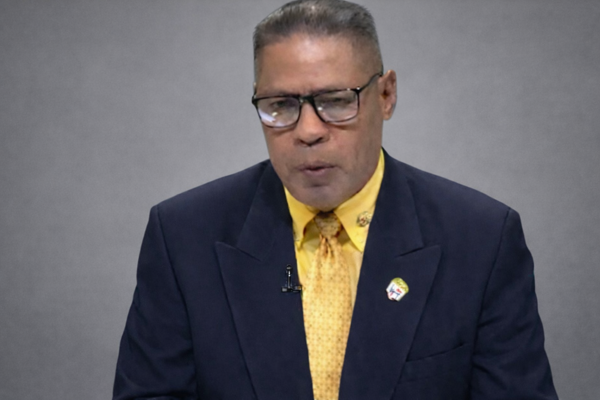
Sociologist and professor at the University of Panama, Fernando Murray, warned that the increase in violence and homicides in Panama cannot be explained solely by the phenomenon of gangs or organized crime, but rather by a complex social, cultural, and economic crisis facing the country.
During an interview on the program "Protagonists of the Truth," hosted by journalist Edmundo Dante Dolphy, Murray pointed out that the rise in violent incidents in broad daylight reflects profound transformations in social relations and in how people resolve their conflicts. "The problem is not just the quantitative increase in crime, but the way it manifests itself. Today we see violent acts in broad daylight, which reveals that we are living in a society with a higher level of violence in interpersonal relationships," he stated.
The sociologist explained that current social dynamics differ from those of two or three decades ago, when conflicts were usually resolved through other mechanisms.
"There are cases of private revenge, where people decide to take justice into their own hands because they believe that institutions have not responded to their demands," he explained. He added that the country also observes manifestations of contract killing or assassinations for hire that are not necessarily linked to structured criminal organizations. "It can be individuals who are paid to carry out a murder without belonging to a gang. This is another component of organized crime that often goes unnoticed," he explained.
He also criticized the lack of exemplary sanctions in cases of corruption or large-scale financial crimes, which, in his view, sends a negative message to society. "When people perceive that major crimes end with plea deals or partial returns of money, it creates a demonstration effect that weakens trust in justice," he stated.
Lack of an Interdisciplinary Approach
Murray also pointed out that combating crime requires an interdisciplinary vision that includes specialists from various fields of social sciences. "Institutions responsible for investigating crime should involve sociologists, criminologists, anthropologists, and other experts. However, the response is often limited to the legal realm," he stated. In his opinion, without a comprehensive understanding of the social causes of criminality, crime prevention and prosecution strategies will continue to be insufficient.
Critique of Penal Populism
The academic also questioned legislative initiatives that seek to address the problem of insecurity by increasing penalties or lowering the age of criminal responsibility. "The penal law will not solve a social problem. When that pressure is released, violent or criminal behaviors emerge," he warned. Murray also believed that crime prevention requires the participation of multiple state institutions, not just security forces. "The police can contain the situation, but they cannot alone solve a social problem of this magnitude," he affirmed.
Illicit Economies and Organized Crime
The sociologist highlighted that organized crime in Panama takes various forms that go beyond gang activity. He mentioned activities such as money laundering, informal economies linked to crime, illegal lending schemes known as "gota a gota," and other mechanisms that combine legal and illegal activities. "There are underground economies that operate within seemingly legal structures. This practice exists, and depending on the victim's profile, it can even be relatively cheap," he noted.
Social and Economic Factors
The academic indicated that criminality cannot be analyzed solely from a police perspective, as there are social factors that influence its expansion. Among them, he mentioned mental health problems, unemployment, social frustration, economic inequality, and high levels of domestic violence. "We are facing a society that accumulates tensions like a pressure cooker. Laws can address part of the problem, but not its structural causes," he affirmed.
Finally, Murray insisted that the phenomenon of criminality must be analyzed from a broad perspective that considers the social, cultural, and economic factors that influence its development. "If we continue to address the problem in an isolated or simplified way, we will continue to repeat the same mistakes," he concluded.