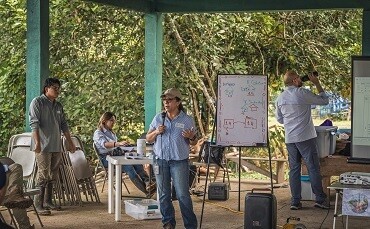
We know it's not easy, but your participation will make the resettlement under the Río Indio Project fair, equitable, an opportunity for local development, and, most importantly, a concrete step to improve the quality of life for each family,” said Ilya Espino de Marotta, Deputy Administrator of the Canal. A nine-month dialogue. Since May 2025, the Panama Canal and most of the families to be relocated by the Río Indio Lake project have maintained a dialogue process as part of the Resettlement Action Plan (RAP) and Livelihood Restoration Plan. As part of the RAP, seven dialogue sessions were completed between May 2025 and February 2026 in each of the nine geographical areas grouping the 38 communities to be resettled under the project, following international standards such as the International Finance Corporation's (IFC) Performance Standard 5. These sessions covered over 60 community meetings and 150 individual encounters with families to analyze and agree on issues related to the resettlement process through a participatory and organized work effort. The thematic agenda, proposed by the families during the different encounters, included aspects such as land appraisals and replacement, compensation schemes for economic impacts, as well as housing design, incorporating multiple recommendations from the families so that the houses respect the lifestyle and traditions of the region. Simultaneously, the Panama Canal is working with the communities on dozens of initiatives, integrating the residents of the Río Indio basin into an approach similar to the one carried out with the families of the Canal basin to promote local development and the conservation of water sources. In terms of basic services, projects for water supply and sanitation have been launched in communities such as La Pita, Riecito Abajo, and El Ahogado Centro, including the rehabilitation of intakes, installation of pipes, construction of household connections, chlorination systems, and improvements in storage tanks, benefiting about 600 residents. The Panama Canal and the families residing in the Río Indio Project area have completed the first phase of a dialogue process that lasted 9 months, which included more than 200 community and individual meetings in each of the nine geographical areas grouping the communities to be resettled. As a result of this dialogue and attending to the opinions and recommendations of the families, the Canal presented its commitment in a written document containing the compensation measures in terms of housing, land, economic means, and socio-cultural aspects, which were discussed over these 9 months and address the impacts, improvements to current conditions, and actions for the restoration of livelihoods. These measures are rules that will be applied equally in all communities, and will be the basis on which the Canal will work individually with each family on the unique characteristics of their resettlement and compensations. “I thank each of the families who dedicated time and effort to this process. Recently, the rehabilitation of two aqueducts in the Coclé area, in the communities of La Tollosa and Las Canoas, has been awarded. In environmental matters, 50,000 native species seedlings have been planted and multiple training sessions and workshops on watershed conservation, the use of organic fertilizers and non-contagious agricultural inputs, and the promotion of gender equity have been developed, with the participation of hundreds of residents and students from the basin. The communities have also been part of sustainable production projects that have involved 80 families and five schools, through the installation of broiler chicken modules, laying hens, family and school gardens, as well as ecological stoves, contributing to food security and the strengthening of the local economy. Likewise, with the support of the United Nations Development Program (UNDP) and the National Land Authority (ANATI), the Panama Canal has promoted land titling processes, delivering 250 property titles during 2025, with the projection of reaching 5,000 titles, providing legal certainty to the families of the basin. Environmental Studies. As part of the preparation for the preparation of the Category III Environmental Impact Assessment, the Panama Canal has been advancing the environmental baseline since July 2025 with the updating of analyses carried out between 2017 and 2019 along the upper, middle, and lower sections of the Río Indio basin. The studies collect information through water, air, and noise quality monitoring, flora and fauna, including the calculation of the environmental flow to ensure that the communities downstream of the lake dam maintain access to and use of the Río Indio river.