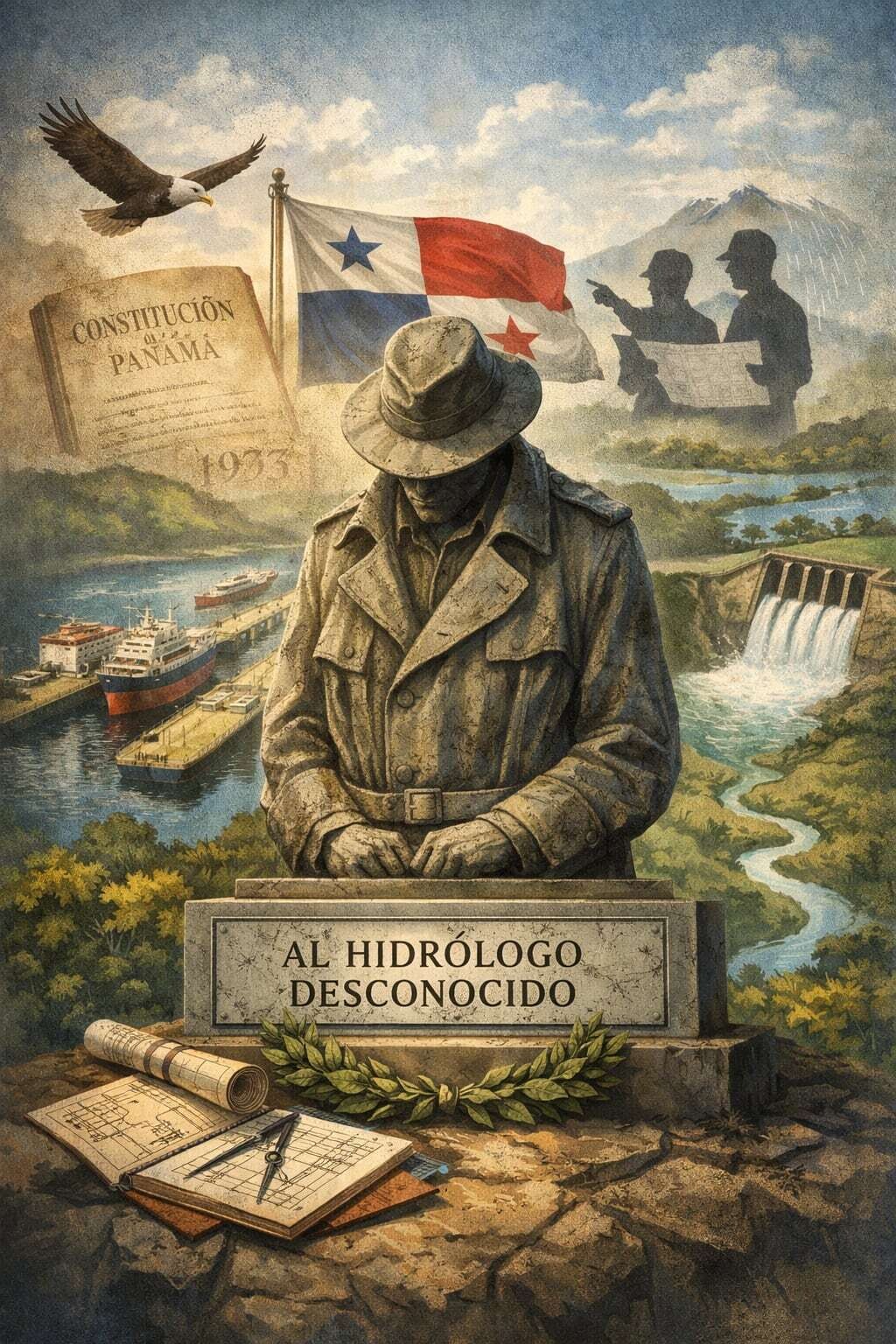
In the search for the “unknown hydrologist,” initiated in my previous article, Ricardo González de Mena's contribution has been invaluable: his rigor and generosity have allowed us to shed light on key aspects of the process of institutionalizing water management in Panama, especially the definition of the limits of the Canal Basin. Therefore, the presidential commissions, in line with international commitments such as the 1977 Canal Treaty, recommended attributing to the new Authority the exclusive responsibility for water resources and the power to define the basin's limits. Engineers such as Salvador Sánchez and Sayda de Grimaldo, directors of the Hydrographic Basin Subcommission, along with Juan Héctor Díaz, Luis Barraza, Ramiro Castrejón, Guillermo Fernández, Dulcidio González, Lorenzo Hincapié, Marcelo Narbona, and Jorge Ricardo Riba, played leadership technical roles. Thanks to the documentation and testimonies he provided — as coordinator of the presidential commissions responsible for laying the legal and technical foundations for the Canal and its basin — we can now reconstruct with greater precision the origins of water governance in the country. From his main role, González de Mena was a witness and direct architect of the work that led to the creation of the Interoceanic Region Authority (ARI) and the Panama Canal Authority (ACP). This uncertainty, far from diminishing interest, motivates us to continue unraveling the origins of decisions that have marked the course of national water management. In the process of historical reconstruction, it is essential to mention González de Mena's book, 'La Tierra Prometida tiene un Mañana,' a work that compiles the initiatives of the presidential commissions during the Endara administration regarding the reverted areas and the Canal, and which constitutes an essential reference for those who wish to understand the institutional and human framework behind Panama's water security. Today, in the face of growing challenges in water matters, the vision and work of those pioneers take on a fundamental relevance. It is to this entire Commission that we owe the institutionalization and protection of the water resource in Panama. The objective was to overcome the dispersion of competencies of the time, in which more than thirty districts and numerous institutions intervened in the basin without a clearly defined authority. In particular, the issue of the Canal Hydrographic Basin was one of the most debated and complex. The mystery remains open, and the invitation to continue investigating is more relevant than ever. My gratitude to González de Mena and to all those who, with their testimonies and dedication, keep the flow of history and the future of water in Panama alive. The author is a former Vice President of Environment, Water, and Energy of the Panama Canal Authority. He coordinated multidisciplinary teams, working pro bono, who contributed a diversity of knowledge to reach consensus on the future of the reverted areas and efficient management of the interoceanic route. It is important to underline that this anonymous group of people is none other than the “Presidential Commission for Canal Affairs,” coordinated by González de Mena. Under the direction of Joaquín J. Vallarino Jr., nearly a hundred professionals formed a Support Group and eight subcommissions, managing to turn the aspirations of sustainability and water protection into concrete proposals. One of the documented milestones was the drafting of the “Durling Constitutional Bill,” directed by the jurist Ricardo Durling and presented to the Cabinet of Ministers. It is suggested that Juan Héctor Díaz may have played a key role, considering his career and leadership in the institution, a hypothesis that also arises in my research and in the testimonies of colleagues such as engineer Luis Alvarado. The challenge was to ensure the necessary water flow for the Panamanian population and the operation of the Canal, facing threats such as climate change, rainfall variability, and demographic growth. The search for the personal identity behind the “unknown hydrologist” is more than an exercise in memory: it is a tribute to science, engineering, and the spirit of public service. The figure of the “unknown hydrologist” symbolizes the silent and committed work of engineers, scientists, and officials who, from anonymity, laid the foundations for modern water resource management. History, like water, reveals unexpected paths. Their collective work made it possible to address, from science and engineering, the complex task of designing an integral management system that laid the foundations for the protection and expansion of the basin. However, the mystery of the true architect of the inclusion in the Constitution of the power of the ACP Board of Directors to define the limits of the hydrographic basin persists. This proposal sought to establish, from the Constitution, a comprehensive and sustainable plan for basin management, complemented by clear regulations and executed in coordination between the future governing entity and the ACP. But definitive certainty still escapes: the consulted archives do not allow for the precise identification of the intellectual author of this crucial numeral 5.