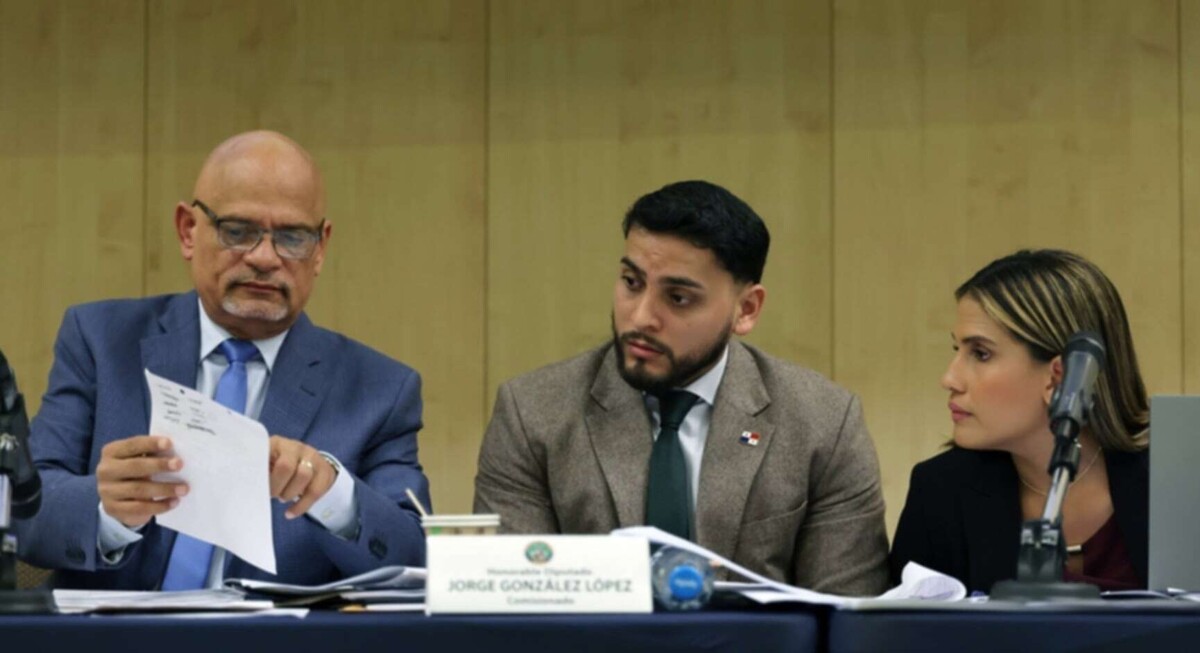
Brenes warned that the population “will pay for the business of a few.” I voted against Bill 443, which establishes the mandatory use of bioethanol. Bill 443, presented with the intention of promoting the use of anhydrous bioethanol as part of Panama's energy diversification strategy, has generated technical and legislative debates that cast doubt on its approval. The bill passed the first debate with the bare minimum votes: of the nine members of the National Assembly's (AN) Committee on Commerce and Economic Affairs, five deputies voted in favor (Jamis Acosta, Ariana Coba, Dana Castañeda, Néstor Guardia, and Julio de la Guardia) and four against (Ernesto Cedeño, Jhonathan Vega, Alexandra Brenes, and Jorge Alberto González). Cedeño, who chairs the aforementioned committee, has written a minority report warning that Bill 443 contains regulatory gaps and risks that could hinder its effective implementation. “While its purpose is legitimate, some of its provisions could generate risks and potential unconstitutional vices, particularly concerning the principles of free competition, reasonableness, legal certainty, and consumer protection, if its scope is not properly delimited,” Cedeño pointed out in his report, dated March 25, the day after its approval in the first debate. He also warned that the proposal establishes differential treatment between national and imported production and introduces a significant level of state intervention. For Cedeño, this statement is an acknowledgment that the country is not ready for the implementation of using anhydrous bioethanol in mixtures with gasoline. They approve without questioning or debating the convenience of this. It is clear that the people will pay for the business of a few! Bill 443 has also been publicly questioned by deputies Alexandra Brenes and Jhonathan Vega, who voted against it in the first debate. She believes that the mandatory blending of bioethanol with gasoline and the prioritization of national production, without clear parameters for quality or price competitiveness, can generate harmful economic distortions for consumers. The Committee on Commerce approved Bill 443 in the first debate, which modifies regulations on biofuels and energy from biomass. The session was chaired by Deputy Ernesto Cedeño. Bill 443 was approved in the first debate as presented by the Ministry of the Presidency (last October 21), without introducing modifications. According to their analysis, this requires: adapting infrastructure, strengthening national production, adjusting the marketing chain, and adopting legal reforms to allow for efficient and sustainable implementation. In this sense, the approval of the bill in its current state could anticipate an implementation for which the country is not yet prepared, which reinforces the need to introduce adjustments to align the regulation with the technical and operational reality of the sector,” he emphasized. The bill is on the legislative agenda for its discussion in the second debate. With 5 votes in favor and 4 against, the mandatory use of bioethanol in the gasoline tanks of all Panamanians was approved in the first debate. For example, the use of anhydrous bioethanol as an oxygenate additive should be progressive, reaching 10% for gasoline mixtures, and not mandatory at 10%, as in the Executive's proposal. He also proposed adding an article to empower the Ministry of Commerce and Industries (MICI) to restrict the import of anhydrous bioethanol when local production satisfies the country's demand. He also suggested that distribution and marketing companies be declared “objectively responsible” for damages and losses caused to the State and individuals due to the handling, storage, transportation, distribution, or marketing of bioethanol or its mixtures, “even in the absence of fault or negligence.” None of this was accepted by the majority of the Committee on Commerce and Economic Affairs. Cedeño also referred to the March 25, 2026 resolution from the National Energy Secretariat, which suspended the mandatory implementation of anhydrous bioethanol use in gasoline mixtures, whose entry into force was scheduled (after several extensions) for next Wednesday, April 1. The Secretariat (which has gone to the AN to defend Bill 443) cited the lack of necessary technical and regulatory conditions in the country. The energy transition must be built responsibly, without transferring greater costs to consumers… Vega has said that the bill will represent higher costs for consumers and rejected its mandatory nature. Cedeño proposed some changes that did not prosper. If this fuel were so good, there would be no need to impose it by law.