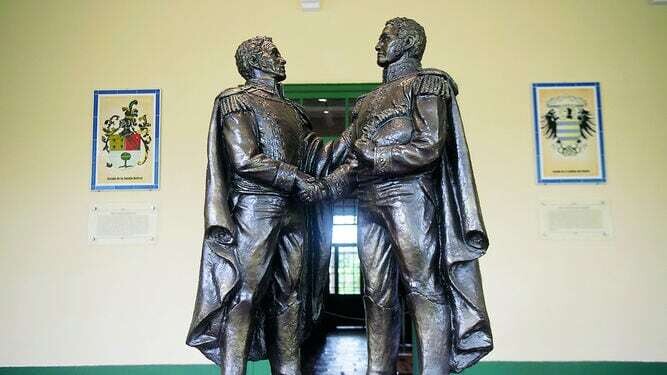
He won the war, but he could not maintain the peace on the terms he had imagined. The Congress of Panama was the attempt to maintain unity, but it was also the moment when its limits began to become visible—not only political, but also material. Bolívar began to understand it before many others. But making war is not the same as making peace. Someone had to make the war, organize the victory, and try to give structure to peace. As independence was consolidated, so were the differences between the new States. And as those distances also produced different interests, politics ended up responding to them and not to supranational formulas difficult to sustain. Among all the protagonists, one carried more weight than the others: Simón Bolívar. Peace demands constant communication, lasting agreements, and institutions capable of keeping immense territories united. Therein lay one of the great difficulties of the Congress of Panama. War can be sustained with campaigns and improvisation. They met in a city without the facilities we now take for granted. And those agreements, in a Spanish America of immense distances and limited means, turned out to be more difficult than the war itself. The author is a civil engineer and author of the book Voices of History. His end was also the human cost of a life consumed by war, politics, and the attempt to sustain an idea greater than his time. It was not only the disease that defeated him, but the accumulated wear and tear of a life dedicated to an extraordinary project. The idea was still great, but the world in which it had to be realized was not prepared to sustain it, not for lack of will, but for lack of means. In December 1830, Bolívar died in Santa Marta. The separation from Spain was not his creation, but the result of a broader crisis of the empire. Bolívar leaves not only a political lesson, but also a human one. The project was immense; the cost was deeply personal. The Congress of Panama thus leaves a lesson that has not lost its relevance. It was not just a meeting; it was the attempt to organize a world that still did not have the means to sustain that organization. That is the central point. Spanish America had men capable of imagining a confederation and drafting treaties. There they tried to agree on the future of a continent that was only beginning to know itself. Someone had to attempt that work, and it fell to him to pay its price. Independence was won with arms. But, seen up close, it was more than just a diplomatic exercise. His ambition was not only personal; it was also a response to a historical need. In that context, war could advance; peace could not. The war had united. Bolívar assumed that task. On paper, his objectives were clear: union, common defense, and cooperation. The problem was not the lack of ideas. What he lacked was the necessary infrastructure to make that project work in reality. The distances between the countries were enormous and the geography adverse. Principles were not lacking; what was lacking were the material means to sustain, in practice, a union between such distant governments. It was a human effort pushed to the limit. The delegates who arrived at the isthmus did not do so under comfortable conditions. The Congress of Panama of 1826 is usually remembered as an early attempt at integration among the new Hispanic American republics. But that project had a cost. Years of war, decisions under constant pressure, continuous displacements, political tensions, criticism, and distrust. The Andes, jungles, immense plains, two seas, and giant rivers made every decision arrive late. The union had to be sustained with agreements. There are ideas that can be just and necessary, but they fail if the material world that must sustain them is not ready. A message could take months to go and come back between governments. But the collapse of an order does not by itself produce a new one. They crossed seas, mountains, and precarious roads for weeks or months. His letters reflect not only political analysis, but fatigue.